Xiaoqikong
The bridge, the cascade staircase, Laya falls and the water forest, in a single 12-kilometre valley. Walk it downstream and take the shuttle back.
 Start your enquiry
Destinations / Guizhou / Libo
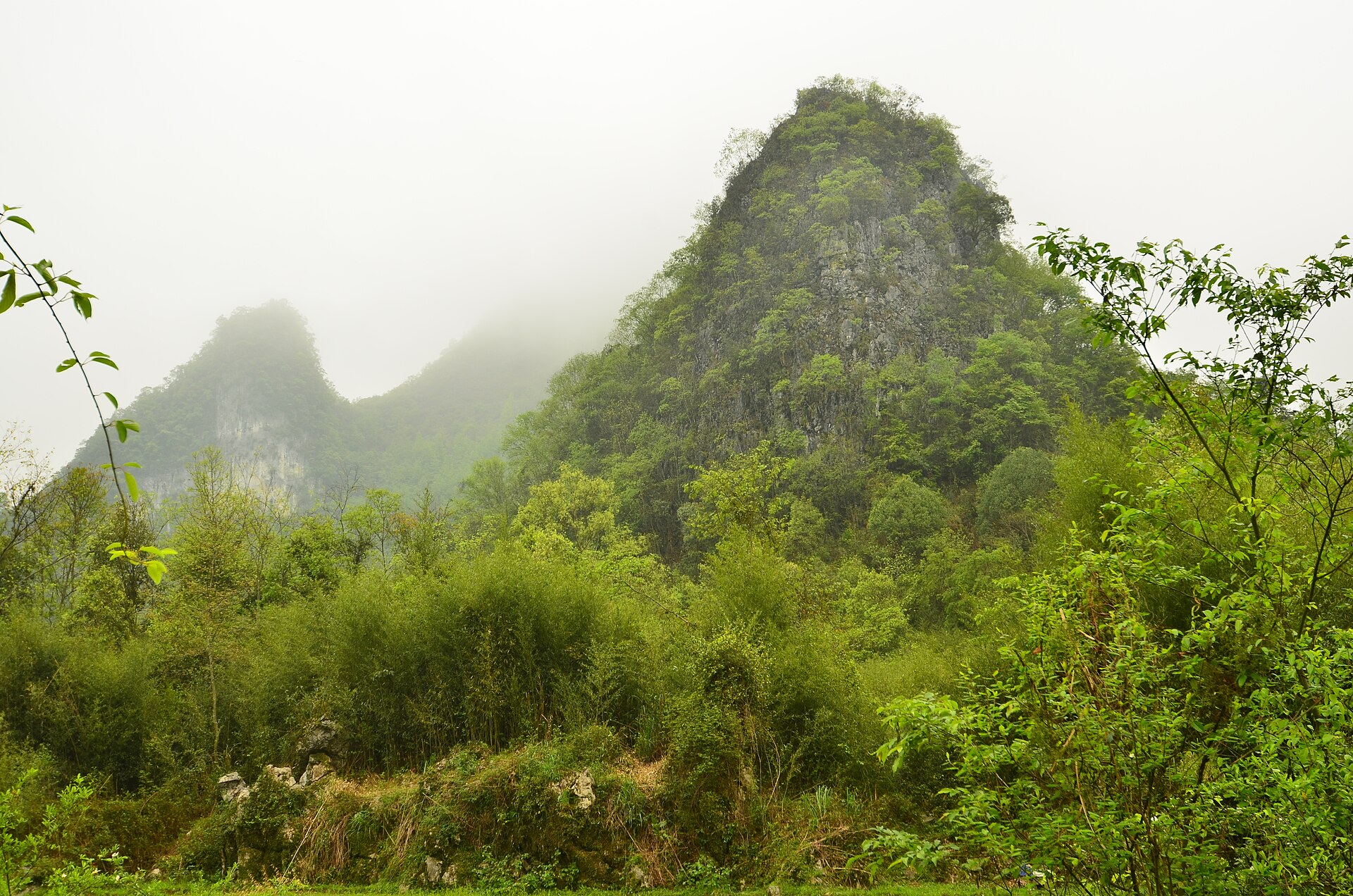
Cone peaks in mist, a river running green between them, and a forest reserve that has never been cleared — the quietest corner of a busy province.
Explore the guide ↓Southern Guizhou · Libo & Maolan
Southern Guizhou is the deepest karst in China: limestone hundreds of metres thick, uplifted, cracked and then dissolved along every joint until the surface became a field of cones with steep sides and flat, wet floors. Around Libo the cones are covered in forest, the valleys hold rivers, and the whole landscape reads as green on green with mist between.
The scenic core is Xiaoqikong, named for a seven-arched stone bridge built in the Qing dynasty over the Zhangjiang. From there a valley walk follows the river past a staircase of small cascades — the “sixty-eight falls” — a waterfall that pours off a side cliff, and a stretch called the water forest where trees grow directly out of the riverbed and you walk through on stone slabs with water on both sides.
West of the scenic area is Maolan, a karst forest reserve of about 200 square kilometres that was never cleared for farmland because there was no soil deep enough to plough. It is one of the largest undisturbed karst forests in the world, part of the South China Karst World Heritage listing, and home to a good number of species that occur nowhere else. It is also, for the moment, almost empty of visitors.
One valley walk, one lake, one reserve.
The bridge, the cascade staircase, Laya falls and the water forest, in a single 12-kilometre valley. Walk it downstream and take the shuttle back.
A lake in a drowned valley system, with forest standing in the water. Rowboats, no motors, and a silence that is unusual for a Chinese scenic area.
Guided walking in old karst forest, with cave systems, waterfalls and a very high chance of having the trail to yourself.
The river road north towards Libo town: bamboo, water buffalo, and villages that see few outsiders.
Green all year, best in the shoulder months.
The wettest and greenest window. The cascades are full, the forest is vivid, and the mist sits in the valleys until ten.
Warm and humid, with the water forest at its most inviting. Busy with domestic families in the school holidays.
The best months: less rain, clear water, cool mornings, and the rice turning in the valley floors.
Quiet, damp and cool. The forest stays green, the water drops, and some of the boat operations close.
High-speed rail has changed this corner.
Libo is on the Guiyang–Guilin high-speed line, about an hour from Guiyang and two from Guilin. The station is 30 km from the scenic area, which is a taxi or a booked transfer.
Xiaoqikong needs five hours if you walk the whole valley. Start at the west gate, walk downstream, and shuttle back — the reverse puts you against the crowd all morning.
The reserve needs a local guide and a vehicle, and the roads in are slow. A full day, and better as two half-days from a base in Libo town.
A landscape that farms itself.
Every valley here drains into a cave eventually. The rivers are clear because they have been filtered through limestone, and they disappear underground without warning in the dry season.
Buyi, Shui and Yao communities live along the Zhangjiang, with their own textile traditions and fish-raising in flooded fields. The Shui are known for their pictographic manuscripts.
Maolan was protected partly by neglect: no soil, no terraces, no logging road. The reserve exists because the ground was never worth clearing.
Water, stone and humidity.
Libo sits at about 500 metres, the lowest ground on any Guizhou route. Humid rather than thin air is the issue.
The water forest is walked on submerged stone, and the valley paths are slick. Sandals with grip or proper shoes, not smooth soles.
The forest is damp and buggy in summer; the valley floor is hot at midday despite the green. Repellent and a hat, both.
Tell us whether you want the valley walk or the reserve. Libo is a two-night place, and the second morning is when it stops being a scenic area.
Start my journey brief ↗