
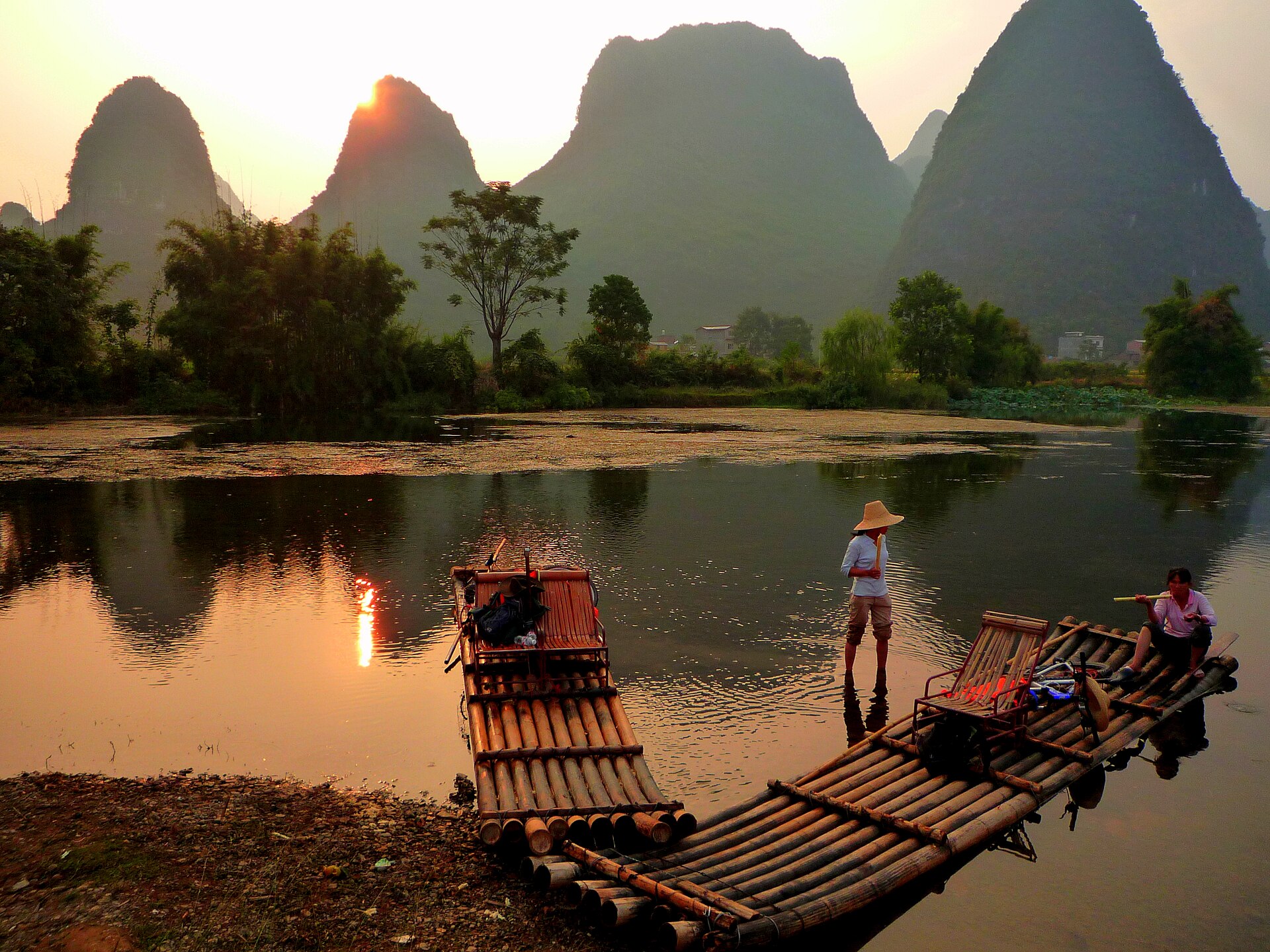
Stand anywhere in the Yangshuo countryside and the landscape looks staged: green towers of limestone, hundreds of them, rising sheer from fields of rice. The first European travellers to Guangxi in the seventeenth century were sure they were looking at ruins. They were looking at arithmetic — the slowest kind.
The chemistry
The towers are made of limestone, and limestone dissolves. Rainwater picks up carbon dioxide on the way down and turns mildly acidic; over unimaginable time it eats the rock, following cracks, widening them, hollowing whole landscapes. The scientific name for this is karst, from a plateau in Slovenia, but the world’s largest and most developed karst terrain is here in southern China — the Guilin towers and the south China karst of Yunnan, Guizhou and Guangxi are UNESCO-inscribed textbook examples.
Three hundred million years
The story starts in the Devonian and Carboniferous seas, roughly 360 to 300 million years ago, when this region was a warm, shallow ocean dumping limestone on the seabed in great thicknesses. The rock was then folded, faulted and lifted by the same tectonic pressures that raised the Tibetan Plateau’s eastern margins. Water found the fractures and spent the age of dinosaurs and most of the age of mammals enlarging them — until the former seafloor became a plain of towers separated by valleys of their own dissolved residue.
Why they end at the water
The towers stop where the water table stops working on them. Karst towers grow where dissolution undercuts steeply; the Li and Yulong rivers drain the landscape, and the fields between the towers are the eroded remains of rock that used to be where the rice is now. That is the quiet joke of the landscape: the flat farmland you walk across is the missing half of the towers, spread as sediment. Every riverbank cliff at Xingping — the bend on the twenty-yuan note — is a fresh cross-section of the process.
Walking the machine
None of this is visible from a boat, which is why the karst rewards walking. The farm paths between the towers pass quarried graves, cave mouths, dry valleys and natural bridges — every stage of the dissolution in one afternoon. Our Yangshuo walking guide follows the network, and the six-day itinerary pairs it with the terraces — the other great slow machine, built by patience instead of chemistry.
Where this leads
Yangshuo on foot
The Yangshuo & Longji trip
The rice terraces, on foot