
Hiking / Yangshuo and Longji walk
Private hiking tour
The Yangshuo & Longji walk.
Six walking days in Guangxi's two greatest landscapes: first the limestone towers of Yangshuo, where footpaths thread between peaks past water buffalo and orange groves, then the climb into the Longji terraces, five centuries of rice paddies stacked a thousand metres up the dragon's back. Two landscapes, one trip, both on foot.
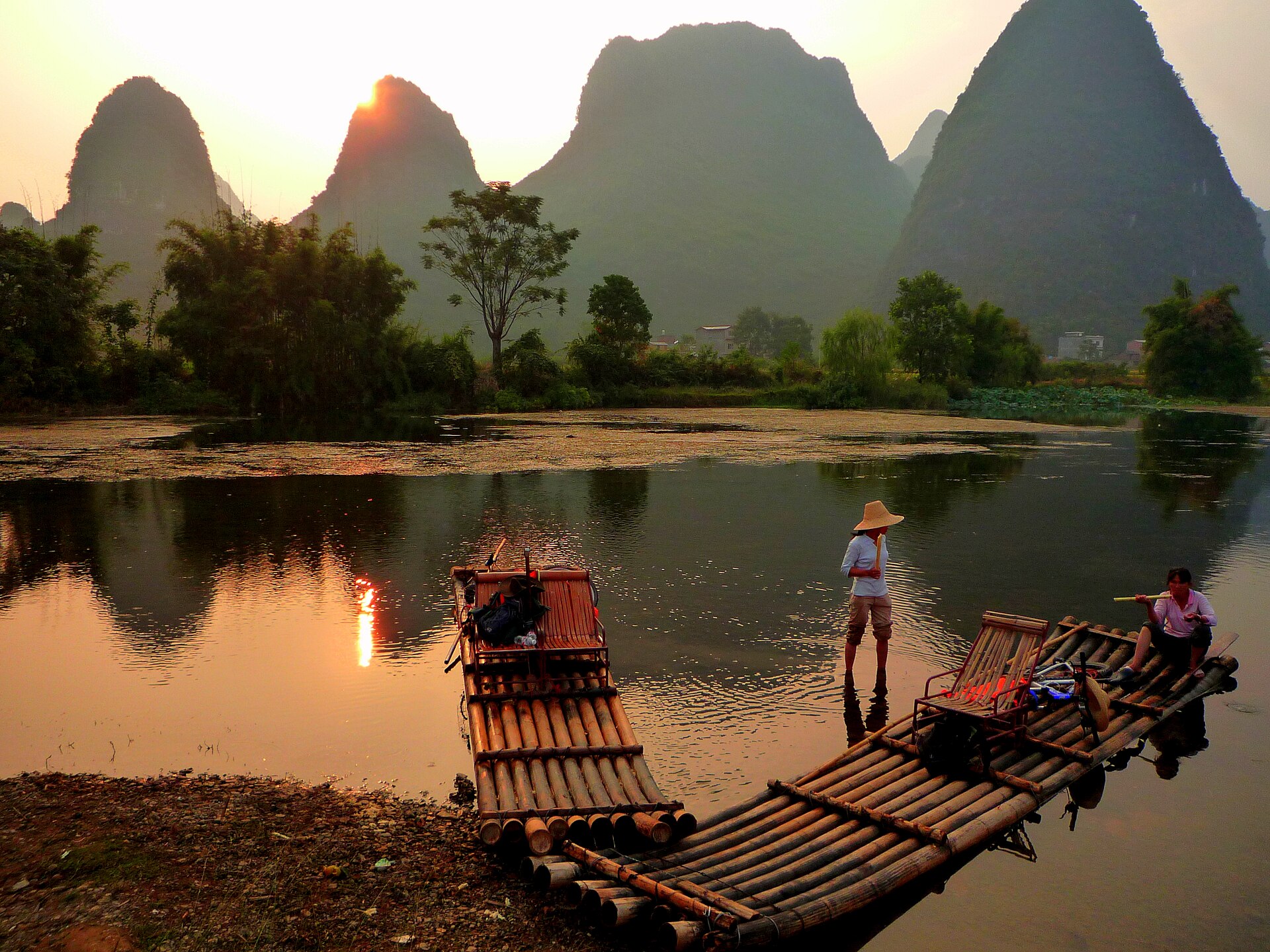
Ask about this itineraryThe Yulong River valley at Yangshuo · walking country between the peaks
of the Li River between Guilin and Yangshuo — the karst corridor your first days walk along, cross and climb around
the Xingping bend of the Li River is the scene on the back of the twenty-yuan note; you will stand in it on day three
of building: the Zhuang and Yao farmers of Longji began stacking paddies up these slopes in the Yuan dynasty and never stopped
elevation of the terraces' highest fields at Dazhai — the farming season you see there is one month behind the valley floor
Why this route
Two landscapes that argue with each other.
Guangxi holds two of China's most photographed landscapes, and most trips see neither of them on foot. This route corrects that. The first half walks Yangshuo's karst country — the stone towers that rise like a dropped skyline out of green paddy — using the network of farm paths, village lanes and riverbanks that locals still move by. You will cross the Yulong on a stone bridge built in the Ming dynasty, climb to viewpoints above the Li River, and end the half with the famous twenty-yuan bend at Xingping, reached by trail rather than tour boat.
The second half trades stone for staircases of water. The Longji terraces north of Guilin are the work of 650 years: Zhuang and Yao villages threaded with paddies that step up the mountainsides like the vertebrae of the sleeping dragon the fields are named for. We walk both major villages — Ping'an, the Zhuang village above the 'seven stars and moon' fields, and Dazhai, the Yao village in the deep Jinkeng bowl — staying overnight in the terraces so the dawn mist and the lamplight belong to you.
The pairing is the point. Karst teaches you what water does to stone; the terraces teach you what patience does to a mountain. Six days of walking holds the two lessons together in a way no flight-in, flight-out itinerary can.
Route Briefing
Rail and road out of Guilin, three walking bases, one continuous south-to-north story. Every transfer is short; every walking day ends somewhere you would choose to stay anyway.
- undefinedundefinedundefined
- undefinedundefinedundefined
- undefinedundefinedundefined
- undefinedundefinedundefined
- undefinedundefinedundefined
- undefinedundefinedundefined
Day by day
The six days.
Walking days are mornings and late afternoons, with lunch in village kitchens and the midday heat spent in shade. The terraces end the trip on purpose — they are the harder walking and the bigger view.
-
Day 01
Into the karst, along the Yulong
Guilin → Yangshuo
Meet in Guilin and drive south an hour and a half to Yangshuo, dropping bags at a guesthouse among the peaks. The first walk starts from the door: the Yulong River valley on its west bank footpaths, ten easy kilometres through paddy, pomelo groves and hamlets, with the karst towers standing in ranks on every side.
The half-way mark is the Ming-dynasty stone arch of the Yulong Bridge, still carrying foot traffic after five centuries. Tea in a riverside village while the cormorant fishermen set out for the evening; the day's walking ends as the fireflies start, and dinner is beer fish, the Yangshuo dish, cooked in the guesthouse kitchen.
-
Day 02
Moon Hill and the high viewpoints
Yangshuo
The karst gives its views grudgingly, and today is the day you climb for them. A morning circuit south of town through the Banyan tree country to Moon Hill — the natural arch in a limestone tower you can walk to the shoulder of — then onto the village paths that link the smaller peaks, twelve kilometres with two short, steep viewpoint scrambles.
The afternoon walk threads back through farming hamlets where every path is shared with buffalo carts and schoolchildren. Finish with the sunset viewpoint above the Li River, watching the tour boats dwindle to lights below.
Optional and unmissable in the dark: the light-and-lava spectacle of a cormorant fishing demonstration is a tourist act, and we say so — but the real fishermen still work the Yulong at dusk, and you will have already watched them on day one.
-
Day 03
The twenty-yuan bend, walked to
Yangshuo → Xingping
Transfer forty minutes up the Li River to Xingping, the ancient river town, and walk the riverside trails south along the water: nine kilometres below the karst walls, past fishing rafts and drowned villages, to the viewpoint at the great bend — the exact scene printed on the back of the twenty-yuan note, which you should bring for the photograph.
Xingping itself is an old port town of Ming and Qing shopfronts, and lunch is in one of them. The afternoon crosses the river by ferry and returns north on the far-bank paths, the side the boats never see.
Late transfer north toward Guilin and onward up into the mountains — overnight in Longsheng town, ready for the terraces.
-
Day 04
Up the dragon's back to Ping'an
Longsheng → Ping'an
The road climbs two hours from Longsheng into the terraces, and the walk begins where the road gives up: five kilometres of stone-step paths rising through the paddies to the Zhuang village of Ping'an, perched at 880 metres above the 'seven stars and moon' configuration of fields that took its shape from the landscape, not the planners.
Check into a Zhuang timber guesthouse, then walk the village's two classic overlooks in the late light — the terraces from above are a bas-relief in green, and every field boundary was laid by hand.
Dinner with the family: sticky rice cooked in bamboo, the local chicken that has run up and down these steps all its life, and rice wine poured by the grandmother of the house.
-
Day 05
Over the saddle to the Jinkeng bowl
Ping'an → Dazhai
The full terrace crossing: eleven kilometres of stone paths over the saddle between the two great village groups, from Zhuang Ping'an down through cloud forest and up again into the Yao country of Dazhai, deep in the Jinkeng bowl where the terraces climb in unbroken curtain from the valley floor to nearly 900 metres.
The route passes through hamlets where the washing lines and the drying racks are built over the paths, and the higher you climb the older the engineering looks — some walls here have held water since before the Ming. Long-haired Yao women of Dazhai keep the tradition of a single haircut from girlhood; the village explains it without performing it.
Arrive at Dazhai and a guesthouse on the middle terraces. If the sky is clear, the sunset from the west-facing viewpoint above the village turns the whole bowl gold.
-
Day 06
Dawn in the terraces, and home
Dazhai → Guilin
A short dawn walk to the upper viewpoint while the mist still sits in the bowl — in season the fields are mirrors, flooded and reflecting the sky, and the photograph takes itself. Breakfast back at the guesthouse, then the cable car down for anyone whose legs have finished negotiating.
The road returns to Guilin by early afternoon, with a stop at the Longsheng hot springs if the train or flight allows. Trip ends at Guilin station or airport.
The honest summary: two landscapes, sixty kilometres of paths between them, and a strong preference, declared by everyone who finishes, for the stairs of water over the towers of stone — until they see the karst again at the airport and reverse the verdict.
What's included
What is included, and what is not.
A short list for a warm-weather walking trip. The left column is arranged before you leave; the right column is either yours or a question we are glad to answer.
Included
Arranged and paid in your price.
-
E
n
-
P
r
-
F
i
-
A
l
-
A
l
-
L
u
Not included
The honest column.
-
F
l
-
T
r
-
D
r
-
O
p
-
T
i
undefined
Enquiry
Ask us about this one.
Tell us your dates. We will come back with what the terraces are doing in your window — flooded mirrors, green stairs or gold — where the karst light is best, and a written outline with a price.
- Difficulty
- Easy to moderate
- Group size
- 2 – 8, private departures only
- Price
- From ¥5,600 per person
- Custom
- Add a Li River boat day, or cycling around Yangshuo
Enquiry sent
Thank you — your enquiry is with us.
We reply within one business day. A copy of what you sent has gone to your inbox.
Need to add something? Write to inquiry@chinadventure.com.
Back to the itineraryRead next