
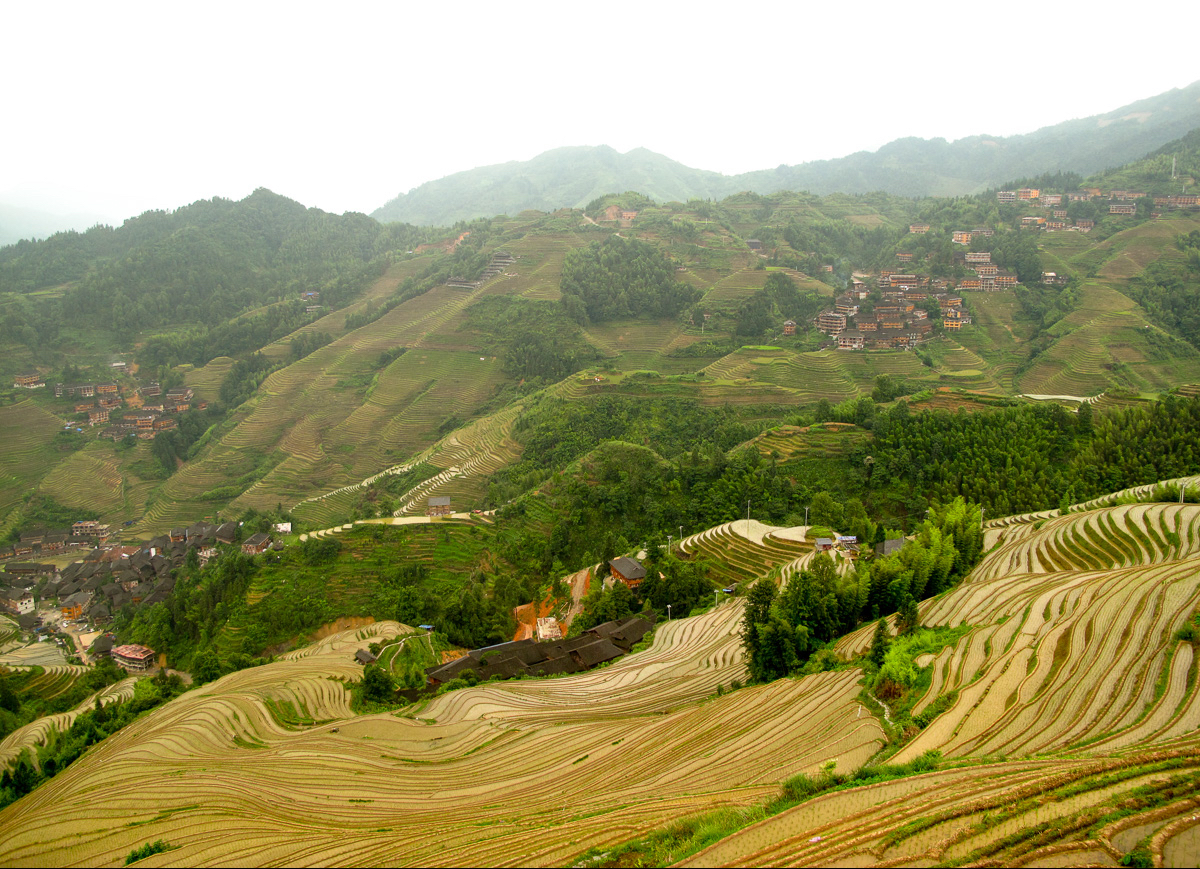
A rice terrace is a very slow machine: a hillside converted, step by step over centuries, into farmland that neither erodes nor drowns. China has built them everywhere rice grows on slopes, but two landscapes became legends — Longji in Guangxi and Yuanyang in Yunnan — and both are best understood the only way their builders understood them: on foot, on the stone paths between the paddies.
Two systems, one idea
Longji, north of Guilin, is a single great mountainside dressed in fields — the Zhuang and Yao villages of Ping’an and Dazhai sit inside a bowl of paddies that climbs from valley floor to nearly 900 metres. Yuanyang, on Yunnan’s Red River south flank, is the opposite scale: an entire mountain range of terraces, over three thousand steps of elevation, built by the Hani people and inscribed by UNESCO as a living cultural landscape. Longji is one mountain worn like a bas-relief; Yuanyang is a horizon-to-horizon amphitheatre.
The mirror season
Between the autumn harvest and spring planting, both landscapes fill their paddies with water and become something else: mirror fields. At Yuanyang this is the headline act — December to March, dawn and dusk, when the flooded terraces catch the sky and the whole range turns to stacked reflections. At Longji the mirror season is shorter and softer, best in late spring just before transplanting, when the young green starts breaking the reflections apart.
The gold season
Then there is the other performance. September into October, the rice ripens and both landscapes go gold — Longji’s harvest is the famous one, the whole bowl turning amber over about three weeks before the cutting starts. Timing is everything: come a week late and you walk through stubble. This is the window our Yangshuo & Longji itinerary is built around, paired with the karst country to the south.
Walking Longji
Longji is a village-to-village walk: stone paths connect Ping’an, Zhongliu and Dazhai across the saddle, a full day of eleven kilometres through the paddies with guesthouses in timber houses at both ends. The walk is moderate; the stairs are the workout. Our Longji guide has the line by stage.
Walking Yuanyang
Yuanyang is a driving-and-walking landscape: the viewpoints between the villages of Xinjie and Duoyishu are linked by roads, but every great viewpoint has a path system through the fields below it, and the best hours are spent walking down into the terraces themselves rather than looking at them. Duoyishu at dawn, Laohuzui at sunset, and the full guide here. Two landscapes, one lesson: the staircase is the civilisation, and the stairs are the way in.
Where this leads
The Yangshuo & Longji trip
The Yuanyang terraces guide
The Longji guide