Huangguoshu
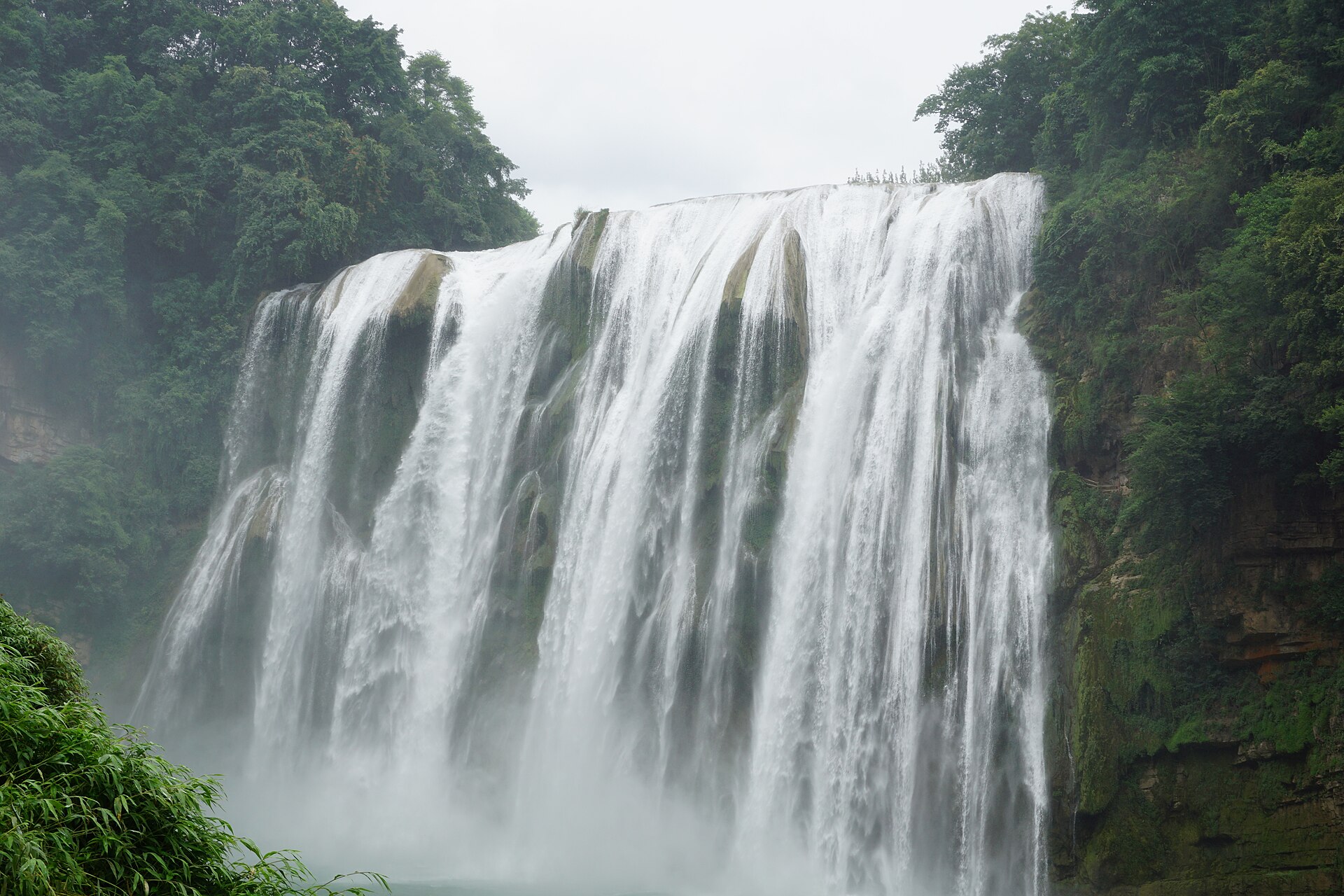
The main fall, the walk down to the pool, and the passage behind the curtain. Be at the gate for opening; by eleven the walkways are a queue.
 Start your enquiry
Destinations / Guizhou / Guiyang & the centre
A capital at 1,100 metres, seventy-eight metres of falling water an hour and a half west, and a set of Ming garrison villages where the costumes outlived the dynasty.
Explore the guide ↓Central Guizhou · Guiyang & Anshun
Guiyang is the province’s rail and air hub, a city of four million in a bowl of green hills, and most travellers treat it as a transit point. That is a mistake for one day, because the city eats well and the museum explains the province. It is also the natural base for the waterfall belt, which begins about ninety minutes west at Anshun.
Huangguoshu is the reason the belt exists. The river drops 77.8 metres in a single curtain 101 metres wide, into a gorge you can walk down into, with a passage behind the falling water that lets you cross from one side to the other. It is the largest waterfall in Asia by width, it is at its fullest from May to October, and it is extremely popular with domestic tour groups between ten and four.
Around it, the same scenic area holds Doupotang, the Tianxingqiao stone forest and a set of smaller cascades, all connected by shuttle. And around Anshun, in the villages of the plain, live the Tunpu: descendants of Ming soldiers garrisoned here in the fourteenth century, whose women still wear a distinctive Han costume and whose men perform Dixi opera in carved wooden masks.
The falls early, the villages late, the city in between.
The main fall, the walk down to the pool, and the passage behind the curtain. Be at the gate for opening; by eleven the walkways are a queue.
A three-kilometre loop of limestone pillars, water and banyan roots in the same scenic area. Quieter than the main fall and better walking.
Baojiatun and Yunshan: stone houses, carved wooden windows, indigo costume and Dixi opera performed on the threshing floor in the first lunar month.
The provincial museum for the province’s minorities and their textiles, the Jiaxiu Pavilion on its bridge, and a food scene built on chilli, sour soup and rice noodles.
Water in summer, clarity in autumn.
The falls at full volume after the spring rains, green hills, and the best chance of the curtain at its widest. Also the wettest.
Warm and humid with afternoon showers. Water still strong, crowds heavy in the school holidays.
Dry, clear and cool. The falls thin to two or three streams, which is beautiful in a different way and much quieter.
Cold, damp and grey. The falls are at their lowest, the villages are quiet, and the Dixi performances cluster around the lunar new year.
A hub, an hour and a half, and a long day.
Guiyang is on the high-speed line from Guangzhou, Guilin, Chongqing and Kunming, with a large airport. Nearly every Guizhou route starts here.
Anshun is 90 minutes by road or 35 minutes by high-speed rail; the scenic area needs five to six hours if you walk it properly. A private vehicle saves two hours of shuttles.
Guiyang for the city, Anshun or the village guesthouses near the falls for the early start. Staying inside the scenic area is possible and worth it for one night.
A dynasty that stayed.
Tunpu means “garrison village”. The ancestors came as Ming soldiers in the 1380s to hold the road to Yunnan and never went home; the dialect, the costume and the opera are the result of four hundred years of not moving.
Performed in the first lunar month on an open threshing floor, with wooden masks, a drum and no stage. It is a ritual as much as a performance; ask before filming.
Sour soup is the province’s signature — fermented tomato and chilli, with fish or beef. Guiyang adds rice noodles, crispy pork and “silk dolls”, a wrap of vegetables and chilli you assemble yourself.
Rain, spray and slippery stone.
At 1,100 metres the city asks nothing of anyone. This is one of the few provinces in the west of China where the height is irrelevant.
The paths at the falls and in the stone forest are polished by water and feet. Real grip matters more than a rain jacket.
The falls take coach groups from about ten to four. Arrive at opening, walk the loop in the opposite direction to the groups, and be leaving as they arrive.
Tell us how early you will get up. Huangguoshu is a different place at eight in the morning, and the whole day is built around that.
Start my journey brief ↗