Xijiang
The view from the upper road at dusk, when every house has its lights on, is the image the province sells. Stay overnight and walk it at seven in the morning instead.
 Start your enquiry
Destinations / Guizhou / The village southeast
The Miao and Dong southeast: a thousand households on one hillside at Xijiang, five drum towers at Zhaoxing, and a singing tradition that carries across valleys without instruments.
Explore the guide ↓Qiandongnan prefecture · southeastern Guizhou
Southeastern Guizhou is a folded country of ridges and narrow valleys, and every flat piece of ground has a village on it. The Miao live higher up, the Dong in the river valleys, and between them they have built the most concentrated landscape of minority architecture in China: stilted wooden houses in tiers, drum towers, wind-and-rain bridges, and terraces cut up the slopes to the ridge line.
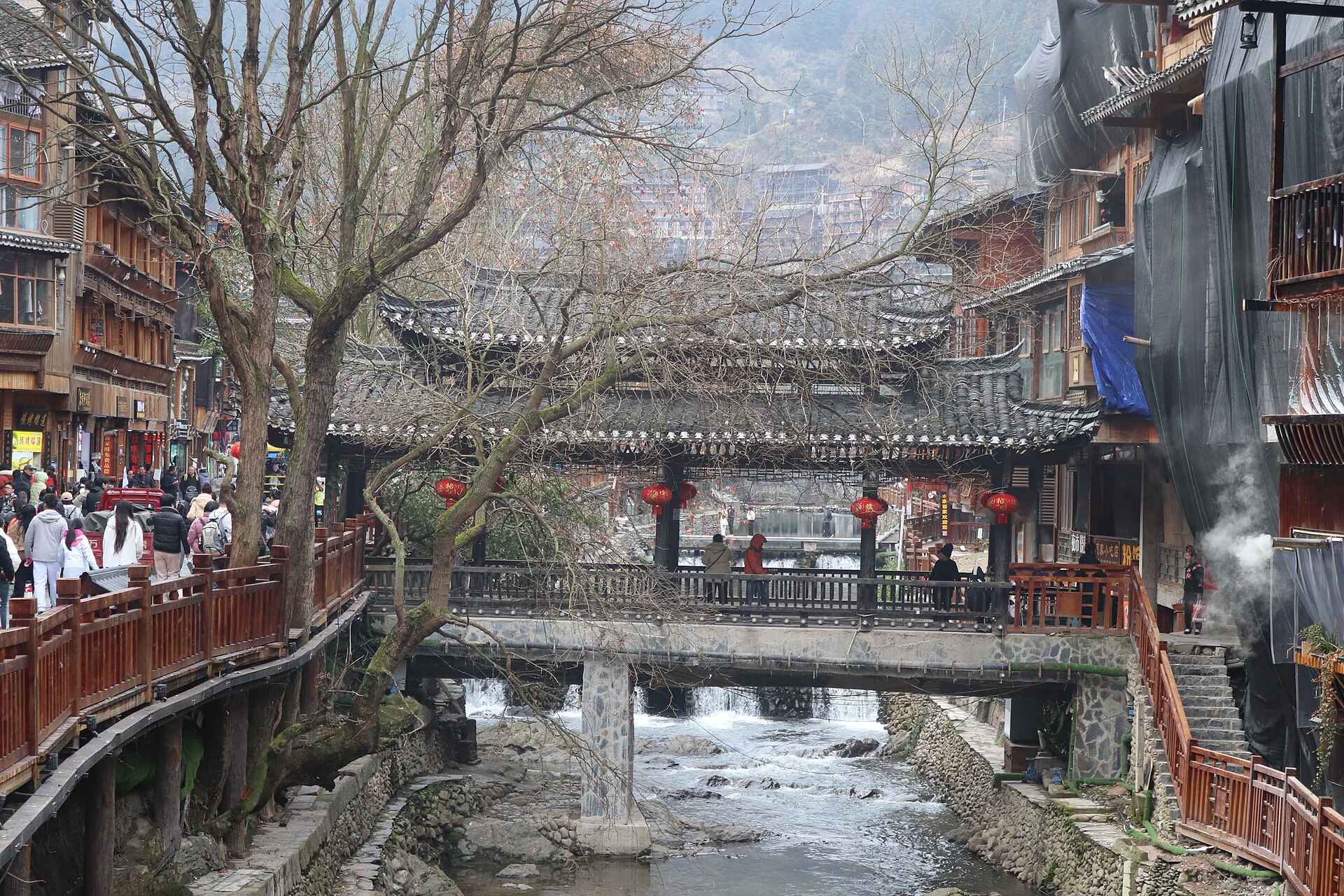
Kaili is the prefecture capital and the practical base — an hour from the high-speed line, with the best market in the region on a Sunday. From there the roads run east into Leishan county, where Xijiang sits: about a thousand households on one hillside, connected by stone lanes and covered bridges, with a nightly performance and a great deal of embroidered cloth for sale. It is the most visited village in the province and it feels like it in the middle of the day.
Zhaoxing, four hours further east in Liping county, is the counterweight. It is the largest Dong village in China, laid out along a river with five drum towers — one for each of the five clans — and it has absorbed tourism without turning into a stage set. Between the two are the smaller villages — Langde, Basha, Dimen, Tang’an — where the rice terraces, the indigo vats and the singing are simply what happens on a Tuesday.
Two big villages, three small ones, and a market.
The view from the upper road at dusk, when every house has its lights on, is the image the province sells. Stay overnight and walk it at seven in the morning instead.
A river village with five towers, five covered bridges and a lot of carpentry. The surrounding terraces at Tang’an are twenty minutes away.
Langde Shang is a compact Miao village with a welcome ceremony that is genuine enough; Basha is known for its gunmen and its coming-of-age rites.
Baskets, indigo cloth, silver, herbal medicine and dogs. The best single morning in the province for understanding what the villages make.
The lunar calendar decides more than the weather.
Green terraces, working fields and the Sister’s Meal Festival in the third lunar month, which is the most photogenic of the Miao calendars.
Warm, wet and full of festivals — the sixth month brings celebration across the southeast. Book villages ahead; guesthouses are small.
Harvest, golden terraces and the clearest skies. The best month for walking between villages.
Miao New Year in the tenth lunar month is the big one, with bullfights, lusheng pipes and a great deal of eating. Otherwise cold, damp and quiet.
Two hours between good bases, and worth it.
Kaili is on the Shanghai–Kunming high-speed line, about 40 minutes from Guiyang. Xijiang is an hour by road from Kaili; Zhaoxing is four hours further east, or a stop on the Guiyang–Guilin line at Congjiang.
Family guesthouses in the villages, with wooden walls and shared bathrooms in the smaller ones. Two nights at Xijiang and two at Zhaoxing is the shape that works.
This is the province where the map lies. Ninety kilometres can be two and a half hours. Build the route around two or three nights per base, not a new bed every night.
Silver, indigo and a choir with no conductor.
Kam grand song is polyphonic singing without instruments or a conductor, inscribed by UNESCO in 2009. It is sung at festivals, in the drum towers and, in some villages, nightly for visitors.
Miao silverwork is a dowry system as much as a craft; Dong indigo dyeing uses fermented indigo and egg white to produce a shine. Both are sold everywhere, and both are better bought from the workshop.
Villages are homes, not venues. Ask before entering a house, do not photograph a ceremony from the front row, and accept the rice wine if you can — refusing it is the ruder option.
Wooden walls, wet steps and a lot of walking.
Village guesthouses are up stone lanes with no vehicle access. A bag you can carry for ten minutes is the difference between a good arrival and a bad one.
This is one of the wettest parts of China. Steps are mossy, bridges are polished, and an umbrella is more useful than a hood in the villages.
Mobile payment works in the big villages and fails in the small ones. Carry cash for guesthouses, and expect the signal to drop in the valleys.
Tell us which festival you are aiming at, if any. The lunar calendar sets the route in this corner of the province far more than the weather does.
Start my journey brief ↗