The Red Clouds Golden Summit
The climb everybody comes for: a chain-and-step ascent up a stone pinnacle, two temples, and a bridge over the gap. Go early; the queue is 40 minutes by mid-morning.
 Start your enquiry
Destinations / Guizhou / Fanjingshan
A 2,570-metre island of ancient forest, a summit split in two by a cleft with a temple on each half, and a stairway that decides whether you enjoy it.
Explore the guide ↓Eastern Guizhou · Tongren prefecture
Fanjingshan is the highest ground in the Wuling range, a massif of metamorphic rock standing 2,570 metres above the surrounding country in the far northeast of Guizhou. Because it has been isolated and protected for centuries — first as a Buddhist mountain, then as a reserve — it holds a fragment of subtropical forest that was never cleared, with more than four thousand plant species recorded and a set of endemics that exist nowhere else.
Two of those endemics are the reason biologists care. The Guizhou snub-nosed monkey lives only here, in a few troops in the high forest, and the Fanjingshan fir survives as a handful of stands on the upper slopes. Neither is something a visitor will see; the point is that the forest they depend on is intact, and walking through it is the experience the mountain offers.
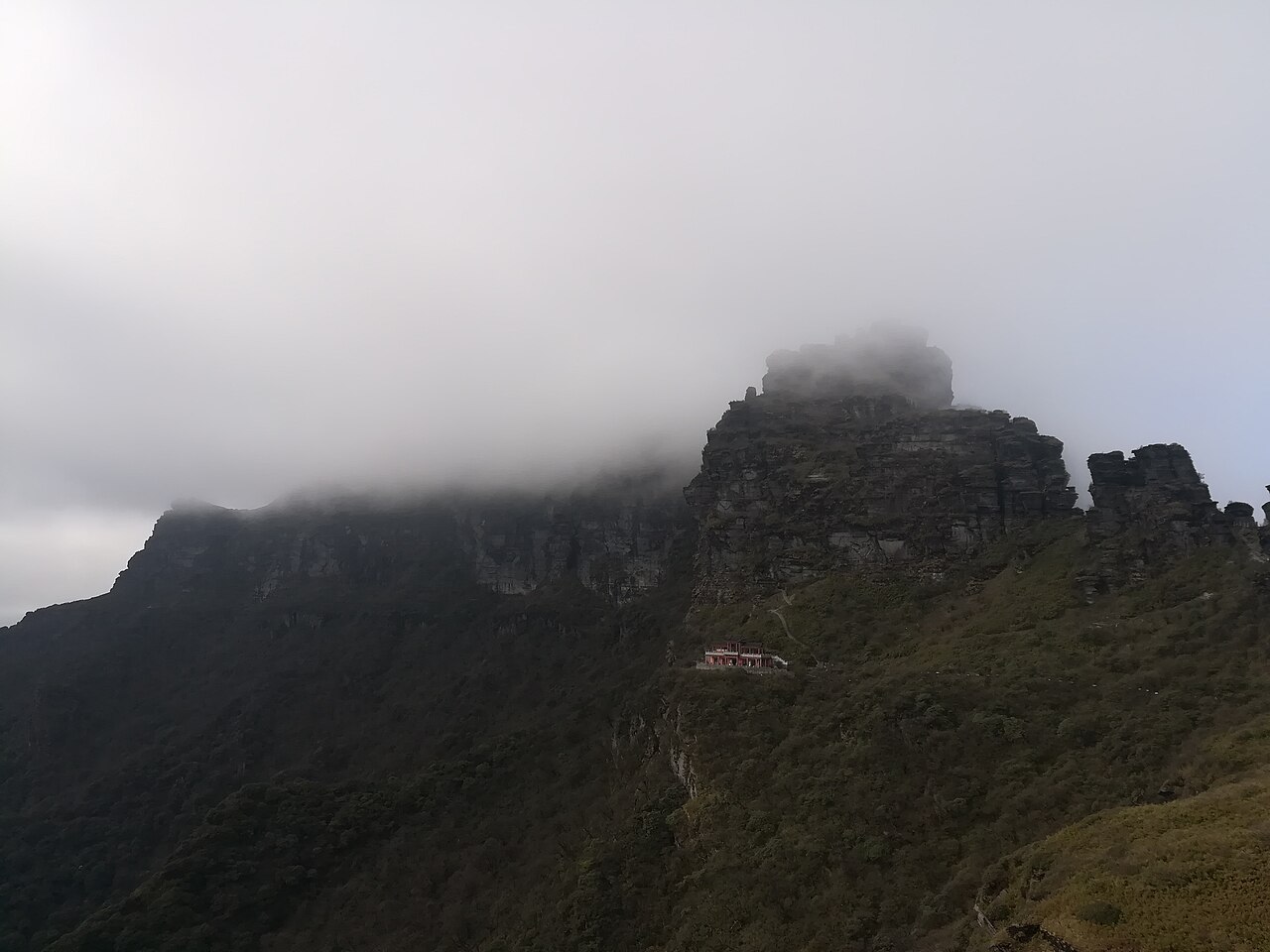
The summit is a split pinnacle. The Red Clouds Golden Summit rises to 2,336 metres, cut top to bottom by a cleft about a hundred metres deep, with a temple on each half and a small bridge between them. The stairs up the rock are cut into the face, steep enough to need both hands on a chain, and narrow enough that two people cannot pass. It is not a long climb, and it is not for anyone who dislikes exposure.
The summit, the old summit, and the forest between.
The climb everybody comes for: a chain-and-step ascent up a stone pinnacle, two temples, and a bridge over the gap. Go early; the queue is 40 minutes by mid-morning.
A balanced boulder on the ridge below the old summit, with the whole massif laid out behind it. The best photograph on the mountain, and a flat five-minute walk.
A quieter stairway to a second set of temples, with fewer people and a better view back at the Red Clouds pinnacle.
Beech, magnolia and hemlock with moss to the knees, and a canopy that stays wet for days. The cable car crosses it; the paths go through it.
Cloud, and the odds of seeing anything.
Green, wet and often in cloud. The best chance of the sea of cloud below the summit, and the worst chance of a view.
Warm at the base, 12–15 °C at the top, with afternoon storms that close the summit stairway. Go at opening.
The best window: cooler, drier, clearer, with the maples turning on the middle slopes from late September.
Cold, icy and occasionally closed. Snow on the stairs makes the summit ascent unsafe, and the cable car stops in high wind.
A cable car, a thousand steps and a queue.
Tongren is on the high-speed line, and the mountain is a further hour and a half by road to the Jiangkou gate. Most people stay at the base village or in Jiangkou town.
Shuttle bus to the cable car, twenty-five minutes up to about 2,100 metres, then an hour of steps to the summit platforms. Walking the whole way from the gate is 6,000 to 8,000 steps and a different day.
Entry is capped daily and timed, and the cable car sells out separately from the ticket. In peak season both need booking a day ahead; on national holidays, a week.
Maitreya, pilgrims and a reserve that keeps its own counsel.
Fanjingshan is a Maitreya bodhisattva site, one of the five sacred Buddhist mountains of China, with temples documented from the Ming. The monasteries on the summits were rebuilt in the last thirty years.
People climb for the merit, not the view, and they climb slowly. Give way on the stairs, and do not block the chain to take a photograph.
The Guizhou snub-nosed monkey is a high-forest animal that avoids people. Nobody sees it on a day trip, and the reserve does not run viewing.
Cold at the top, whatever the base says.
The summit runs 10 to 15 degrees colder than the gate. In August that means a fleece at noon; in October it means a down layer and gloves.
The summit ascent is a chain-and-step climb with real exposure and a one-person width. Anyone with knee trouble or a fear of heights should stop at the Mushroom Stone, which is the better view anyway.
The summit and the cable car close in high wind and lightning. Build a spare morning; this is a mountain that decides its own access.
Tell us your appetite for stairs and your tolerance for cloud. Fanjingshan is a two-day proposition if you want the summit in clear weather.
Start my journey brief ↗