Guiyang and Anshun
The falls at opening, the stone forest loop, the Tunpu villages and one day in the city for the museum and the food.
 Start your enquiry
Destinations / Guizhou / Route shapes
Guizhou is built privately rather than sold as fixed departures. These are the three shapes we build most often, and what each one costs in days and road time.
Explore the guide ↓Guizhou, all regions
Most of what we run in China is a published itinerary with fixed days and a price. Guizhou is different, and the reason is the province: the village calendar is lunar, the water is rainfall-driven, and the roads between good bases are slow enough that the sequence matters more than the sites. So we build it privately, around three shapes that work.
Each shape below is a real route we have run, described in days and in the decision that shapes it. None of them is a fixed departure, and all of them can be shortened, extended or attached to Guangxi or Yunnan at either end.
Seven days, two bases.
The falls at opening, the stone forest loop, the Tunpu villages and one day in the city for the museum and the food.
The Sunday market, two nights in the village, and a day walking between the smaller villages on the terraces.
Water at full volume from May, festivals from the third lunar month, and the clearest skies in October.
Eight days, one region.
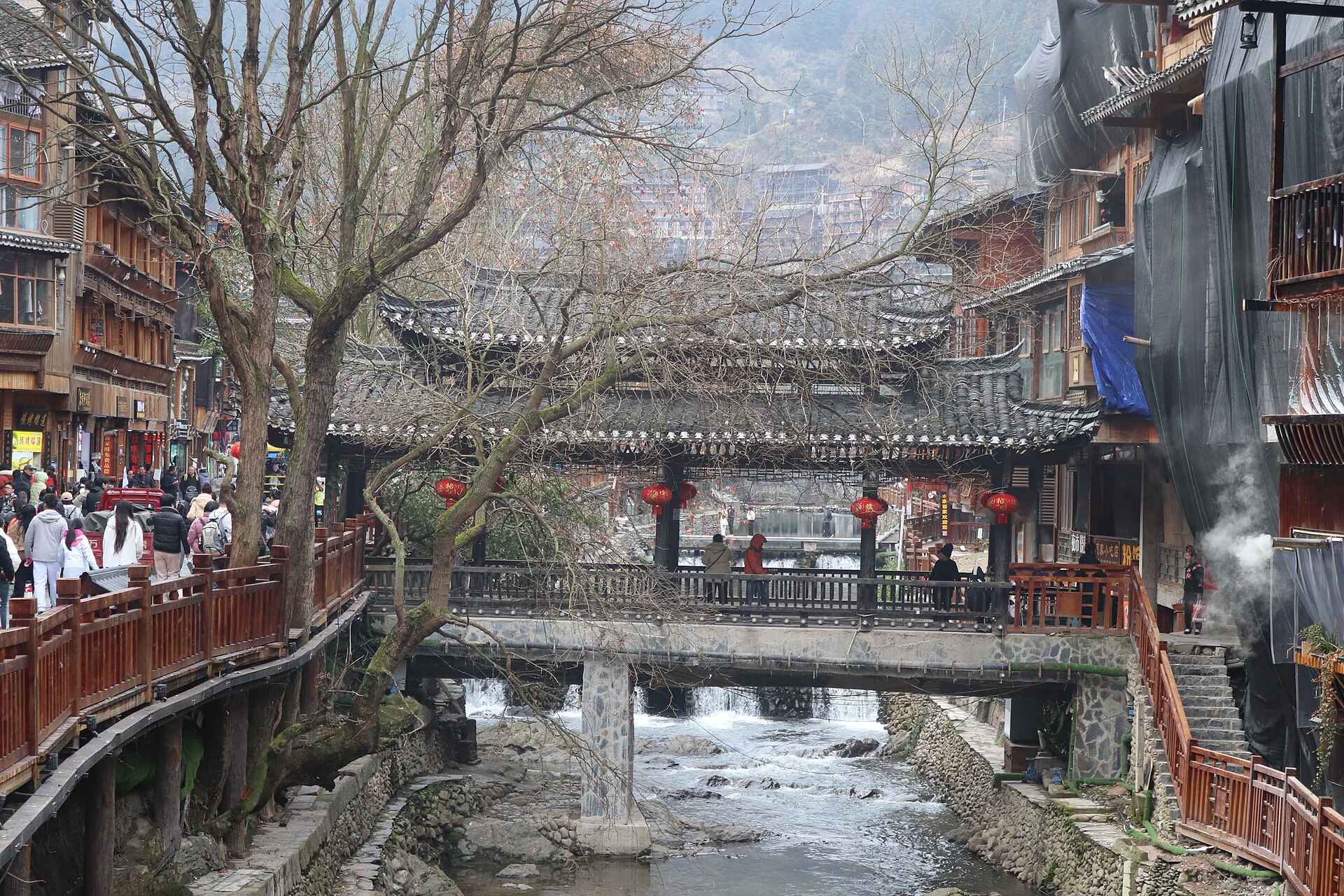
Kaili, Langde, Xijiang, Rongjiang and Zhaoxing, with the terraces at Tang’an and a night in a village with no vehicles.
Built around Miao New Year, the Sister’s Meal Festival or the Dong New Year, whichever falls in your window.
Zhaoxing to Congjiang, then the high-speed line south into Guangxi — the natural continuation.
Six days, the two extremes.
The Xiaoqikong valley walked downstream, the lake by rowboat, and a day in the reserve with a local guide.
A base at the foot of the mountain, an early cable car, and a spare morning for the cloud to lift.
The clear window for the summit, with the karst rivers still green after the summer.
Guizhou sits between three other provinces.