Ping’an
The most visited terrace area, an hour’s climb from the car park, with the Seven Stars with the Moon viewpoint above the village. Easier access, more guesthouses, and the place to be if you have one night only.
 Start your enquiry
Destinations / Guangxi / Longji
Sixty-six square kilometres of rice paddies stacked between 300 and 1,100 metres on the ridge above Longsheng, cut by Zhuang and Yao villages over six and a half centuries and still farmed by hand.
Explore the guide ↓Longsheng · northern Guangxi
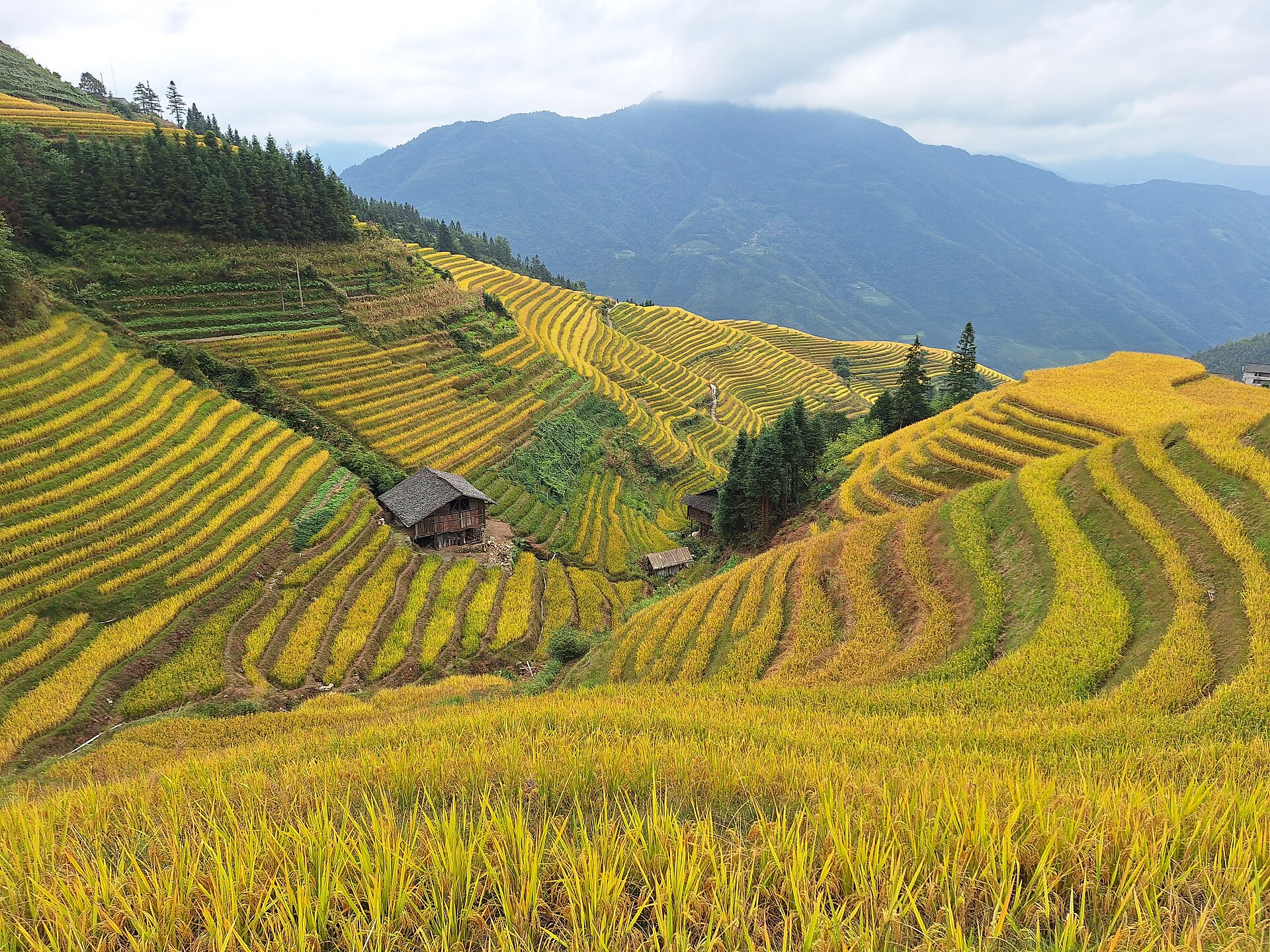
Longji means dragon’s backbone, and the name describes the ridge: a line of hills north of Guilin that the Zhuang and Yao farmers of Longsheng began terracing in the Yuan dynasty and finished in the early Qing, six hundred and fifty years later. The result is sixty-six square kilometres of paddy, distributed between 300 and 1,100 metres, on slopes that mostly run 26 to 35 degrees and in places reach 50.
What makes it extraordinary is not the area but the scale of the individual field. Most plots are only wide enough for one or two rows of rice; the local saying is that a rain cape will cover a field. Everything is done by hand or by buffalo, and the water is moved between terraces by opening and closing mud walls, one farmer at a time.
There are two main terrace areas and they are different trips. Ping’an is Zhuang, closer to the road, developed earlier and busier, with the two classic viewpoints of Seven Stars with the Moon and Nine Dragons and Five Tigers. Dazhai, in the Jinkeng area, is Yao, further up a worse road, larger in scale, and the place photographers go. Between and beyond them are village paths that link the valleys and make this the best two- or three-day walk in Guangxi.
Two terrace systems, one long ridge, and the villages between.
The most visited terrace area, an hour’s climb from the car park, with the Seven Stars with the Moon viewpoint above the village. Easier access, more guesthouses, and the place to be if you have one night only.
Five Yao villages under a bowl of terraces with three main viewpoints. Less developed, steeper, and considerably more dramatic in low cloud. The road up is slow and the last section is on foot.
Stone-flagged paths connect Ping’an, Zhongliu, Dazhai and the smaller hamlets, crossing ridges at around 1,000 metres. A guide is not required but the junctions are not signed in English.
A Yao village on the road into the terraces, known for the red Yao women who cut their hair once in a lifetime. Performances are scheduled and commercial; the village itself is worth an hour.
Four distinct landscapes in one year.
The flooded terraces: every field a mirror, the classic image, and the busiest two weeks of the year. Book ahead and expect company at the viewpoints.
Green rice, high cloud, and the best chance of the sea of cloud that fills the valleys below the ridge at dawn. Hot and humid at the lower villages.
The harvest. The terraces turn gold and are cut progressively up the mountain, so the colour moves; late September is usually the peak. This is the best all-round window.
Bare, flooded or occasionally snow-covered terraces, with very few visitors. Cold, damp, and the guesthouses are cheap. Snow on the terraces is rare but spectacular when it happens.
Seventy kilometres, one ridge, and a lot of steps.
About 70 km and two hours from Guilin to the Longji ticket gate, then a shuttle or a walk to the villages. Buses from Guilin’s Qintan station run in the morning; most people come with a driver.
Ping’an is a 40–60 minute climb from the road; Dazhai is a shuttle plus 20 minutes. Between them, on foot, is a full day over the ridge. Luggage can be carried up by porters for a fee.
Guesthouses in Ping’an or Dazhai, all family-run, most with a terrace facing the paddies. Two nights is the minimum for a dawn and a walk; three is better.
Zhuang and Yao, and a farming calendar that runs the year.
Ping’an is Zhuang, the largest minority in Guangxi; Dazhai and the Jinkeng villages are Red Yao. The costumes, the language and the house styles are different, and the two areas are administered separately.
Terraces are fed by gravity through a network of channels cut along the contours, with each family responsible for its own section. In spring the whole system is repaired before the fields are flooded, which is why the mirrors appear within a few days of each other.
Longji tea, glutinous rice, chilli and the local rice wine are the things the villages sell and eat. The tea is grown above the terraces and picked before the rice is planted.
Steps, weather and one very good sunrise.
There are no roads between the villages, only stone paths with a great many risers. Bring a small pack, leave the case in Guilin or send it up by porter, and allow more time than the map suggests.
The famous photographs are made in low cloud and at dawn, not in clear midday sun. Two nights gives you two dawns, which roughly doubles the chance of the valley filling with cloud.
Some viewpoints are on village land with a small charge, and some paths cross private fields. The fees are a few yuan and they are how the village keeps the paths open.
Tell us whether you want the mirror season or the harvest, and whether you would rather sleep above Ping’an or walk over the ridge to Dazhai.
Start my journey brief ↗