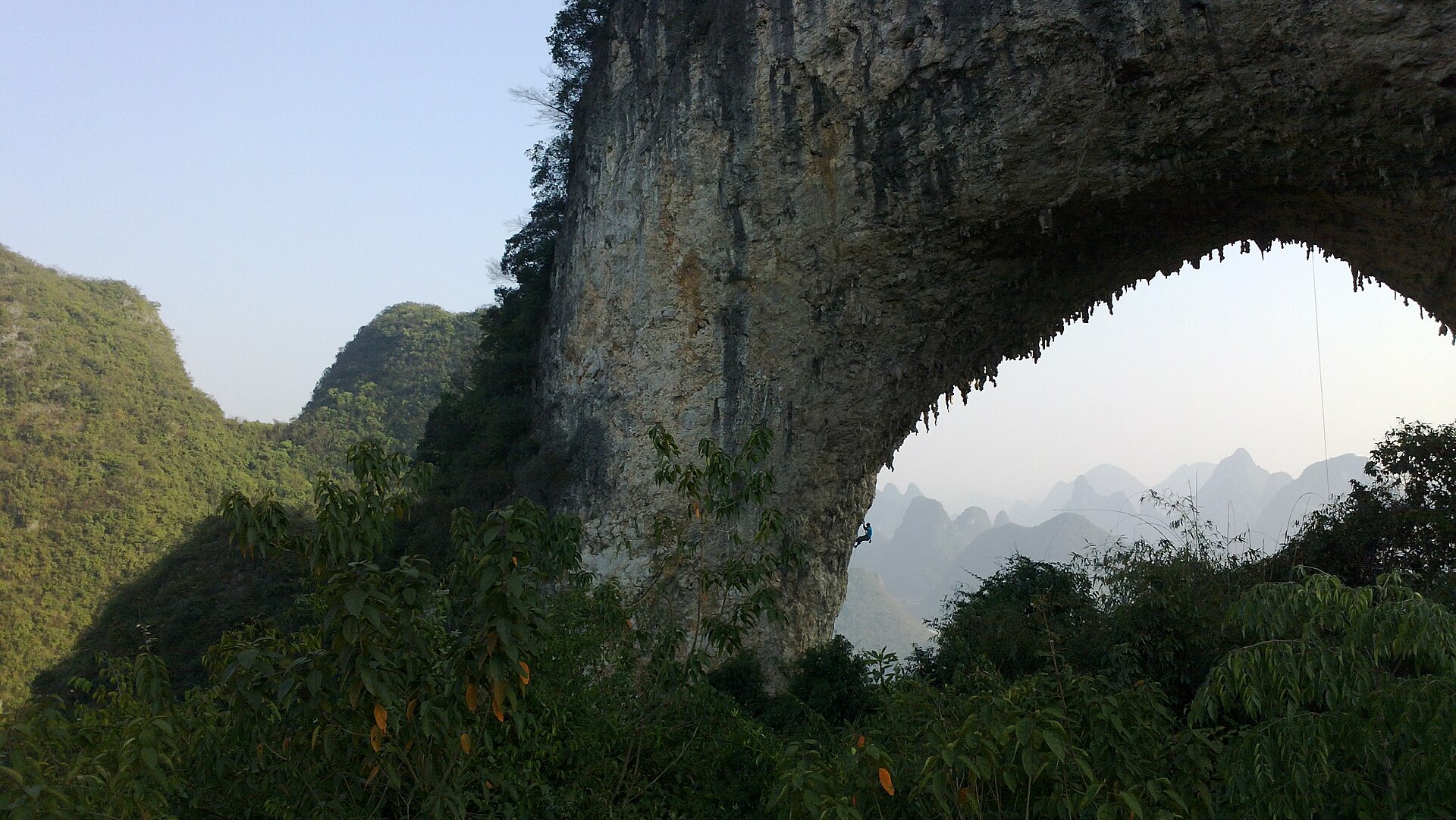
A thousand bolted routes on the towers that everyone else photographs from a raft. The climbing capital of China, an hour and a half south of Guilin, with a river to rest on.
Yangshuo sits in a cluster of karst towers about 65 kilometres downstream of Guilin, at the point where the Li River turns east. Most visitors arrive on the boat, walk West Street, and leave. The reason to stay is that the same towers hold more than a thousand bolted sport routes across dozens of crags — the largest concentration of climbable rock in China, and one of the most developed areas in Asia.
The rock is Devonian limestone, dissolved into vertical joints, pockets, tufas and stalactite formations. That makes it steep and three-dimensional rather than slabby, and the holds are often deep and positive. The first route was put up by the American climber Todd Skinner on Moon Hill in 1992; thirty years of development later there are climbing shops, bilingual guides, a guidebook culture and an annual festival that has run since 2008.
The second river is the other reason people stay. The Yulong, 43.5 kilometres long and the Li’s longest tributary inside Yangshuo county, is shallow, clear and slow, and it runs through the same towers without the cruise boats. Between the two rivers there are about ten kilometres of paddy, village lanes and dirt roads that make the best cycling in the province.
What to explore.
Rock, river, and the lanes between them.
Moon Hill
The arch · 5.7 to 5.13
The hill everyone photographs, with more than a hundred routes and a twenty-minute approach. The classic moderates through the arch queue on good weekends, and the entrance fee of around ¥30 has been the subject of a dispute over site operation.
Wine Bottle and the easy crags
5.7 – 5.10
A cluster of gentler lines close to town, used for first outdoor days and warm-ups. The right place to find out what your indoor grade is actually worth.
White Mountain and the steep end
5.11 – 5.13
The concentration of harder sport routes, in shade from early afternoon after a hot twenty-five-minute walk-in. Where local strong climbers work their projects.
The Yulong River
43.5 km · bamboo rafts
Rafts from a dozen wharves, the Ming-dynasty Yulong Bridge, and a riverside path that is walkable and cyclable for most of its length. The quiet alternative to the Li.
When to go.
Climb in the cool half of the year; float in the warm half.
October – November
The best climbing months: dry rock, 15–25 °C, reliable friction, and the rice turning. Book accommodation around the October holiday.
March – April
The second window: comfortable and green, with occasional rain that dries fast on the steep crags. The countryside is at its best.
May – September
Hot and humid, mid-thirties, afternoon storms. Limestone seeps for days after heavy rain. Locals climb from seven to eleven and swim in the afternoon.
December – February
Cold and sometimes damp, 8–15 °C, but the crags are empty and the light is clear. Bring a warm layer for belaying.
Plan the journey.
An hour and a half from Guilin, or the end of the boat.
Getting there
The high-speed station at Yangshuo is 30 km from town, on the Guiyang–Guangzhou line. From Guilin, buses take about 90 minutes; the river boat takes four to five hours and arrives in the middle of the afternoon.
Getting to the crags
The crags are 4–10 km from town. Scooters are the local solution at ¥60–100 a day, but riding one without a Chinese licence is not a plan. A driver for the day, or a guide who drives, removes the problem.
Where to sleep
Town for restaurants and other climbers, the Yulong valley for quiet, and Xingping if you want the river bend at dawn. Three nights is the minimum for a climbing trip that is not all travel.
The climbing.
How a Chinese rice town became the country’s climbing school.
The grades
Routes run from about 5.7 to 5.15a on the Yosemite decimal system, with most accessible lines between 5.10 and 5.12. Choose the crag for the group, not for the tick-list: a wall with easy and hard lines beats two cars.
The cost
A full kit rents for roughly ¥150–350 a day. A guided half day is ¥300–500; a full day with a bilingual guide ¥600–1,200. Introductory courses run ¥400–600 for a day, ¥1,200–1,800 for three.
The access
Crags sit on farmland, village land and inside scenic areas, and access is a local agreement rather than a right. Moon Hill access has been inconsistent through 2025 and 2026. Confirm the specific crag for your specific week.
Before you go.
Skin, heat and honest grading.
Three days on, two off
Limestone is hard on skin and the approaches are hot. A five-day climbing block usually produces three good days; a rest day on the river is what makes day four work.
Grade honestly
The single biggest predictor of a good trip is a guide who knows your real level. Yangshuo rewards people who climb two grades below their indoor maximum for the first two days.
Wet rock is not a challenge
Polished limestone that is merely insecure in the dry becomes dangerous when wet, and climbing on it damages the routes for everyone. If it rains, go to the cave crag or go cycling.
Tell us your honest grade, how many days you can climb, and whether the rest of the group wants a river or a bicycle. Those three answers build the week.