
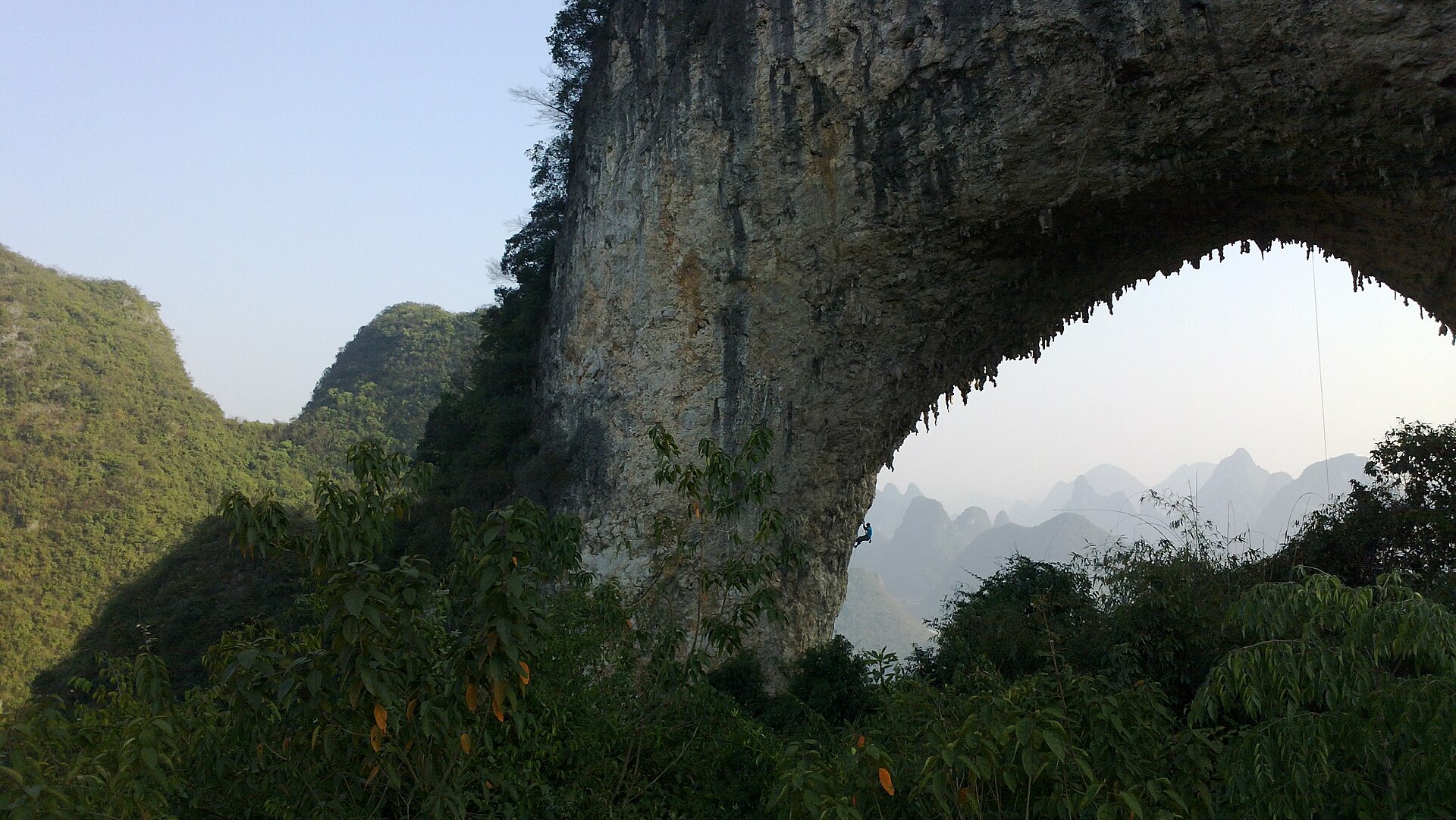
Yangshuo sits in a cluster of karst towers in Guangxi, about an hour and a half south of Guilin. Visitors come for the Li River and the rice fields, and most of them leave without registering that the same peaks hold one of Asia's most developed sport-climbing areas: climbing-community route databases count more than a thousand bolted lines across dozens of crags, and the figure keeps rising.
What matters for planning is not the total. It is that the rock, the grades and the access each behave in a particular way, and a trip built without knowing that tends to produce two good days and four frustrating ones.
Why the rock climbs well.
The towers are Devonian limestone, roughly 300 million years old, dissolved into vertical joints, pockets, tufas and stalactite formations. That geology produces steep, three-dimensional climbing rather than the slabby friction work that limestone serves up elsewhere. Holds are often positive and deep — which is why visiting climbers with modest outdoor mileage can sometimes climb harder here than at home — but the same features collect water, polish under traffic and, on the popular moderates, feel more slippery than the grade suggests.
Yangshuo's first bolted route was put up by the American climber Todd Skinner on Moon Hill in 1992. Three decades of development later, the town has climbing shops, bilingual guides, a guidebook culture and an annual festival that has run since 2008 — the seventeenth edition took place in December 2025.
Which crag for which level.
Grades across the area run from about 5.7 to 5.15a on the Yosemite decimal system, with the bulk of accessible routes between 5.10 and 5.12. The named crags are not interchangeable, and choosing by grade rather than by reputation is what makes a first trip work:
- Wine Bottle — a cluster of easier lines in the 5.7–5.10 range, close to town and the usual choice for a first outdoor day or a warm-up.
- Moon Hill — the arch, more than a hundred routes, and the one crag non-climbers have heard of. Approaches are 20 minutes uphill from the car park; the classic moderate lines through the arch are popular enough to queue for on a good weekend.
- White Mountain — the concentration of mid-5.11 to 5.13 sport routes, and reliably in shade by early afternoon. The walk-in is hot and takes about 25 minutes.
- Twin Gate — overhanging 5.12 and 5.13 in a cave that stays cool through the middle of the day, which makes it a summer option when everything else is baking.
- Lei Pi Shan — steep, hard, and where the local strong climbers work their projects. Worth visiting as a spectator even if 5.13 is not your range.
The season and the seepage.
October and November are the best months: dry rock, temperatures in the mid-teens to mid-twenties, and reliable friction. March and April are the second window — comfortable, greener, occasionally wet. December to February is cold and the rock can stay damp in the morning, but the crags are quiet.
May to September is the problem. Daytime temperatures reach the mid-thirties, humidity is high, and afternoon thunderstorms are routine. Limestone does not shed water quickly: some lines seep for days or weeks after heavy rain, and a polished foothold that is merely insecure in the dry becomes dangerous when wet. Local climbers start at seven in the morning and stop by eleven. If your only free window is July, plan climbing as a morning activity and put the river, the caves or the cooking class in the afternoon.
Access is not permanent.
Crags sit on farmland, village land and inside scenic areas, and the arrangement that allows climbing is a local agreement rather than a right. Moon Hill has an entrance fee — around ¥30 — and access there has been inconsistent through 2025 and 2026 because of a dispute over the site's operation. That is not a reason to avoid Yangshuo; it is a reason to confirm the specific crag for your specific week rather than assume last year's information still holds.
The same applies to new routing. Bolting on someone's land without permission closes crags for everyone, and land managers do not distinguish between the person who placed the bolt and the next visitor who clips it. If you climb, follow the local ethics: no new lines without agreement, no cleaning of routes that are not yours, and no climbing on wet rock.
What a day costs.
Yangshuo is inexpensive by international standards. Rental of a full kit — shoes, harness, helmet, chalk, rope and draws — runs roughly ¥150–350 a day, and multi-day rates are lower. A guided half day is typically ¥300–500; a full day with a bilingual guide, ¥600–1,200. Introductory courses run ¥400–600 for a day and around ¥1,200–1,800 for three. A beginner via ferrata session, if you want a non-climbing alternative for part of the group, is around ¥258 including equipment.
Prices move, so treat those as the shape of the cost rather than a quote. The one line item people forget is transport to the crags: they are 4–10 km from town, and while a scooter is the local solution at ¥60–100 a day, riding one without a Chinese licence is not something to plan around. Hiring a driver for the day, or climbing with a guide who drives, removes the problem.
Building the week.
A climbing trip here works best as three climbing days and two weather days, not five climbing days. Limestone is hard on skin, the approaches are hot, and the difference between a good trip and a great one is usually whether day four was a rest day.
A sensible shape: arrive, settle, easy afternoon at Wine Bottle; a full day at Moon Hill or White Mountain depending on grade; a rest day on the river or in the countryside; then the hardest day while you are still fresh; then a short final morning before the transfer. If the forecast turns, the rest day moves and the plan survives.
Two things make the difference between a climbing holiday and a climbing-led journey. The first is honest grading before you arrive — a guide who knows your real level will put you on routes you can finish, which is where the improvement happens. The second is accepting that Yangshuo is a town as well as a crag: the countryside cycling, the river and the food are part of why people stay for a fortnight rather than a weekend.
Route counts, grades, prices and access status checked 3 November 2026 against climbing-community route databases, local operator pricing and published reporting on the Moon Hill access dispute. Crag access, entrance fees and bolting permissions change locally and without notice — confirm the specific crag before travelling.
Climbing can anchor a wider journey.
See how we plan rock climbing in China →