The Li River, Guilin to Yangshuo
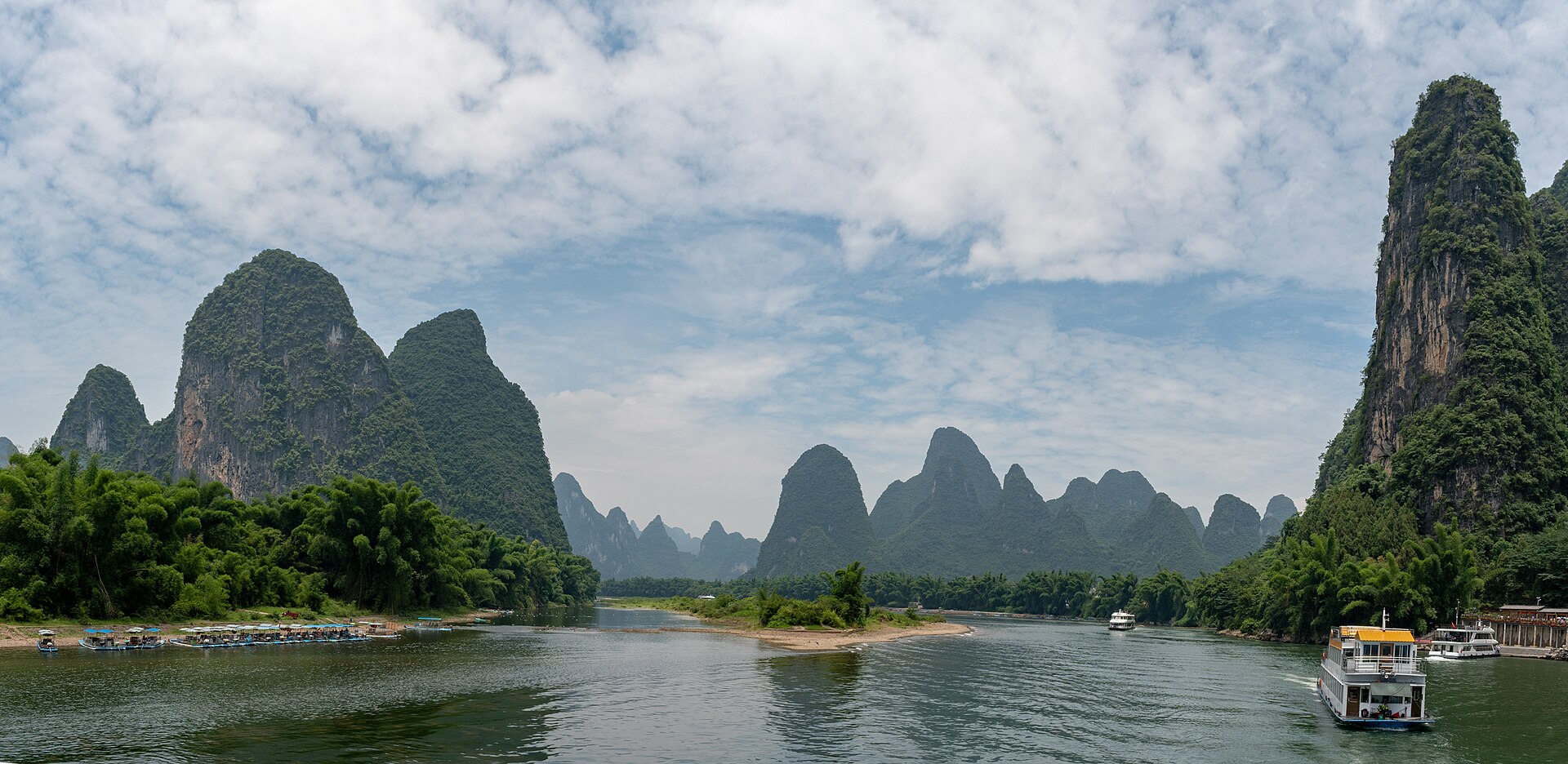
The boat from Zhujiang or Mopanshan pier to Yangshuo. Sit on the open top deck, on the left going downstream, and accept that the best light is in the first hour.
 Start your enquiry
Destinations / Guangxi / Guilin
A city of seven hundred thousand built between limestone towers, and the 83 kilometres of river south of it that made the phrase “Guilin’s landscape is the finest under heaven” a cliché before the phrase was four hundred years old.
Explore the guide ↓North-east Guangxi · 150 m
Guilin sits on the Li River where the Guangxi plateau drops towards the basin, and the city is arranged around isolated limestone towers that rise straight out of the streets. The rock is Devonian limestone, roughly three hundred million years old, dissolved along vertical joints into the shapes that made the place famous. In 2014 the Guilin karst was inscribed as part of the second phase of the South China Karst World Heritage property.
The classic route is the river. The Li runs 164 kilometres in total, and the 83 kilometres between Guilin and Yangshuo are the scenic section: a corridor of towers, bamboo and water that takes four to five hours by boat and passes the formations printed on the twenty-yuan note near Xingping. It is genuinely one of the great river journeys, and it is also the most crowded thing in the province between May and October.
The city itself is worth a day. The Ming princes’ palace of Jingjiang, built in 1372 and finished thirty-four years before the Forbidden City, encloses Duxiu Peak, and the climb of 306 steps gives the only view over the whole city. The phrase “Guilin’s landscape is the finest under heaven” was first carved into the rock at the foot of that peak in 1201, by an official called Wang Zhenggong, to encourage examination candidates; the second half of his couplet was lost under flowstone until 1983.
The river, the city, the canal and the towers.
The boat from Zhujiang or Mopanshan pier to Yangshuo. Sit on the open top deck, on the left going downstream, and accept that the best light is in the first hour.
The S-bend of the river below Xingping old town is the view on the back of the twenty-yuan note. Laozhai Hill, a twenty-minute climb opposite, is where the photograph is taken from — go at dawn.
A walled Ming palace inside the modern city, later the Guangxi examination hall, with more than a hundred cliff inscriptions from the Tang onwards. The 306 steps to the summit are the best hour in Guilin.
Sixty kilometres north at Xing’an, the canal that joined the Xiang and the Li and let Qin armies supply their conquest of the south. One of the three great water works of the Qin, and still flowing.
A wet subtropical city with a short, excellent autumn.
The best window: 20–28 °C, low humidity, clear water and the highest chance of a clean reflection. Book the river boat a few days ahead.
Mist and low cloud, which is what the classical paintings were describing. Rain is frequent but rarely all day, and the crowds are thinner than in summer.
Hot, humid and wet, with the river at its highest and brownest. Cruise boats still run, but the water is opaque and the light is flat.
Cool and damp, 8–14 °C, with occasional cold snaps. The towers in mist are beautiful; the boat is cold and the days are short.
An airport, a high-speed station, and one river.
Guilin Liangjiang (KWL) is 28 km west of the city; the high-speed station connects to Guangzhou in about three hours and to Guiyang in two. From Guilin to Yangshuo is 65 km by road, or 83 km by river.
Boats leave from Mopanshan and Zhujiang piers in the morning and take four to five hours to Yangshuo. Tickets are sold by class; the difference is the deck, not the view.
Guilin for the city and the palace, Xingping for the bend and the dawn, Yangshuo for the climbing and the restaurants. Two nights in Guilin and two downstream is the usual shape.
Why the landscape is a subject, not just a backdrop.
Devonian limestone, laid down around 300–400 million years ago, lifted with the plateau, then dissolved along vertical joints. Towers form where the rock is thick and jointed; peak clusters form where it is thinner and the valleys have not yet widened.
The towers have been painted for a thousand years, and the aesthetic still governs how the place is visited: mist is good, sunlight is ordinary, and a reflection doubles the composition. That is why the six o’clock boat and the dawn climb both exist.
“桂林山水甲天下” was written in 1201 by Wang Zhenggong at a banquet for eleven newly successful examination candidates. It is a piece of examination encouragement that became a tourist slogan, which is a very Chinese career for a line of poetry.
Crowds, water and one early start.
The river is busiest in July, August and the October holiday. April and November give you the same landscape with half the boats.
In the dry months the upper river can be too low for the big boats, and the route may start further downstream. In flood, it can close altogether.
Whatever else you skip, be on Laozhai Hill above Xingping at first light once. The river bends around a tower in front of you and the whole landscape is below.
Tell us whether you want the boat, the dawn or the palace — and whether you would rather sleep in the city or in a village on the river.
Start my journey brief ↗