Mid-May – early June
The mirror season. Every field holds water and the ridge becomes a set of reflecting steps. The busiest two weeks of the year at Longji; book accommodation months ahead.
 Start your enquiry
Destinations / Guangxi / Season board / The terraces
Water, green, gold, bare. The terraces change four times a year, and each stage lasts about a fortnight at its best — which is why the dates matter more here than anywhere else in the province.
Explore the guide ↓Longsheng · 300–1,100 m
The terraces are a working farm, so their appearance is a farming calendar rather than a season. In spring the fields are flooded and then planted; through summer the rice grows and the terraces turn green; in autumn they ripen to gold and are cut; in winter they are bare, flooded, or occasionally white.
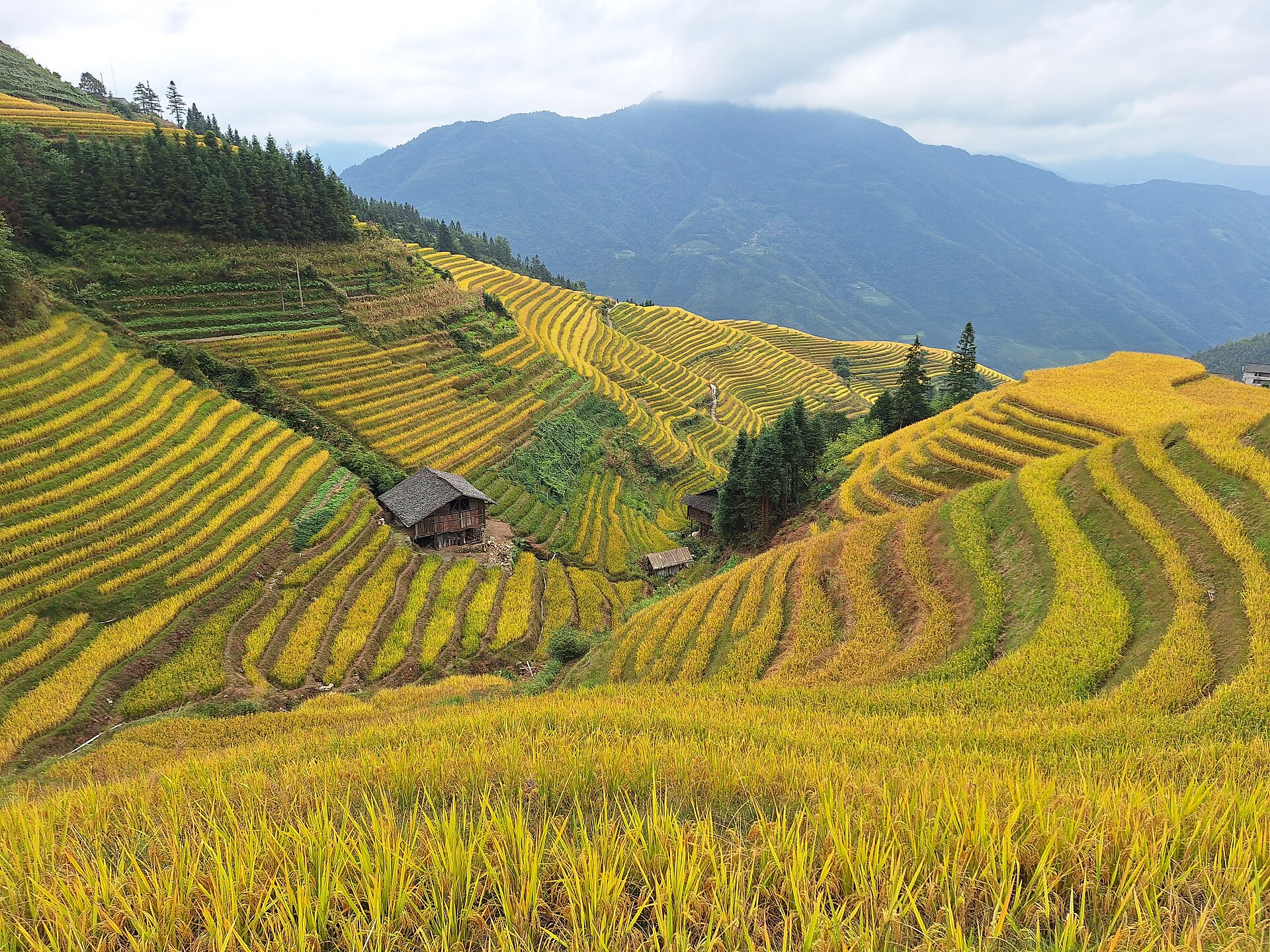
Each stage has a peak of about two weeks. The flooded mirrors are at their best from mid-May to early June, between the flooding and the transplanting. The gold is at its best from mid-September, and moves up the mountain as the harvest progresses. Miss the fortnight and you get the next stage, which is not worse but is different.
The altitude is what makes the timing complicated. The terraces run from 300 to 1,100 metres, and the farming season lags by roughly a month between the valley floor and the highest fields at Dazhai. On any given day in October, the bottom of the ridge can be cut and bare while the top is still gold.
What to expect in each window.
The mirror season. Every field holds water and the ridge becomes a set of reflecting steps. The busiest two weeks of the year at Longji; book accommodation months ahead.
Green rice and low cloud. The valleys below the ridge often fill with cloud at dawn, which is the other famous photograph. Hot, humid, and the guesthouses are quiet mid-week.
The harvest. Gold from the top down, with the cutting following the ripening. Late September is usually the single best week, and the weather is drier than in spring.
Bare terraces holding water, or dry and brown, or — rarely — covered in snow. Cold, cheap, empty, and the most graphic the lines ever look.
A month of lag between the valley and the ridge.
Temperature falls with altitude, so the highest fields at Dazhai ripen up to a month after the lowest at Ping’an. On a single October day you can photograph bare stubble and uncut gold in the same frame.
The whole system is fed by gravity channels cut along the contours, opened and closed by hand. That is why the mirrors appear within days of each other across a whole valley rather than field by field.
Most plots are one or two rows wide and everything is done by hand or buffalo. The harvest is still a family operation, which is why the timing varies by household as well as by altitude.
Tell us which of the four colours you want, and we will build the trip around that fortnight rather than around the flight price.
Start my journey brief ↗