
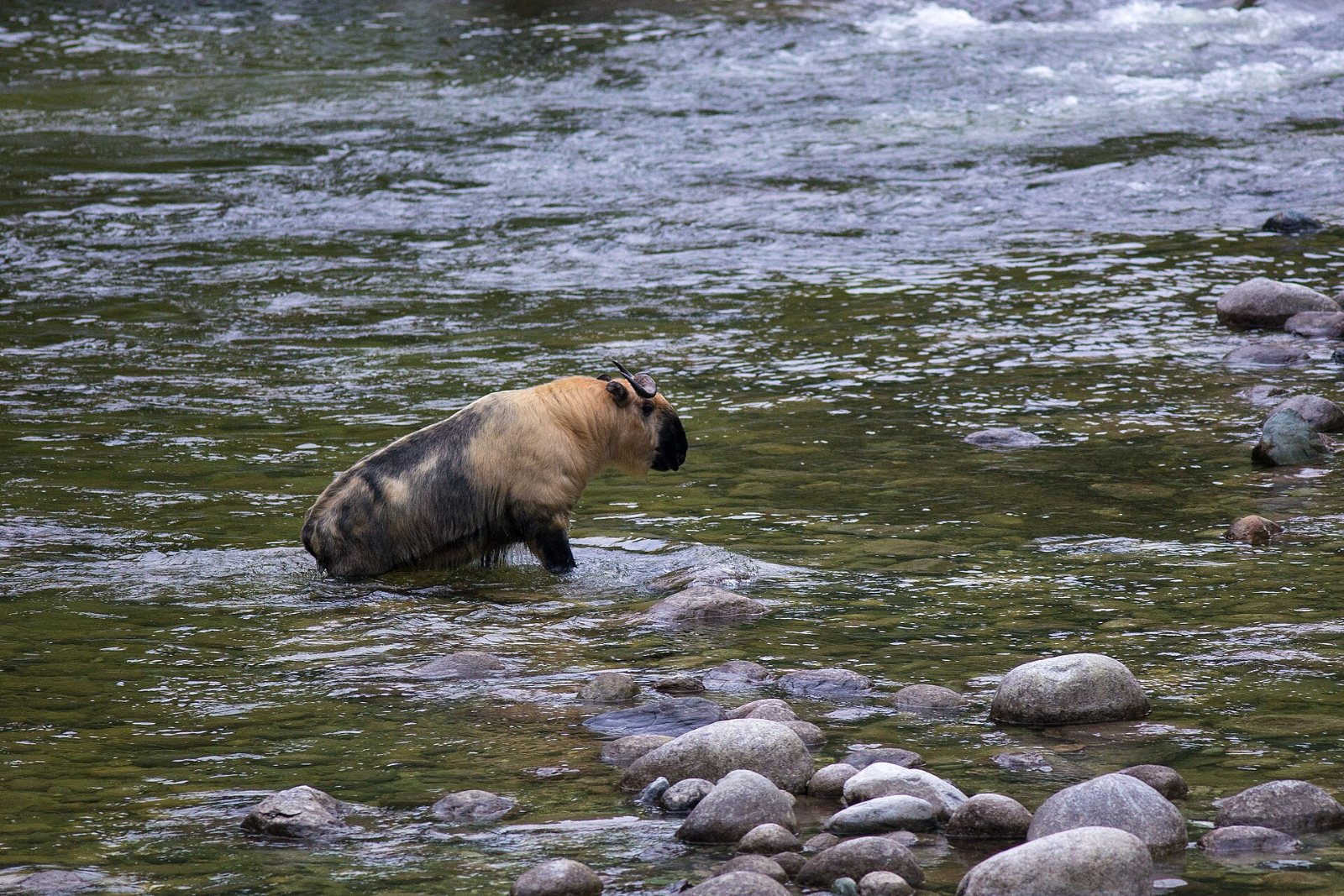
Ask a Chinese mammal-watcher where the takin are and you get a list of reserves where a takin is a rumour — a trail camera here, a distant herd there. Then ask about Tangjiahe, at the northern end of the Giant Panda National Park’s Sichuan section, and the answer changes shape: in this one valley the takin is the animal you plan the trip around, and our own field odds table rates it High, in company with Reeves’s muntjac and the Tibetan macaque.
Assembled from spare parts.
The Sichuan takin looks like a committee designed it: a goat-antelope with a humped shoulder, heavy horns that sweep back, a golden coat and the calm confidence of an animal with no local predator that matters. It is built for exactly this landscape — the cold, foggy, steep forests of the Minshan range — and it uses the ground in a way that makes it visible: herds wade the main river, graze the open banks, and feed along predictable lines at the valley edges in the first hours of light.
The valley’s bellwether.
That reliability is not a tourism accident; it is a health indicator you can read yourself. The share of juveniles in a takin herd is the single best read on how the whole valley is doing — a valley that calves well carries its future in the open, and the middle rows of its animal list stay full too. Tangjiahe’s herds have calved well for years, which is why the same two days reliably produce muntjac, macaques and goral, and why the rarer guests — leopard cat, golden pheasant, and the panda sign everyone half-expects — are worth trusting the valley to deliver in their own time.
Two days, first light.
The valley is four to five hours north of Chengdu, and the trip turns on one decision: sleeping inside the reserve, not at its gate. That converts one drive-in day into two field days with first light already in position. The main valley first — river fords and open banks, a day of stopping rather than covering ground — then the east valley on its own morning, a different set of edges and a different cast. The reserve hotel runs a night tour when weather and park permission allow, and some of the cast only clocks in after dark.
The rest of the cast.
What makes the two days valuable is the shape of the list rather than any single animal: High rows you can plan around, a Medium row that fills the gaps between takin sightings, and a Low row that includes some of China’s most wanted species. The ungulates field guide makes the argument in full — that the middle of the list, not the headliner, is what a working forest trip is actually made of.
Planning the valley.
We run Tangjiahe two ways: as the opening movement of the eight-day Sichuan mammal tour, and on its own as a two-day window from Chengdu for shorter calendars. The species guide for the Tangjiahe valley carries the groundwork, and the reserve pairs naturally with the golden monkey valley north of it — the monkey meeting is a different article about the same range.
Plan the valley?
Tangjiahe: the species guide
The Sichuan mammal tour: the eight-day circuit
Ungulates beyond pandas: the case for the middle row
The golden monkey meeting, in the same range
Tangjiahe: the reserve guide, the whole valley