
Almost every crane story China tells is a winter story. Poyang Lake in January, with five thousand Siberian cranes on the mudflats. Caohai and Dashanbao, with black-necked cranes standing in frosted barley. Napa Hai, where the count rises every December. Winter is when cranes concentrate, and concentration is what makes them watchable: one lake, one hide, one morning, a thousand birds.
The breeding season is the exact opposite, and that is the point of it. Pairs spread out across a marsh, each one holding a nest in the sedge, and the whole exercise depends on nobody walking up to it. It is a harder trip to sell and a better one to take: fewer birds per field, far more behaviour, and a landscape that is doing something rather than waiting.
A winter habit.
There is a reason the winter version dominates. Between November and March a crane is a bird in a crowd on open water, visible at a kilometre, and a hide or a watchtower does most of the work for you. The published counts are winter counts. The photographs are winter photographs. The tours run in winter because that is when the outcome is close to certain.
Summer offers none of that certainty. A nesting pair is hidden by design, the weather on the plateau turns over every afternoon, and the honest promise is a handful of sightings at distance rather than a flock at close range. What you get instead is the behaviour the winter crowds never show you: display, incubation shifts, a pair working the sedge with two chicks between them.
The marsh that holds them.
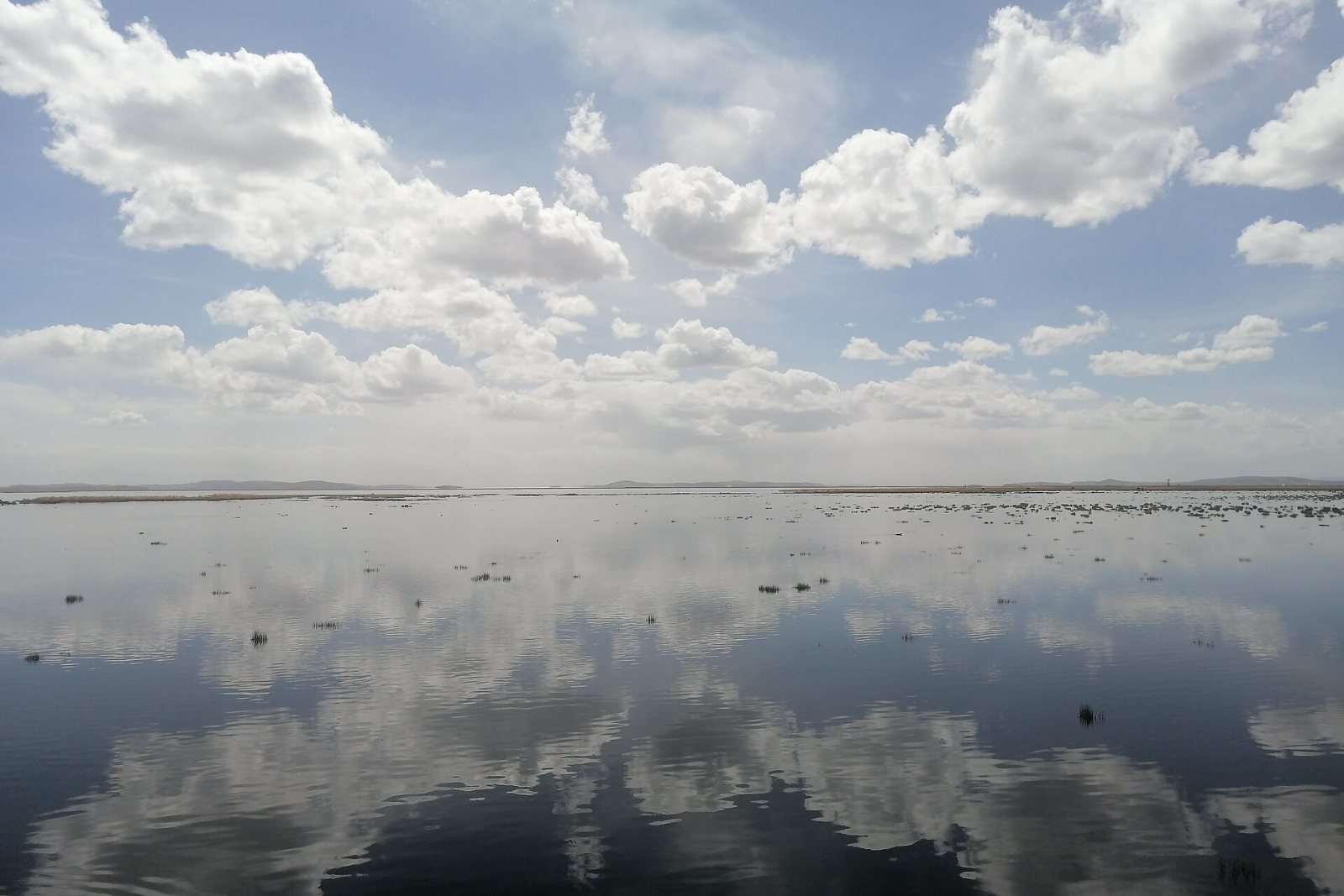
Ruoergai, in Ngawa prefecture on the Yellow River’s first bend, is the largest high-altitude peat swamp in China: 1,665 square kilometres of bog and shallow water at 3,400 metres, with 41 lakes of its own and 148 kilometres of the Yellow River’s main stem running through it. Peat is the reason it matters. The marsh holds water the way a sponge does, releasing it slowly into the river that half of northern China drinks from, and it has been building that sponge for thousands of years.
It is also where the eastern population of black-necked cranes breeds. The county’s own figures put 85% of the species’ breeding ground inside its boundaries and record the breeding count rising from 407 to about 2,500 over three decades of protection and wetland repair — 1,100-plus counted inside the reserve in the 2025 season. That is a conservation story with a number attached, which is rarer than it should be.
The breeding calendar.
The birds arrive from late March. Some come from Dashanbao in Yunnan and Caohai in Guizhou, more than nine hundred kilometres south — the same wetlands that carry the winter crane tourism, emptying out as the plateau thaws. Egg-laying runs from late April into June, two eggs to a clutch, and both birds take turns incubating. By June the first chicks are walking, and the family parties work the sedge together through the summer.
Then the marsh freezes, and in November the whole population turns south again. The window for seeing any of this is roughly June to August, and it is narrow for a reason that has nothing to do with tourism: the birds are only this visible while they are feeding chicks, and only this vulnerable while they are on eggs.
Why distance is the method.
A nest here sits deep in sedge, and it is off-limits — not by our preference but by the reserve’s rules and by the arithmetic of the species. An incubating crane that leaves the nest exposes two eggs to the plateau’s cold and to everything that patrols the marsh. Two eggs is the entire annual output of a pair.
So the watching happens from the edges: road verges, boardwalks, the reserve boundary, with long lenses and no approach. That is a less exciting sentence than “we got close”, and it is the only version worth printing. The county made the same argument formally in 2025, banning roadside feeding of wildlife for photographs and telling guesthouses to stop advertising it — a rule aimed squarely at the practice of luring animals onto a road for a picture.
A June day, honestly.
You are at 3,400 metres, so the first day is flat walking and very little else. Hua Hu, the 6.74-square-kilometre lake at the centre of the marsh, sits at 3,468 metres and carries greylag and bar-headed geese, gulls, terns and fifteen species of fish under the surface; there is a boardwalk, and no boat. Expect 5–18°C, hard sun at midday and a storm most afternoons. July is the wettest month, and the boardwalks flood first.
The marsh is not only cranes. Ruoergai holds the world’s largest wild population of Sichuan sika deer, about 1,800 of them, along with marmots, raptors and the plateau’s usual cast along the grassland roads. A dawn at the edge of the sedge, an afternoon on the boardwalk and a slow drive back is a full day here — and the reason to give the place two nights rather than one.
Both halves of the year.
The two halves of the crane year make a coherent pair. Winter is where the numbers are: Poyang with the world’s Siberian cranes, Napa Hai with a record 573 black-necked cranes in 2025–26. Summer is where the species lives: pairs on nests, chicks in the sedge, and a marsh that most crane travellers never see.
We run the winter journeys as trips with fixed seasons and near-certain sightings. Ruoergai is the counterpart — a summer add-on to a Sichuan or plateau itinerary, planned around patience rather than a schedule, and booked with the expectation that the birds will keep their distance. The guide to the marsh, its hours and its altitude is on the Ruoergai page.
Plan around the cranes?
Ruoergai: where the cranes nest
The black-necked crane tour: the plateau winter
Watching wildlife without disturbing it
Two crane winters
Napa Hai: the cranes’ winter lake