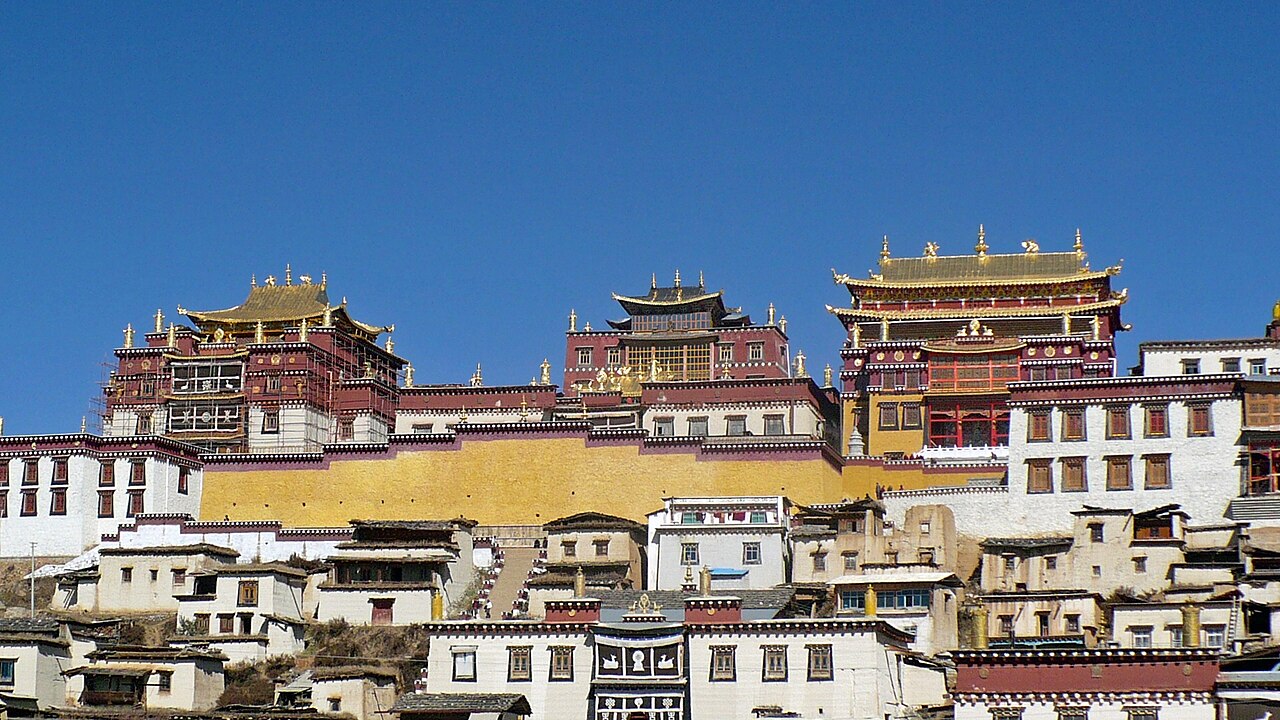
Songzanlin monastery
Yunnan's largest Tibetan monastery, founded 1679 — the lamrim halls, the monks' lanes and the kora circuit around the lake. Go with a guide who can open the right doors.
 Start your enquiry
Destinations / Yunnan /
The plateau city the novel was named for: a 300-year-old monastery on a hill, a whitewalled old town, barley fields under 5,000-metre ridges — and 3,300 metres of real altitude to plan around.
Explore the guide ↓Diqing prefecture · 3,300 m · the plateau
The city renamed itself after James Hilton's Shangri-La in 2001 — marketing, yes, but the plateau country behind the name earns it: Songzanlin monastery filling a hillside with gilded roofs, the whitewashed Dukezong old town with its giant prayer wheel, and barley fields running to 5,000-metre ridgelines. This is Diqing Tibetan Autonomous Prefecture, and the culture is not staged — the monastery holds hundreds of monks, the pilgrims walk the circuits, and the villages farm the plateau as they always have.
Two planning facts govern everything. Altitude: 3,300 m means the first day is deliberately gentle — the monastery, the old town, an early night. Season: the plateau has two green windows (May–June rhododendron, September–October gold) and a cold, crystalline winter that pairs with the flooded terraces of the southeast.
Six stops around the prefecture.
Yunnan's largest Tibetan monastery, founded 1679 — the lamrim halls, the monks' lanes and the kora circuit around the lake. Go with a guide who can open the right doors.
The 1,300-year-old market town, carefully rebuilt after the 2014 fire — the prayer-wheel hall's gilt wheel takes several people to turn, which is the point.
Black-necked cranes in winter, yak pastures in summer, the lake's mirror under the ridges in autumn — the wetland that changes costume four times a year.
China's first national park on the park model: alpine lakes, old-growth fir and the boardwalk circuits at 3,500–4,000 m. Take it slow; it is a real altitude walk.
The valley north of town — hot springs, pastoral villages and the road toward the Baima pass that the monkey forests guard.
The deep gorge country east of the plateau — a road-and-walk day through canyon walls the Lancang's tributaries cut.
The altitude is the itinerary.
Arrive from Lijiang (2,400 m) after the gorge — two steps up. First day: monastery and town, no Pudacuo, no Yubeng pass. Most travellers are fine by day two; the itinerary assumes it.
Diqing Shangri-La airport flies from Kunming; the road line from Lijiang via Tiger Leaping Gorge is the scenic standard. The rail link is pushing toward the city — we confirm current service at booking.
Even in summer, nights run near freezing and afternoons sunburn at altitude. Layers, a real shell, sun hat and lip balm — the plateau kit list, non-negotiable.
Circumambulate clockwise, keep voices low in the halls, ask before photographs of monks. Our guides open the halls tourists miss; the courtesy is what earns it.
Shangri-La is the gateway to the Meili range (the overland continues west) and the Baima monkey forests (north). Both extend the same journey — the line, not the loop.
Tell us your altitude experience — the plateau is kind to the well-paced and unkind to the rushed, and we build for the former.
Start my journey brief ↗