The White Jade River
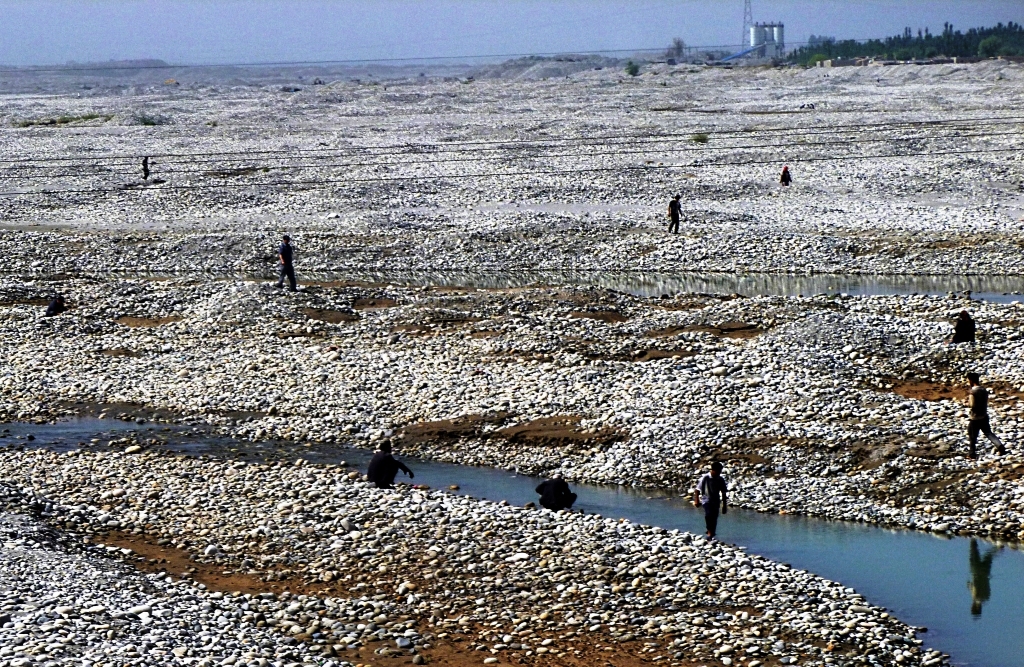
The wide pebble bed of the Yurungkash, where families sift for jade with the patience of an old economy — best in the cool hours.
 Start your enquiry
Destinations / Xinjiang /
The southern arc's great oasis: a river that still gives up jade, workshops that still knot carpets, and the dried-fruit market that feeds the desert's southern rim — with the poplar forests an hour north.
Explore the guide ↓Southern Xinjiang · 1,375 m · the jade oasis
Hotan's wealth was never agricultural alone: the river brought jade from the Kunlun, the oasis grew silk and cotton, and the workshops turned both into the things the caravans carried west. That economy still runs — visibly, daily — in the jade market's tables of river stones, the carpet workshops' looms and the dried-fruit market that makes the city the pantry of the south.
The city rewards two unhurried days: a market day and a workshop day, with the White Jade River in the cool of the morning. North of the city the Tarim's poplar forests begin — the autumn loop journey crosses the desert highway to arrive here — and west the road runs to Kashgar and the Pamir. Hotan is the southern arc's hinge, and the flagship journey anchors two nights here.
Six stops across the city and river.
The wide pebble bed of the Yurungkash, where families sift for jade with the patience of an old economy — best in the cool hours.
Tables of raw and worked nephrite, from river pebbles to boulder carvings — the liveliest market in the south, and a genuine trade to watch before buying.
Hotan carpets knot the southern arc's motifs — workshops welcome visitors, and the honest ones let you watch before they sell.
Walnuts, dates, figs, raisins and the year's crop sacked by the kilo — the desert's agriculture made edible and portable.
The ruined cities of the southern arc, out in the sand beyond the oasis — wind-dug walls and stupa remains under an enormous sky.
When the weekly market assembles, the whole oasis arrives — livestock, cloth, food and the jade trade all at once.
Season, connections and buying well.
Hotan works in every season except high summer — the southern oasis is hot and dusty in July, glorious from October to April.
Direct flights to Urumqi and Xi'an; the rail line now runs the southern rim to Kashgar. The poplar loop and the flagship both end here.
Buy slowly and learn first: the market is a real trade, prices are negotiable, and certificates vary. We can arrange a workshop visit with an honest broker.
The southern style runs sweet and rich — lamb with dried fruit, thick yoghurt, the walnut breads. The Sunday market's food stalls are the region's best lunch.
The river and workshops are workplaces. Ask before photographing people, buy a little if you photograph a lot.
Tell us what you want from the south — stone, wool or desert — and we will build the days around it.
Start my journey brief ↗