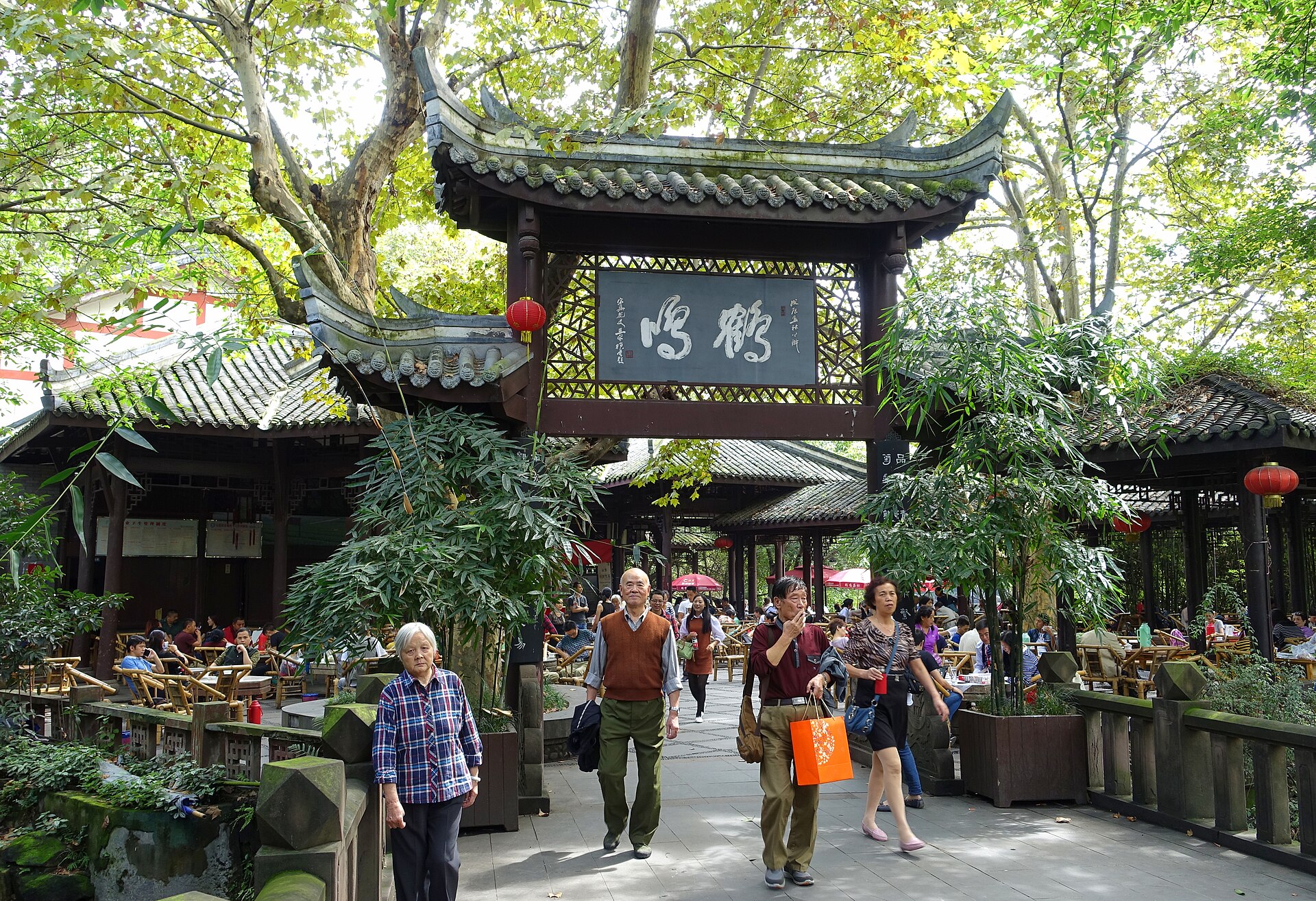
People’s Park and Heming Teahouse
A bamboo chair, a covered cup of jasmine tea, a bowl of sunflower seeds and an hour of doing nothing. The teahouse has been in the park for a century, and the ear-cleaners still work the aisles.
 Start your enquiry
Destinations / Sichuan / Chengdu
A city of fourteen million at five hundred metres, where the plane lands, the kit gets bought and the last flat week of the trip is spent drinking tea in a park.
Explore the guide ↓The Sichuan basin · 500 m
Chengdu sits in the middle of the Sichuan basin, on a plain so level and so wet that it has been engineered for irrigation since the third century BC. The Dujiangyan works, built around 256 BC and still running, diverted the Min river without a dam and turned the plain into the rice bowl of southwest China. UNESCO listed the site in 2000.
The city itself is a rare thing in China: a very large city that is genuinely pleasant to walk in. The old lanes around Kuanzhai and Zhai Xiangzi have been restored rather than rebuilt; the parks are full of people playing mahjong and drinking tea from covered cups; and the food is the reason many travellers come back. It is also the only place on a Sichuan itinerary where you will sleep below 1,000 metres.
Practically, Chengdu is the hinge of every route in this guide. Two airports, a high-speed rail network and the western bus stations all sit here, and the gear you forgot — boots, down jacket, gloves, sun cream — is easier to buy here than anywhere west of it.
Tea, pandas, lanes and one very old irrigation works.
A bamboo chair, a covered cup of jasmine tea, a bowl of sunflower seeds and an hour of doing nothing. The teahouse has been in the park for a century, and the ear-cleaners still work the aisles.
The Chengdu Research Base of Giant Panda Breeding, twenty minutes from the centre, is a research station rather than a zoo. Go at opening: the animals are active before ten and asleep after.
Three parallel Qing-era lanes restored as a pedestrian quarter, plus the surrounding grid of courtyard houses. Tourist-heavy at the centre, quiet two streets out.
The irrigation system that made the plain, an hour by rail from the city. The engineering is the attraction; the temple on the hill above it is the view.
A warm, wet plain with a grey winter.
The best window: 15–25 °C, blossom, and the city at its most sociable. Rain arrives in April and is frequent but light.
Hot and humid, 30–36 °C with the humidity to match, and the monsoon at its height. This is the season to leave the city and go up.
Dry, mild and clear, with October the best month of the year. The osmanthus flowers in September and the whole city smells of it.
Grey, damp and 5–10 °C, with almost no sun and no central heating. Cheap, quiet, and the hotpot season.
Two airports, one rail hub, and the start of the G318.
Tianfu (TFU) handles most international and long-haul flights, 50 km southeast; Shuangliu (CTU) is 16 km from the centre and handles domestic and regional routes. Both are connected by metro.
The metro is extensive, cheap and signed in English. Taxis are metered; the airport run is the only one worth pre-booking. Do not rent a car for the city.
The centre around Tianfu Square for transport, the lanes for atmosphere, and the south around Yulin for restaurants. Two nights is enough before the mountains.
What the city is actually for.
Chengdu drinks tea in public, at length, in parks, with friends and without apology. A covered cup, a thermos of hot water and an afternoon is the local unit of leisure, and it is the single best thing to do in the city.
Face-changing, fire-spitting and a comic tradition that survives on tourism and local affection in equal parts. The hour-long tourist programmes are honestly good; the teahouse performances are better.
Sichuan pepper is not heat but numbness — the ma of ma la. It is what makes the food different from the chilli cooking of Hunan, and it is best met in a hotpot, a bowl of dan dan noodles, or a plate of mapo tofu.
Crowds, humidity and one early start.
The base opens at 07:30 and the animals are active for two hours. By eleven the enclosures are a queue and the pandas are asleep, which is what they do for twenty hours a day.
Entry is by timed reservation and the morning slots go first. We hold them with the rest of the route.
Chengdu has the largest outdoor retail in southwest China, including the Decathlon and the gear streets near the sports university. Anything you forgot for 4,000 metres is available in a morning.
Tell us whether the pandas are non-negotiable and how much of the day you want to spend sitting down. The city rewards the second thing more than the first.
Start my journey brief ↗