The exterior
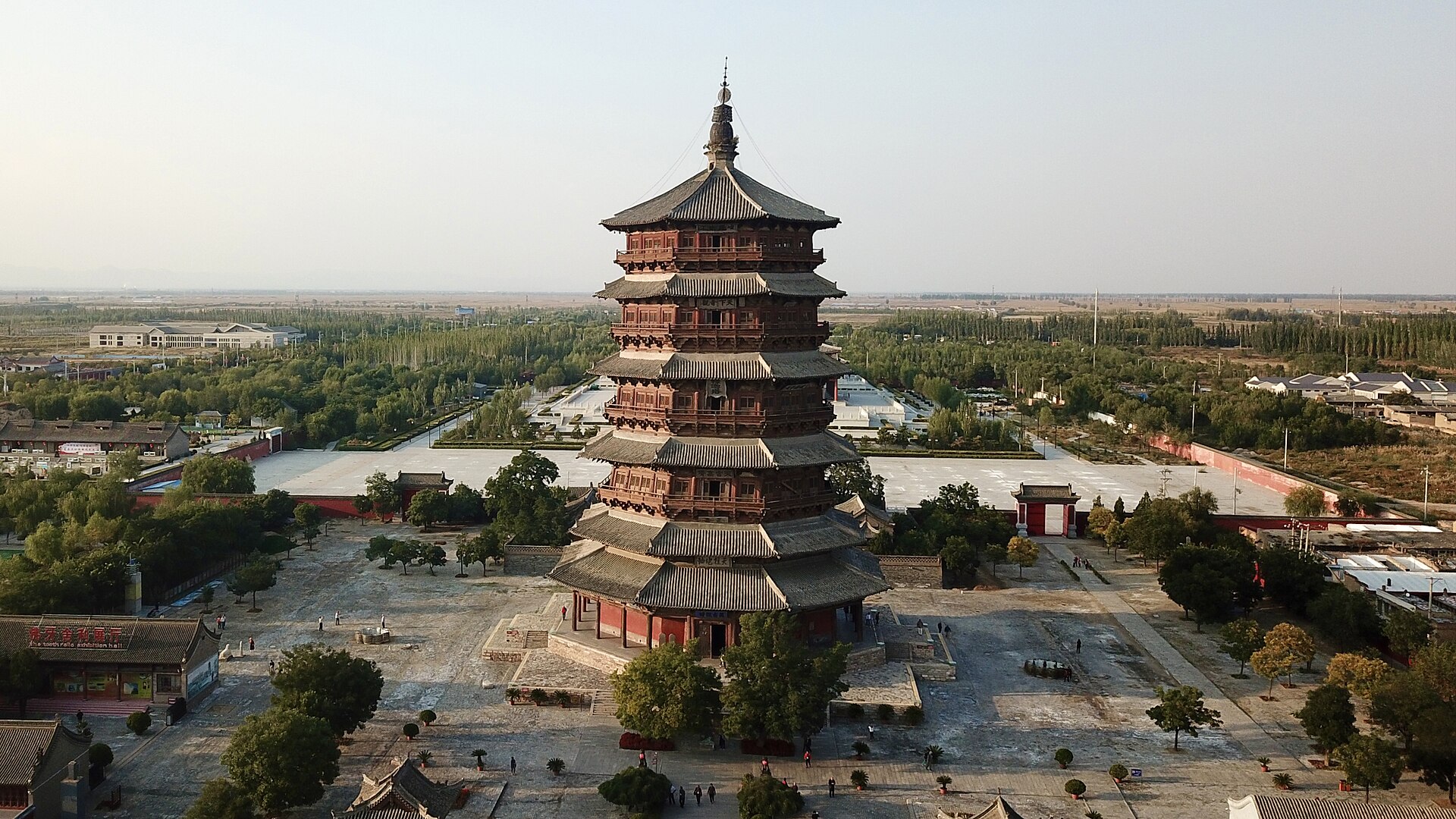
Five visible storeys, each with a deep tiled eave, stepping in as they rise. The silhouette is a column that narrows slowly and then finishes in a spire — read it from the far side of the square, not from the gate.
 Start your enquiry
Destinations / Shanxi / Yingxian
Sixty-seven metres of timber, nine internal storeys, fifty-nine kinds of bracket set, and no iron nail anywhere in the structure. It was built in 1056 and it is still standing, which is the least likely fact about it.
Explore the guide ↓Northern Shanxi · Ying county · 67.31 m
Yingxian is a county town on the Sanggan river plain, sixty kilometres south of Datong, and it has one reason to exist on a travel map. In the north-west corner of the old town stands the Sakyamuni Pagoda of Fogong Temple, built in 1056 under the Liao dynasty, four years before the Norman conquest of England. It is the oldest and tallest all-timber pagoda in the world.
The numbers are the argument. Sixty-seven metres and thirty-one centimetres to the tip of the finial, on an octagonal plan thirty metres across, weighing around 7,400 tonnes. Inside, nine storeys — five visible from outside, four hidden in the structure between them — each with its own ring of columns, so that the whole thing behaves like five stacked timber frames rather than one tall box. Fifty-nine distinct bracket types distribute the load, and the joints are all mortise and tenon.
It has been hit by earthquakes, shelled in a civil war, and left without maintenance for centuries at a time. In 2016 the Guinness records people certified it as the tallest wooden pagoda in the world, which is a strange thing to need certified after 960 years of standing there.
The tower outside, the figures inside, and the town around it.
Five visible storeys, each with a deep tiled eave, stepping in as they rise. The silhouette is a column that narrows slowly and then finishes in a spire — read it from the far side of the square, not from the gate.
A seated Sakyamuni in clay, six metres across the shoulders, with two attendant figures and a painted halo. The scale is set by the room, and the room is set by the tree trunks.
Dougong in fifty-nine distinct configurations, several found nowhere else. They project in tiers and act as shock absorbers, which is the reason the tower has outlived every stone building of its era.
Fifty-two tablets hang on the tower, from the Ming emperors Zhu Di and Zhu Houzhao among others. “Jiji Shengong” — “workmanship beyond human skill” — is the one to look for above the south door.
The tower leans slightly, most visibly at the second storey, from centuries of uneven settlement and the 1926 shelling. It has been monitored since the 1990s; the lean is stable but the tower is closed above the first floor.
A small Liao temple a block north-east of the pagoda, with a main hall from 1124 and a set of Ming wall paintings. Almost nobody goes, and it takes twenty minutes.
The plain is hot in summer and hard and clear in autumn.
Dry, 15 to 27 degrees, with long clear evenings. The square is empty on weekday mornings and the light on the timber is warm.
Hot, 28 to 33, with the rainy season. The pagoda is a quick visit and the town has little shade; this is the least comfortable season.
The best window: 8 to 22 degrees, dry air, and the plain turning. October light is low enough to show the eave shadows on the upper storeys.
Cold and often hazy, minus 12 to minus 20 in January. Snow on the tiled roofs is the best photograph of the year and the square is empty.
An hour on site, half a day with the town.
Yingxian is on the road between Datong and Mount Wutai, about seventy minutes from Datong and ninety minutes from the Wutai basin. No railway station of use; a car is the practical way.
The pagoda is closed above the ground floor, so an hour covers the interior, the plaques and the square. Add twenty minutes for Jingtu Si and an hour for the old streets.
The natural pairing is Datong in the morning, Yingxian at midday, Wutai in the evening, or the reverse. It breaks the four-hour drive between the two better than any service station.
The square south of the pagoda gives the full height; the lane on the west side gives the lean. Late afternoon in autumn is when the west face is lit.
Why timber survived a thousand years of earthquakes.
Five separate ring frames stacked on each other, linked by the hidden storeys. Each frame can move slightly against its neighbours, so the building flexes rather than resists.
Fifty-nine dougong types act as a flexible joint between column and beam. In an earthquake they slide and absorb; in a stone building the same energy cracks the masonry.
Between each visible storey is an inner level of straight beams and diagonal braces — a stiffening ring. From outside they are invisible, which is why the tower reads as five storeys and behaves as nine.
A short visit, a closed upper floor, and soft wood.
Since 2011 only the ground floor is open, and the closure is not likely to lift soon. Do not plan the trip around climbing it.
The timber is original and the surface is soft. Barriers and ropes are there to keep hands off, and the guards enforce it.
Yingxian is a working county town with a wide new street and a small old quarter. The pagoda square is the only reason to linger; two hours is generous.
Spring dust and winter haze both cut visibility. If the pagoda is the purpose, aim for September or October.
An hour on the square, twenty minutes at Jingtu Si, and back on the road. It is a stop rather than a destination — but it is the single best building in north China, and it takes almost no time.
Start my journey brief ↗