Tianxian Gate
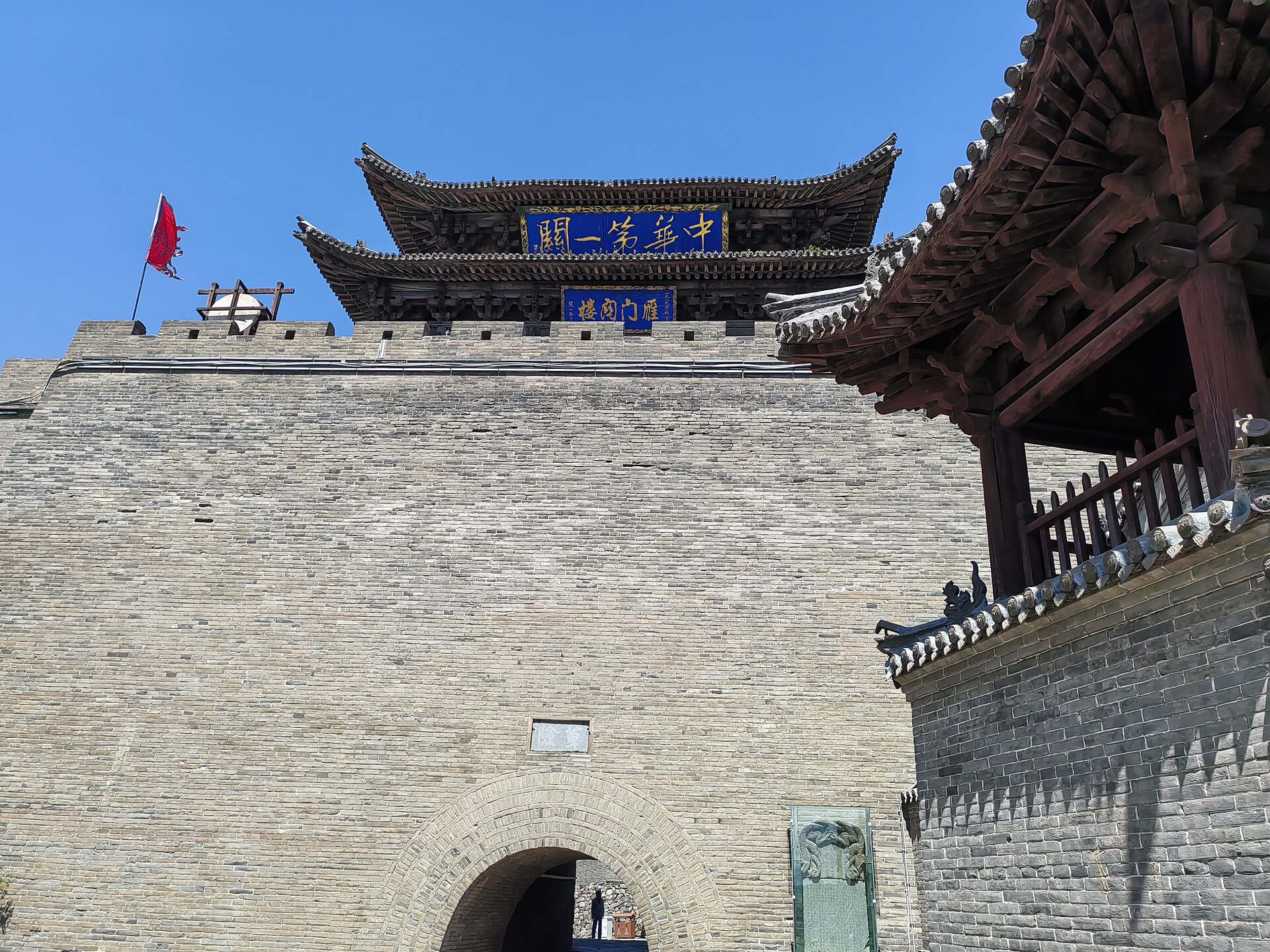
The main gate, with a 10-metre brick wall, a stone arch and a double-eaved tower above it. The plaque over the arch reads “Tianxian” — natural barrier. The tower is the one in the photograph above.
 Start your enquiry
Destinations / Shanxi / Yanmen Pass
The pass on the road from Taiyuan to the steppe, rebuilt in 1374, with 5,033 metres of Ming wall running along the ridge beside it. Chinese military writing calls it the first of the nine frontier passes.
Explore the guide ↓Northern Shanxi · Dai county · 1,800 m
The Yanmen gap is a break in the Hengshan ridge where a river valley gives a road from the Taiyuan basin up onto the Mongolian plateau. It is not the only pass through the northern mountains, but it is the shortest and the easiest to supply, which is why every dynasty that held the north fortified it and every army that wanted the basin came through it.
The present pass was moved to its current site in 1374, when the Ming rebuilt the frontier after expelling the Mongols. The fortification is three concentric works: a small walled town 1 kilometre round with 10-metre walls, an outer circuit that follows the ridges for more than 5 kilometres, and, outside that, three large stone barriers and twenty-five smaller ones. Gates face east, west and north; the east one, Tianxian, carries a double-eaved tower and a plaque reading “the first pass under heaven”.
What makes the site legible is that the wall runs away from the gate up the ridge in both directions, over ground that has not been built on. The section to the west, called Baicaokou, is 5,033 metres of Ming wall at 6 to 8 metres high, with a tower or beacon every 120 metres. It is one of the best-preserved stretches of original wall in the country, and almost nobody walks it.
Six parts of one defensive system.
The main gate, with a 10-metre brick wall, a stone arch and a double-eaved tower above it. The plaque over the arch reads “Tianxian” — natural barrier. The tower is the one in the photograph above.
The second gate, plainer, with the site of a shrine to Yang Liulang — the Song general who held this pass — in the tower above. The two gates are 200 metres apart inside the town.
A small walled enclosure in front of the north gate, so that attackers who broke through were trapped in a courtyard under fire from three sides. The plaque here carries the couplet about the nine passes.
The wall that runs up the ridges on both sides of the gate and closes behind the town. Stone faced, following the rock, with a gate at the northern end.
Beyond the outer wall, three heavy stone walls and twenty-five lighter ones blocked the side valleys. Most survive as footings; the pattern is visible from above.
Two Ming garrison towns north of the pass — Xin Guangwu and Jiu Guangwu — with walls, streets and a drum tower, largely un-restored and mostly empty.
The Baicaokou stretch, and how to walk it.
The best-preserved Ming wall in the region: 6 to 8 metres high, 5 metres at the base, 3 at the top, following a ridge west of the pass with a tower or beacon every 120 metres.
No new brick, no handrails, no ticket booth. Some sections are eroded to a spine of rubble; the walk is on the wall itself, not beside it.
A full traverse takes most of a day with a car at each end. The middle third is the most intact and can be done in two hours from the pass.
From the wall the ground falls north to the Sanggan basin, and the road through the pass is visible as a single line. This is the view the garrison was paid to watch.
May to October, and the wall is best in the last hour of light.
Dry, 14 to 26 degrees, clear air. The best months for the wall walk: the ground is firm and the ridge is green.
Warm and wet, with thunderstorms on the ridge. The wall is exposed and there is no shelter; go early and be down by mid-afternoon.
The best window: 10 to 22 degrees, hard clear light, and grass turning on the ridge. October is the most reliable month of the year here.
Cold and windy, minus 12 to minus 20, with snow on the north faces. The pass is empty and the wall reads clearly against snow, but the walk needs care.
Half a day for the pass, a full day with the wall.
Twenty kilometres north of Dai county town, two hours from Taiyuan and ninety minutes from Datong. High-speed rail stops at Dai county; the pass is twenty minutes by taxi from the station.
Tianxian gate, the town, Dili gate, the barbican, and the first kilometre of wall up the ridge. Two to three hours at an easy pace.
Drive to the west end of Baicaokou, walk east to the pass, and have a car waiting. Four to five hours, with 300 metres of up and down and no water on the ridge.
Dai county town has a Ming Confucian temple and the Bianjing tower, a large drum tower on the old axis, ten minutes from the station. Half a day more if you want both.
Two thousand years of the same argument.
Yanmen means the gate of the wild geese — the point where the birds turned back on their migration north. The metaphor for the edge of the settled world was already old when the Ming rebuilt it.
Li Mu of Zhao beat a Xiongnu army here; Wei Qing and Huo Qubing rode north from it under the Han; Yang Ye held it for the Song. Almost every northern campaign in Chinese history has a sentence about this pass.
The phrase “of the nine frontier passes under heaven, Yanmen is the first” is carved over the north gate. It is a claim made by the garrison, not by a geographer — which is the most honest kind of inscription.
Wind, stone stairs and a wall with no shade.
The pass funnels wind. Even in summer, the ridge is 5 to 8 degrees colder than the basin and the wind is constant. A shell is necessary.
Loose brick, broken edges and drops of several metres on the outer face. Walk the crown, not the parapet, and do not walk it in rain.
Nothing on the wall between the pass and the west end. Two litres per person, and no shade anywhere on the traverse.
One ticket covers the pass and the wall immediately above it; the Baicaokou traverse is outside the ticketed area and needs a car and a local arrangement.
Half a day for the pass itself; a full day if you walk the Baicaokou wall, which is the reason to come. Sleep in Dai county, start at the west end, and finish at the gate in the last hour of light.
Start my journey brief ↗