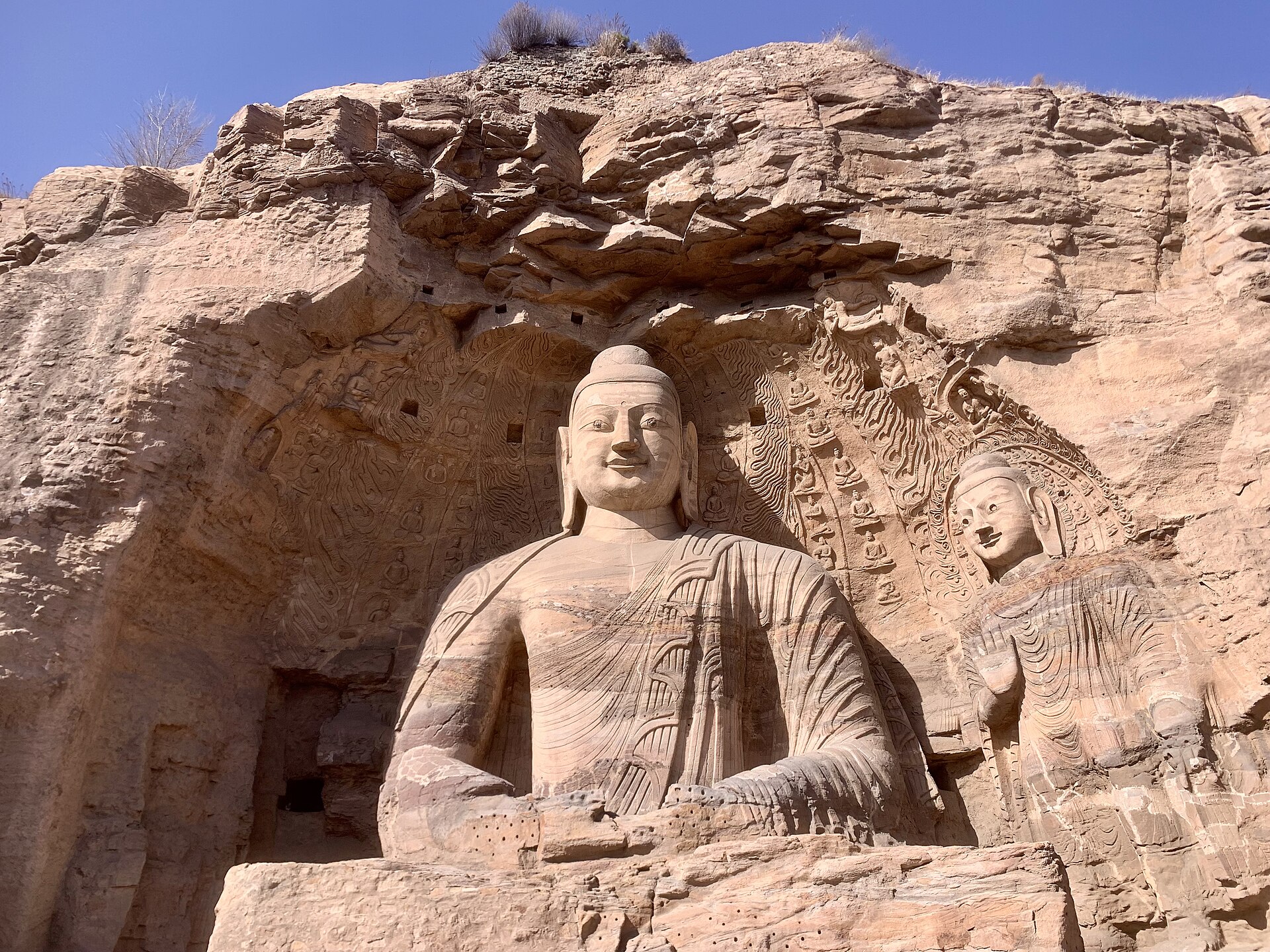
Cave 20
The most photographed figure in the complex: a seated Buddha with the front wall of its cave collapsed, open to the sky since the Liao. Broad shoulders, a faint smile, and drapery cut in hard regular folds.
 Start your enquiry
Destinations / Shanxi / Datong
A frontier city that was a capital twice, and left two things behind: 51,000 Buddhist figures cut into a sandstone cliff in the fifth century, and a temple of forty rooms pinned to a cliff face sixty metres above a gorge.
Explore the guide ↓Northern Shanxi · the Yungang cliff · 45 caves
Datong sits on the northern edge of the loess plateau at 1,050 metres, on the road between the Yellow River and the Mongolian grassland. The Northern Wei made it their capital in 398 and held it for ninety-six years; the Liao made it a secondary capital; the Ming made it a garrison town on the inner wall. Each of those administrations left something enormous, and the largest thing is the cliff.
The Yungang caves run for a kilometre along the south face of Wuzhou Shan, seventeen kilometres west of the city. Cutting began in 460, under the monk Tanyao, with five caves each holding a colossal Buddha — the so-called Tanyao caves, 16 to 20. The programme continued for sixty-four years and stopped when the court moved south to Luoyang, which is why the caves read as a sequence: heavy, foreign-looking figures at the start, increasingly Chinese faces and Chinese clothing towards the end.
Forty kilometres south-east, in a narrow gorge below Mount Heng, is the second thing: a monastery built in 491 against a cliff, held up by beams let into the rock. It has survived 1,500 years of earthquakes, and it is the only temple in China that houses Buddhist, Taoist and Confucian shrines under one roof.
Five caves to understand the rest.
The most photographed figure in the complex: a seated Buddha with the front wall of its cave collapsed, open to the sky since the Liao. Broad shoulders, a faint smile, and drapery cut in hard regular folds.
A seated Buddha inside a two-storey timber front built in 1651, with a body that fills the cave from floor to ceiling. The scale is only legible from the back of the room.
A square cave with a central pillar and 33 relief panels telling the life of the Buddha from birth to enlightenment, carved in a continuous narrative band around the walls.
A ceiling crowded with celestial musicians playing lutes, harps, flutes and drums — a catalogue of fifth-century instruments, several of which survive nowhere else in depicted form.
The Tanyao caves: five colossal figures, each associated with an emperor of the Northern Wei, in a style that still carries Gandharan and Central Asian weight.
West of cave 20, some two hundred small caves cut by officials and merchants after the court left, with slender figures and long necks — the beginning of the Chinese Buddha image.
Forty rooms on a cliff, held by beams rather than columns.
The whole monastery occupies 152.5 square metres of floor plate on a cliff face, in 40-odd rooms on three levels. The beams are set two-thirds into the rock; the visible columns below carry almost nothing and are there to reassure.
The floor of the lowest gallery is now 58 metres above the valley, not the 90 it was when built — the river bed has silted up over fifteen centuries. The cliff above and the gorge below are the whole design.
The highest hall holds statues of the Buddha, Laozi and Confucius side by side. It is the only surviving temple in China where the three traditions share a single building.
The temple sits in the Jinlong gorge between the two main peaks of Mount Heng, the northern sacred mountain. The walk in from the car park is ten minutes and the scale only makes sense from below.
What else the frontier capitals left.
A Liao monastery inside the city wall with a main hall from 1140 and, in its lower hall, a set of Liao clay figures in a sunken box that is one of the strangest interiors in China.
The other Liao foundation, larger and quieter, with three halls in a row and a set of 24 heavenly kings. Less visited than Huayan and in some ways better preserved.
The Ming wall was rebuilt in the last twenty years over its original line — 7.2 kilometres, with gates and towers. New brick on old foundations: walk it at dusk for the view over the roofs.
A Ming glazed screen in front of the old prince’s palace, 45 metres long, with nine dragons in coloured tile. Five minutes from Huayan Si and worth the detour.
May to October; the caves are cold in winter but empty.
The best weather: 15 to 26 degrees, dry, clear. Windy in May, which is also when the loess dust blows. The caves are at their best in low morning light.
Warm to hot — 28 to 32 degrees — with the rainy season. The advantage is that the cliff faces south and stays dry; the disadvantage is the holiday crowds in the first week of October and through July.
The best month. 10 to 22 degrees, hard clear light, and the sandstone reads at its sharpest. The first week of October is a national holiday and the caves hit their visitor cap early in the day.
Cold: minus 10 to minus 18, with coal-season haze. The caves are nearly empty and the low winter sun rakes across the figures. Snow on the cliff is worth the cold.
One day for the caves, half a day for the temple and the town.
Datong has an airport and a high-speed rail station on the Beijing–Taiyuan line, about two hours from Beijing. The grottoes are 17 kilometres west of the city, twenty minutes by taxi.
Caves 5, 6 and 20 are the three that matter, and they are spread over a kilometre. Two to three hours at an easy pace, more if you read the panels in cave 6.
Sixty-five kilometres south-east of Datong, ninety minutes by road, on the way to Mount Heng. Entry is timed and the galleries are narrow; an hour on site is enough, two with the gorge walk.
The usual shape is caves in the morning, Heng Shan and the hanging temple in the afternoon, back in Datong for dinner. A car and driver for the day is the practical arrangement.
Sandstone, stairs and a timed ticket.
The sandstone is soft and the surfaces are already sugaring. Barriers are there for a reason; flash is banned inside the caves and tripods need permission.
Go to cave 20 first, before the tour groups, then work east. Cave 5 and 6 have the longest queues and the timber front holds the crowd in.
Steep, narrow, and one-way in places. Not suitable for anyone uneasy with heights or unsteady on stairs; the gorge view from below needs no ticket.
The city is at 1,050 metres and spring dust storms are real. A mask is useful in April, sunglasses all year.
One full day: the Yungang caves in the morning, the hanging temple and Mount Heng in the afternoon, Huayan Si at dusk. Two nights in Datong is the comfortable shape; one is possible if you start early.
Start my journey brief ↗