North terrace — Yedou
The highest ground in north China, with the temple of Lingying Si on top, a small black pool that never dries, and 190 days of gale a year. Usually reached by road from Hongmenyan; the walk up takes three hours.
 Start your enquiry
Destinations / Shanxi / Wutai Shan
Five flat summits arranged in a ring, the highest at 3,061 metres, and inside the ring a town of temples. Two of the halls on the mountain are the oldest wooden buildings in China, and one of them settled a century-old argument about whether Tang architecture survived at all.
Explore the guide ↓North-east Shanxi · Xinzhou · 3,061 m
Wutai is a massif of five plateaux — east, south, west, north and centre — set around a basin at roughly 1,700 metres. The name means exactly that: five terraces. The rock is among the oldest in China, metamorphic beds laid down more than two billion years ago and lifted into a dome, which is why the summits are rounded and grassy rather than pointed, and why the mountain has been used as a reference section for Precambrian geology.
The religious logic is equally geometric. Each terrace holds a temple and a manifestation of Manjushri, the bodhisattva of wisdom, so that walking the circuit — the great pilgrimage, sixty kilometres and three or four days on foot — traces a closed figure rather than climbing to a single point. Pilgrims have walked it for a thousand years. In the basin below, the town of Taihuai holds the density: dozens of working monasteries, Han and Tibetan Buddhism side by side, yellow roofs and grey ones within a hundred metres of each other.
The mountain matters architecturally for a separate reason. Two halls outside the ring survived the persecution of Buddhism in 845 and every rebuilding campaign since: the main hall of Nanchan Temple, dated by an inscription to 782, and the east hall of Foguang Temple, dated to 857. The second was identified in 1937 by Liang Sicheng and Lin Huiyin, who found the donor’s name painted on a beam and matched it to a stone pillar outside. That is where the argument that no Tang building survived in China ended.
Clockwise from the north, and how long each one takes.
The highest ground in north China, with the temple of Lingying Si on top, a small black pool that never dries, and 190 days of gale a year. Usually reached by road from Hongmenyan; the walk up takes three hours.
The sunrise terrace, looking east over the plain. A one-hour climb from the road head, with the temple of Wanghai Si at the top and a view that on a clear morning runs a hundred kilometres.
A broad grassy dome covered in angular boulders — a periglacial pavement, formed by freeze and thaw. The temple of Yanjiao Si stands in the middle of it.
The quietest of the five and the best for stars: no town within sight, and a temple, Falai Si, that keeps a few rooms for pilgrims.
The lowest and warmest terrace, named for its summer meadow. The walk between the south and centre terraces is the easiest leg of the circuit, two hours across open grass.
The full clockwise walk, staying in temple guest rooms. Doable without a tent between June and September; the northern legs are exposed and the weather changes fast.
What is inside the ring, and the two halls outside it.
Thirty metres long, seven bays, with eaves that project almost four metres and bracket sets the size of a small tree. Tang proportions, Tang colour, and a set of Tang clay figures still on the platform inside.
A single hall, three bays wide, on a low platform: the oldest dated wooden building in China. Small, plain and easy to walk past, which is roughly why it survived.
The Tibetan-style white pagoda at 56.4 metres is the image of the mountain: a bulbous white body, thirteen rings and a gilt finial, with a temple wrapped around its base.
Traditionally founded in 68 AD, in the reign of Mingdi of the Han — the first Buddhist temple on the mountain. The present halls are Ming and Qing, including a hall of bronze and one built entirely without beams.
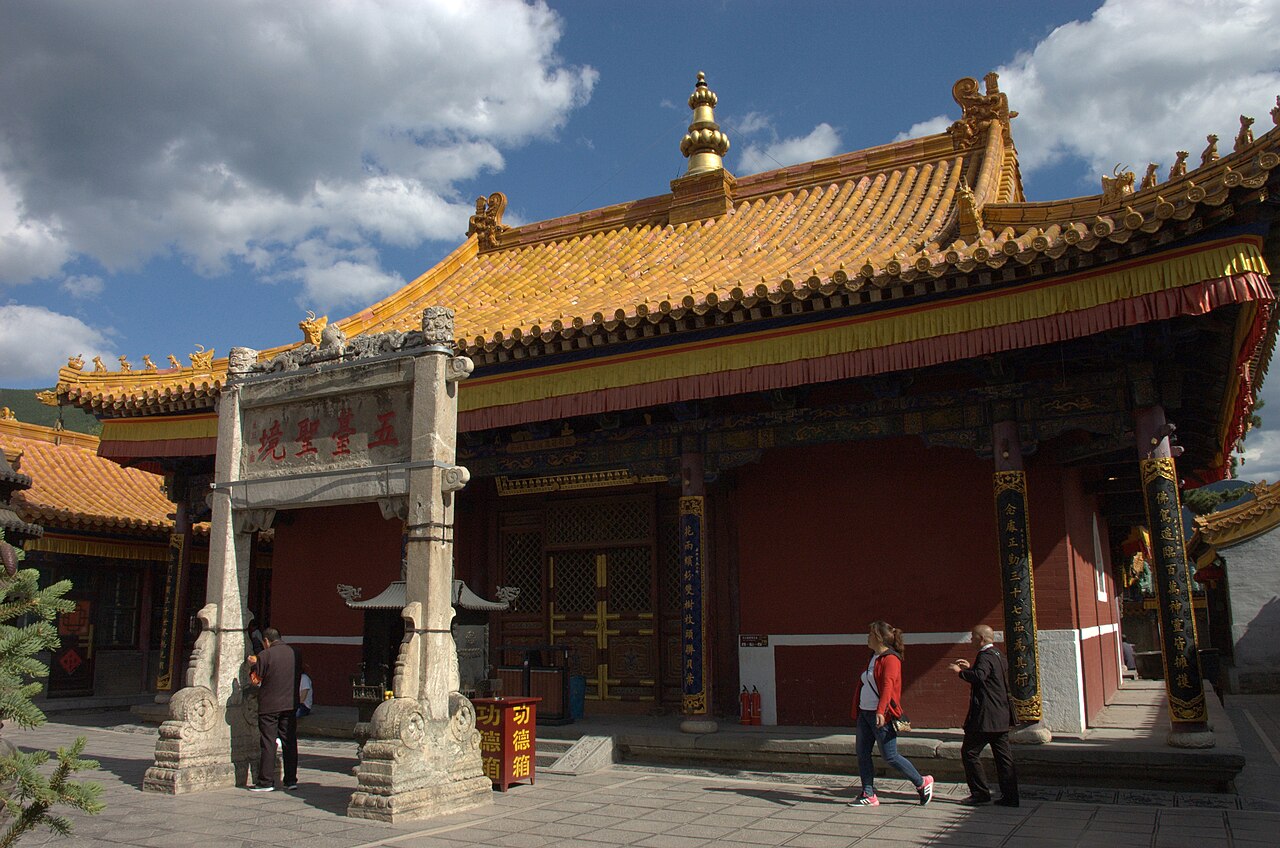
The Qing imperial temple at the top of a flight of 108 steps, with golden tiles, Tibetan inscriptions, and the four-language plaque over the gate. The photograph at the top of this page is its main hall.
The hilltop temple east of town with a compact set of five Manjushri figures, so that a pilgrim with one day can complete the circuit in miniature: the “small pilgrimage”.
June to September, and one cold clear week in October.
The pilgrim season: 15 to 22 degrees in the basin, meadows out, and the whole mountain working. Rain comes as afternoon storms; mornings are usually clear. This is also the busiest time and the time to book rooms in advance.
The best window. Air clears, the grass goes gold, daytime temperatures sit at 10 to 18 degrees, and the crowds thin after the first week of October. Snow is possible on the north terrace from late September.
Cold and windy but quiet. The basin is green, the terraces are still brown, and the temples are close to empty. The north terrace road may still be closed by snow.
Winter: minus 15 to minus 25 on the summits, and the north terrace usually shut. The basin temples stay open and are at their most atmospheric in snow, with almost no visitors.
Two days for the basin, three or four for the circuit.
Taiyuan to Taihuai is about three hours by road; the nearest airport is Wutaishan (about two hours). There is no railway to the basin — the station called Wutaishan is 50 kilometres away and on the wrong side of the mountain.
Taihuai is walkable. Xiantong, Tayuan and Pusading are within fifteen minutes of each other; Dailuoding is an hour up steps from the east end of town. Two nights covers the core without rushing.
Foguang and Nanchan are outside the ring, forty and fifty kilometres south-west of Taihuai on the road to Doucun. They need a car and most of a day, and they are the reason to add a day rather than a morning.
Three to four days clockwise, 60 kilometres, with guest rooms at each terrace temple. Not a technical route but a high one: the northern legs are above 2,800 metres, exposed, and can hold snow in any month.
Why two small halls matter more than the gilded ones.
Nanchan’s main hall carries an inscription from the third year of the Jianzhong era. It is three bays wide, with a single roof and a low platform, and every part of it — the bracket sets, the curved purlins, the door frames — is Tang. Nothing earlier survives in China.
Foguang’s east hall is the building Liang Sicheng came looking for in 1937, following a wall painting at Dunhuang that showed a temple called Dafoguang. He found the name on a beam, and a stone pillar outside carrying the same donor’s name and the date.
Emperor Wuzong’s suppression destroyed some 4,600 monasteries. Wutai’s two Tang halls survived because they were small, remote and off the main pilgrim road — an accident of geography that left China its two oldest wooden buildings.
Altitude, cold, and a mountain with its own weather.
The basin is 1,700 metres and the terraces run to 3,061. Coming straight from Beijing or Taiyuan, the first night can be broken sleep. Walk the terraces on day two, not day one.
The north terrace freezes at night even in July, and the wind is constant. A shell, a warm mid-layer and gloves belong in the bag from June to September.
Photography inside halls is usually forbidden and always worth asking about. Walk clockwise around stupas and prayer wheels; do not point at images. The mountain is a working religious site, not a museum.
The north terrace road closes with snow, sometimes for weeks. The circuit’s northern legs are the ones affected. Local advice at Taihuai is more reliable than any published schedule.
Two nights in Taihuai for the temples and the white stupa, one long day south-west for Foguang and Nanchan, and a third night if you want the north terrace at sunrise. The circuit needs three more days and better legs.
Start my journey brief ↗