The stage
The first building inside the gate, half open and half closed, with a double roof at the back and a single one at the front. Eight jars were buried under the floor to amplify the actors.
 Start your enquiry
Destinations / Shanxi / Jinci
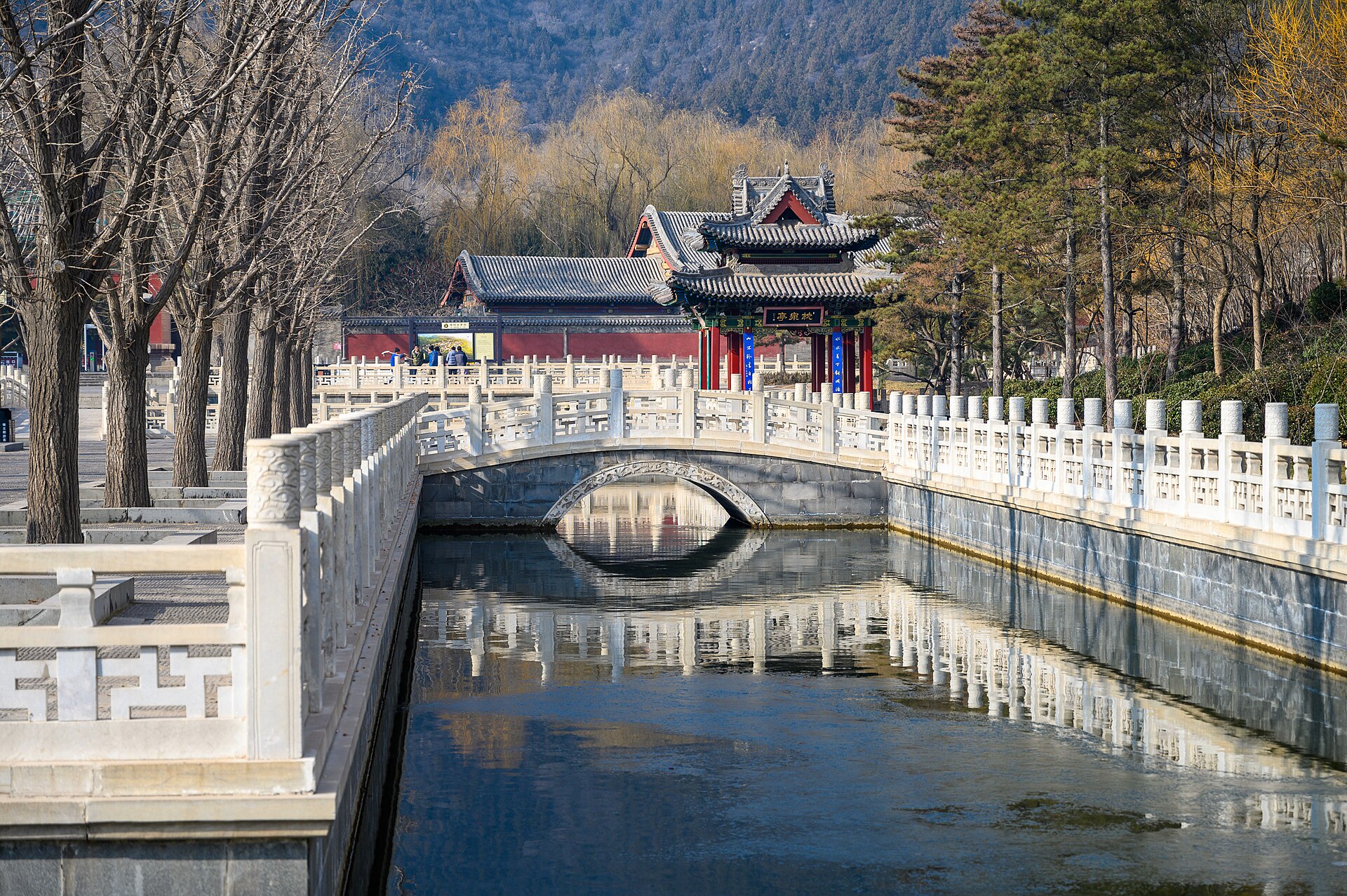
A temple at the source of a spring, with a Song hall on a stone platform, a cross-shaped bridge over a fish pond, and forty-three painted clay attendants who have been standing in the same room since the eleventh century.
Explore the guide ↓Central Shanxi · Taiyuan · 1023–1032
Jinci sits at the foot of Xuanweng Mountain, twenty-five kilometres south-west of Taiyuan, where a set of springs comes out of the rock at the head of the Jin river. The site is a memorial to Shuyu, the younger brother of the Zhou king, who was enfeoffed here as the first ruler of Jin; the shrine is mentioned by Li Daoyuan in the sixth century, and there was already a hall by the Northern Wei. Every dynasty after that added something.
The result is a compressed architectural history along a single axis, 500 metres long, running east to west up a gentle slope: a Ming stage, a Song bridge, a Jin offering hall, and a Song main hall, with side halls, springs, and old trees between them. Because the site was a shrine rather than a capital, nothing was ever rebuilt on a grand new plan. Buildings from five dynasties stand within a hundred metres of each other, which is why architectural historians use it as a teaching collection.
The main hall is the reason most people come. Built between 1023 and 1032 for the mother of Shuyu, it is 19 metres high, seven bays wide, with a double eave and a colonnade on all four sides — the earliest surviving example of that ring-colonnade plan in China. Eight carved wooden dragons coil round the front columns, added in 1087, and inside are 43 painted clay figures from the same period.
Six things, in the order you meet them.
The first building inside the gate, half open and half closed, with a double roof at the back and a single one at the front. Eight jars were buried under the floor to amplify the actors.
Four cast-iron figures on a square platform, each over two metres tall, guarding the spring. The south-west one carries a date of 1097 and is still bright after nine centuries.
A pavilion-like hall with no walls, only a low balustrade between the columns — built to hold offerings, so it needed light and air rather than enclosure. Rebuilt in 1168 and unchanged since.
A square pond with a cross-shaped bridge over it: 34 octagonal stone columns carrying a flat deck that runs east–west and splays down to the banks north and south. The only bridge of its kind in China.
Nineteen metres high, seven bays, with a double eave and a colonnade. The eight coiled dragons on the front columns are the earliest carved wooden column dragons in the country.
The spring that gave the site its reason, still flowing under a pavilion, and a cypress said to be three thousand years old, leaning at forty-five degrees and propped by a concrete strut.
April to October; the springs and the old trees carry the winter.
The best months. The site is green, the springs are running, the peonies are out in early May, and temperatures sit at 12 to 26 degrees. Weekday mornings are quiet.
Hot in Taiyuan — 30 to 34 — but the site is wooded and the springs cool the air. Afternoon thunderstorms in July and August; go early.
Clear, dry, 10 to 24 degrees, with the old trees turning. The best light of the year on the glazed roofs and the stone bridge.
Cold and quiet, minus 8 to minus 15 in January. The spring runs all year and does not freeze; snow on the roofs is the reason to come in winter.
Half a day from Taiyuan, and the springs are next door.
Twenty-five kilometres from central Taiyuan, forty minutes by taxi or an hour on bus 308. It is easily combined with the Tianlong Shan caves, twenty kilometres further up the same valley.
Two to three hours at an unhurried pace for the axis, the springs, the cypress and the side halls. Add an hour for the Jinci park outside the wall.
Tianlong Shan, with 25 caves cut between the Eastern Wei and the Tang, is a further twenty minutes by road. Half a day for both is the standard pairing.
Coach groups arrive from 9 to 11 and again from 2 to 4. The axis is walkable in the gaps, and the side halls are quiet at any hour.
What the site itself considers essential.
Forty-three painted clay attendants in the main hall, forty-one of them original. Each has a different face, posture and expression — the sculptors were working from life, not from a canon, and it shows.
Nanlao Quan, “the spring that does not age”, named from a line in the Book of Songs. It has supplied the Jin river and the city’s water for two millennia and still flows, though the head has dropped with regional pumping.
The Zhou cypress leans at about 45 degrees, its trunk propped, its crown still green. Along with the spring and the figures it makes up the site’s traditional three wonders — two of them living things.
A museum with ropes, and a real spring.
No flash, no tripods, and no touching. Some halls have a guard and a rope line; the figures are unfired clay and the paint is original.
The bridge deck and the paved courts are polished by nine hundred years of feet, and slick when wet. The steps up the axis are shallow and easy to miss.
The water is not for drinking at the source, whatever the vendors say. Bottled water is available at the gate.
The city has two good reasons of its own — the Shanxi Museum and the twin pagodas at Yongzuo Si — and Jinci fits into a day with either.
Half a day from Taiyuan: two hours on the axis, an hour at the springs and the cypress, and an hour at Tianlong Shan if the light holds. It is the best single site in the province for understanding how Chinese buildings develop.
Start my journey brief ↗