The wall walk
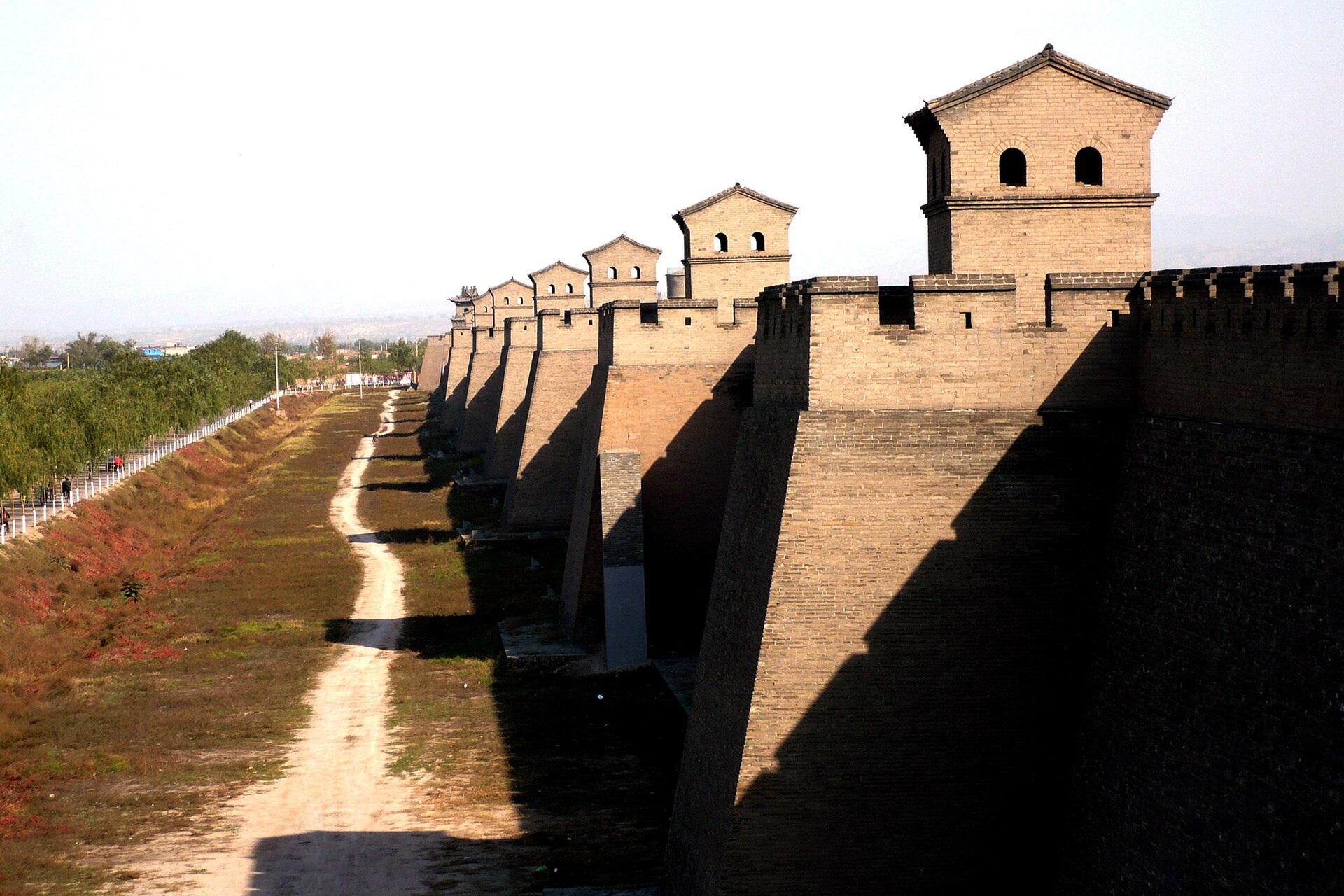
You can walk most of the circuit on top: brick parapet, 72 towers, and a view over 4,000 grey roofs with no modern building inside the line. Best in the last hour of light.
 Start your enquiry
Destinations / Shanxi / Pingyao
A county town that rebuilt its wall in 1370 and then stopped changing. Six kilometres of brick rampart, seventy-two watchtowers, and the courtyard house where Chinese banking began in 1823.
Explore the guide ↓Central Shanxi · Jinzhong · 2.25 km²
Pingyao was founded in the Western Zhou, sometime between 827 and 782 BC, and it has been a county seat ever since. What survives is not that town but its Ming rebuild: in 1370, with the Yuan gone and the northern frontier unsettled, the old rammed-earth wall was replaced in brick, thickened, and given a full set of towers. The town inside kept the layout it already had — four main streets, eight lanes, seventy-two alleys — and because Pingyao stopped being important after the railways came, it also stopped being rebuilt.
The wall is 6,163 metres round, about 12 metres high, with 3,000 crenellations and 72 watchtowers, numbers conventionally read as the 3,000 disciples and 72 worthies of Confucius. Six gates, each with a barbican, give the town its nickname: the turtle city, with the south gate as the head, the north as the tail, and the four side gates as legs. Inside, some 4,000 courtyard houses survive, most of them single-storey, built of grey brick around a paved court with a single-slope roof draining inward.
The reason Pingyao is on the map is money. In 1823 a dye merchant named Lei Lutai converted his shop on West Street into Rishengchang, the first draft bank in China: you deposited silver in Pingyao and drew it in Hankou against a paper draft. Within decades the town held more than twenty such houses with branches across the empire; at its peak the street was handling a large share of the country’s inter-provincial remittances. The buildings that did this are ordinary courtyard houses with heavy doors, which is exactly why they are worth walking through.
Six things, in the order they make sense.
You can walk most of the circuit on top: brick parapet, 72 towers, and a view over 4,000 grey roofs with no modern building inside the line. Best in the last hour of light.
A courtyard house on West Street with a counter, a strongroom and a set of account ledgers. The draft system it invented is explained on the walls in decent English.
A full Qing administrative compound — court, prison, granary, temple — rebuilt and furnished. The largest single building inside the wall and the clearest explanation of how a county was run.
A Song hall on a high platform at the south-east of the town, with the examination hall beside it. Quiet, and the oldest building in Pingyao.
The main streets are shops; the alleys behind them are houses, with stone thresholds, brick screens and door gods. Walk three blocks off South Street in any direction.
Pingyao’s other craft: lacquerware rubbed to a mirror with the palm of the hand, in layers of thirty or more. Two or three workshops still do it and let you watch.
Two temples that most day visitors miss.
A walled temple with more than two thousand painted clay figures from the Song, Yuan, Ming and Qing, packed into a handful of halls. The guardian in the first hall is the one everybody photographs.
The oldest timber hall in Shanxi after the two at Wutai: a Five Dynasties building with a set of Five Dynasties figures, on a quiet road outside the town.
A Qing merchant complex on a hillside, smaller than the Qiao or Wang compounds but with fewer coach parties. Half a day if you want one merchant house.
April to June, September to October, and never the holiday weeks.
The best months: 12 to 26 degrees, dry, long evenings, and the wall walk comfortable. May is the peak of the domestic spring season, so book ahead.
Hot — 30 to 34 — and humid for Shanxi, with rain in July. The courtyards stay cool; the wall at midday does not.
Clear, dry, 10 to 24 degrees. The best light of the year on the grey brick. The first week of October is a national holiday and the town is at capacity; go after the 8th.
Cold, quiet, and cheap. Minus 10 to minus 15 in January, with coal haze. Snow on the roofs is beautiful and the wall is empty.
Two nights inside the wall, one day for the town.
Pingyao has a high-speed station on the Taiyuan–Xi’an line, about thirty minutes from Taiyuan and three hours from Xi’an. The station is 10 kilometres from the old town.
Guesthouses in the courtyards are the point of staying in town; most are conversions with underfloor heating and thin walls. February is cold in them.
One combined ticket covers the wall and about twenty sights over two days; the wall alone has a separate entry at the south and north gates. Check which gates are open that day.
Day one: wall at dusk, West Street, Rishengchang. Day two: the yamen, the temple, the lanes, then Shuanglin Si in the late afternoon. Three days if you add Zhenguo Si and a merchant house.
Stone streets, tour groups and a wall with one exit.
Rough granite setts, uneven for a kilometre at a time. Shoes with a sole, not thin trainers, and expect to walk everywhere inside the wall.
Coach groups arrive between 9 and 11 and leave by 4. The lanes and the wall are close to empty before 8 and after 5, which are also the best light.
There is no shade and no water on the parapet, and the access points are limited. Carry water, wear a hat, and do not start the full circuit after 5pm.
Restaurants on South Street charge tourist prices for tourist food. Two lanes back, the same dishes cost a third and are better.
One night minimum, two better: wall at dusk on day one, the yamen and the lanes on day two, Shuanglin Si in the afternoon. Pingyao is small enough to walk and dense enough to fill two days without a car.
Start my journey brief ↗