Red Stone Gorge
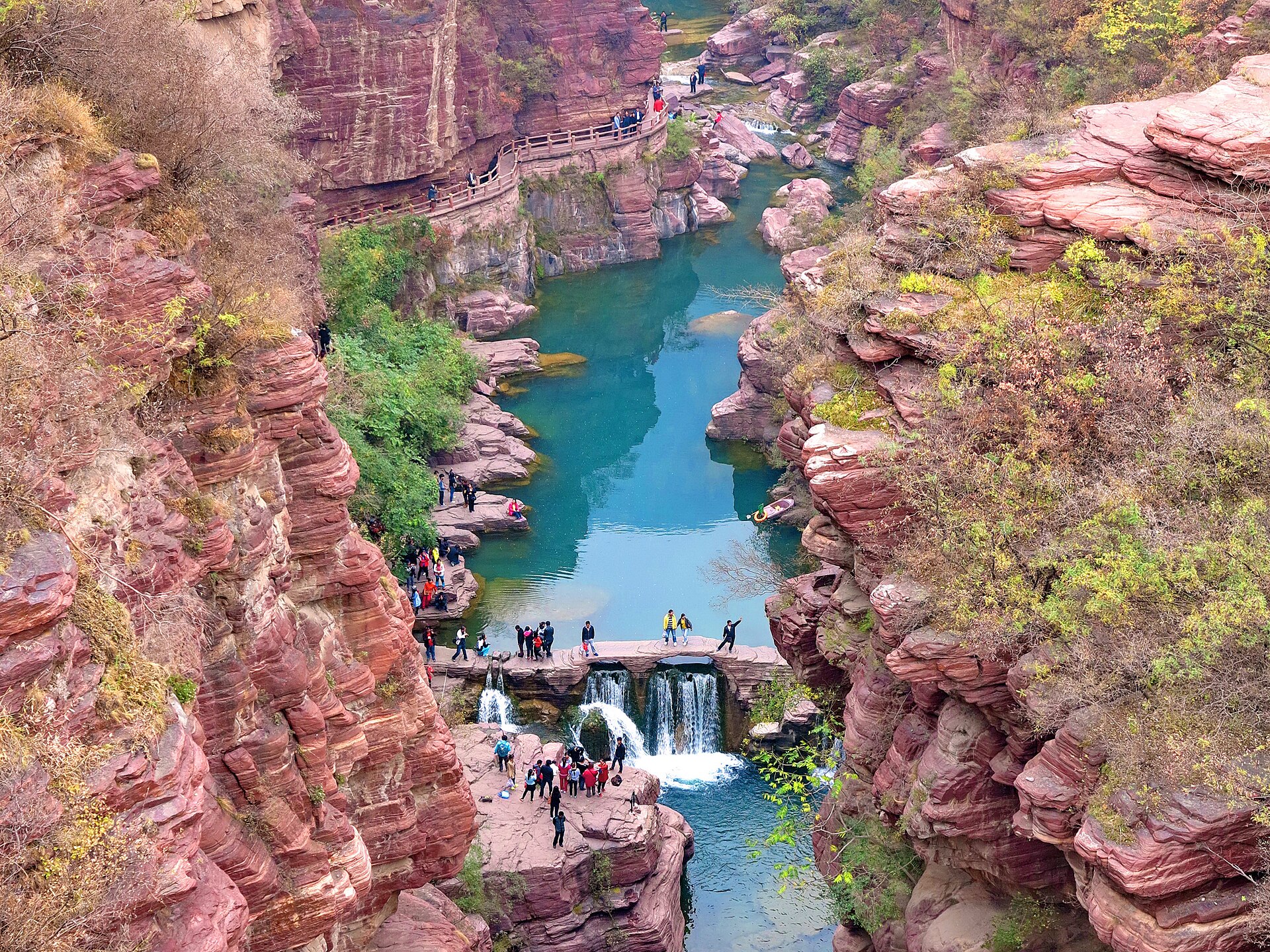
The signature walk: a boardwalk through a slot between red walls, over nine green pools, past a 50-metre fall, all of it one-way. An hour at a walk, longer with the crowds, and wet underfoot throughout.
 Start your enquiry
Destinations / Henan / Yuntai Mountain
A red quartz gorge 1.5 kilometres long and 86 metres deep, a single waterfall of 314 metres at the head of another valley, and a summit at 1,308 that a Tang poet made famous.
Explore the guide ↓Northern Henan · Jiaozuo · 1,308 m
The rock at Yuntai is quartz sandstone laid down in shallow seas between 1.4 billion and 1 billion years ago, with a high iron content that oxidises to the colour the Chinese name describes: red stone. What makes it a landscape rather than a layer is the faulting — the block was lifted and then cut by water along vertical joints, which is why the gorge is narrow, deep and straight-sided instead of a valley.
The result is a park of parallel slots. Red Stone Gorge runs 1.5 kilometres, between five and twenty metres wide, up to 86 deep, with a string of nine pools along the floor and a 50-metre fall at its lower end. Two valleys further north hold the water: Tanpu Gorge, two kilometres of stepped cascades, and Quanpu Gorge, three kilometres ending at the Yuntai waterfall, which drops 314 metres in a single unbroken fall.
Above all of it is Juzhu Peak at 1,308 metres, the summit of the massif, reached by road and then stairs, with a temple on top and the whole plain of northern Henan laid out below. The park was among the first batch of UNESCO global geoparks in 2004, and it is a 5A scenic area, which in practice means: excellent paths, a compulsory shuttle system, and a lot of other people.
The slot, the two water valleys and the summit.
The signature walk: a boardwalk through a slot between red walls, over nine green pools, past a 50-metre fall, all of it one-way. An hour at a walk, longer with the crowds, and wet underfoot throughout.
The valley that ends at the big waterfall: three kilometres of gorge to a single 314-metre drop, in a rock amphitheatre. Best after rain; a trickle in a dry winter.
The gentlest of the three valleys: stepped pools and small falls over a natural staircase of rock, with the best swimming-hole light in the park and the easiest walking.
The top of the massif, with a temple, a stairway through pine, and a view over the plain. The Tang poet Wang Wei is traditionally associated with this summit and the dogwood that gives it its name.
Water in July, colour in October, ice in January.
The best all-round window: green, warm, and the falls running. The gorge is cool even in June because it is deep and shaded.
The heaviest water of the year and the biggest crowds. The waterfall is at its most impressive, the gorge is at its wettest, and the park fills by nine in the morning.
The best light and the most reliable weather, with colour on the upper slopes from mid-October. The peak month for domestic visitors.
Cold and dry. The waterfall drops to a thread or freezes, the gorge keeps its colour, and the park is quiet apart from the January ice weekends.
Jiaozuo in, one gate, and a shuttle between five zones.
Jiaozuo is about 40 minutes from Zhengzhou by high-speed rail, and the park gate is an hour further by road. Many people come from Zhengzhou as a day trip; two days is better.
Private cars stop at the gate. Shuttles run between the zones — Red Stone Gorge, Tanpu, Quanpu, the summit road — and the queues at each transfer point are the real timetable.
Red Stone Gorge first, at opening, before the tour buses; then Quanpu for the waterfall in the afternoon light; the summit on the second morning if you have it.
A gorge with a poetry problem.
The third-century poets and drinkers who withdrew from court politics are said to have stayed at Baijiayan, on the edge of the massif. The tradition is old, the sites are thin, and the association is the reason the park has a literary layer as well as a geological one.
The Tang poet’s most-quoted poem about missing home on the ninth day of the ninth month names the dogwood that grows on this summit. Whether he wrote it here or about a different mountain is disputed; the local claim is confident.
Yuntai means cloud terrace, and the cloud that sits in the valleys on summer mornings is the reason. Come early if you want the version on the posters.
One-way paths, wet feet and the water question.
Red Stone Gorge and both water valleys run one direction in season. You cannot turn round mid-gorge, and the exits are at fixed points. Plan the day around that.
The gorge boardwalk passes under seeps and small falls, and the stone is permanently damp. Grippy shoes matter more here than on any other walk in the province.
The 314-metre fall is a seasonal object, fed by a small catchment and supplemented in dry periods. In winter and in drought years it is not the thing in the photographs. Ask before you build the day around it.
Tell us whether the water or the rock matters more, and whether you can start at opening. At Yuntai the hour you enter decides the day.
Start my journey brief ↗