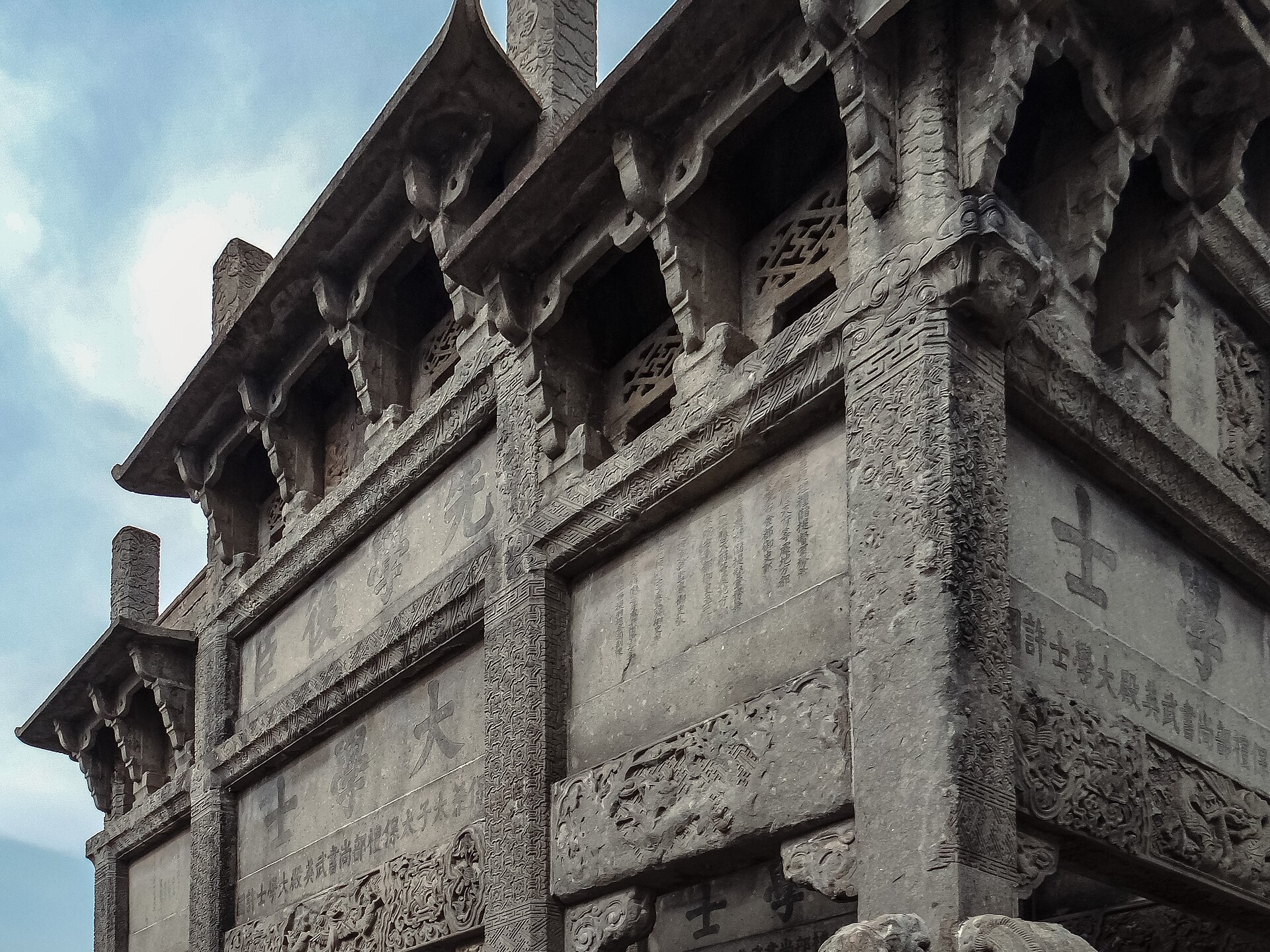
The prefecture city of Huizhou: one walled town inside a county that produced the salt fortunes, the ink, the inkstone, and more stone arches than anywhere else in China.
Huangshan municipality · the old Huizhou prefecture seat
County since
221 BC
Historic city
1986
Xuguo arch
AD 1584
Yuliang weir
143 m long
A county town that was also a provincial capital.
Shexian has been a county since the Qin, and from the Tang until 1912 it was the seat of the prefecture that gave the region its name: Huizhou. That double status is visible in the plan. The county yamen and the prefectural yamen stood inside the same walls, one city inside another, so the old town has two centres, four gates, barbicans, and a street pattern that still reads as two overlapping grids.
The money behind the architecture came from salt. Huizhou merchants controlled the Lianghuai salt trade for roughly four centuries and sent profits home, and the county they built is the result: a thousand years of stone paving, merchant halls with carved beams, ancestral halls in matched pairs, and the memorial arches that the region is known for. Some 250 Ming and Qing arches survive across the county, more than anywhere else in the country.
The old town was listed as a national historic city in 1986, and since 2014 it has been the core of a 5A scenic area that also takes in the villages around it. It is also still lived in. The lanes off the main streets are residential, the shopfronts on the through-road are for local trade as much as visitors, and the best hours are early, before the coaches arrive from Tunxi.
The walled town.
Four things to see inside the walls, in order.
The Xuguo arch
AD 1584 · the only one of its kind
Xu Guo was a grand secretary who had tutored the Wanli emperor, and when he retired in 1584 the emperor allowed him an arch in his home town. Instead of the usual four columns in a line, this one has eight, arranged as a square so that it reads as a gatehouse on all four sides. It is the only surviving example in China. The characters were written by Dong Qichang, Xu’s student and the most influential calligrapher of the age.
Doushan street
Merchant houses · Ming and Qing
A narrow lane of high-walled courtyard houses built by salt families: the Wang, Yang, Xu and Pan compounds, a private school, and a Song well in the middle of the paving. The lane is dark, cool and almost silent, and the doorways give onto exactly the kind of inward-looking courtyard the merchant clans preferred.
The prefecture yamen
Reconstructed · the administrative core
The seat of the Huizhou prefect, rebuilt in the 2000s on the excavated plan after the original was demolished in the twentieth century. The scale is the point: this was the office that governed six counties, and the sequence of gate, courtyard, hall and rear garden is intact.
The bridges
1234 · 1573–1620
Taiping bridge, the long stone bridge south of the wall, was built in 1234 and rebuilt many times; Ziyang bridge, three kilometres downstream, is a nine-arch Ming structure about 140 metres long. Both are still carrying traffic, which is the best thing that can be said about a bridge.
The weir.
The piece of engineering the merchants sailed out of.
What it is
A stone barrage across the Lian river at the southern edge of the town: 143 metres long, 27 metres at the base, 6 metres at the crest, about 5 metres high, with a sloping downstream face. It holds a head of water above it for the wharf and lets the flood season run over the top.
How it holds
The facing stones are granite, laid in courses and locked with dovetail stone keys and vertical dowels, with a stone column dropped through the body of the weir roughly every 1.5 metres. Two low discharge openings near the southern end take the normal flow; in flood the whole crest spills. It is the reason the place is called the Dujiangyan of the south, though the comparison does the local masons no favours — this is a smaller, later and entirely original piece of work.
The record
A weir of brushwood and piled stone was first thrown across the river by the prefect Song Ji in 1221 and rebuilt in stone in 1229. The Ming prefect Zhang Zhen repaired it with public funds in 1449 and again in 1501, and there were further campaigns under the Wanli and Chongzhen emperors and three in the Qing. A small hall on the north bank, the Chongbao shrine, was built to make offerings to everyone who had ever paid for a repair.
The wharf
Yuliang street runs from the weir up to the town gate: a kilometre of stone steps, two-storey shopfronts and the houses of the boat families. This is where the salt and tea cargoes were transferred from river boats to mule trains for the crossing into Zhejiang, and where emigrant merchants took ship and did not come back for ten years. It is now a quiet lane with almost no visitors, and the walk from the arch to the weir and back takes about two hours.
Tangyue.
Seven arches, three hundred years, one family.
The row
Seven memorial arches stand along the old road at Tangyue, eight kilometres west of the town: three Ming and four Qing, built over the best part of three centuries to honour the Bao family’s dead for loyalty, filial piety, chastity and charity, in that order of civic usefulness. They are cut from local dark limestone, jointed without mortar or iron, and they are best seen at an angle so that the whole row recedes at once.
The halls
Behind the arches are two surviving ancestral halls: Dunben hall for the men of the clan, and Qingyi hall, built for its widows, which is the rare case of a separate women’s ancestral hall in China. Both are plain outside and heavily carved within.
Getting there and away
Tangyue is a 20-minute drive from Shexian and usually paired with the town and the weir in a single day. The site is a ticketed scenic area; the fields either side of the arch row are working farmland, not parkland, which is why it photographs so well in early summer.
Before you go.
Two hours, or a full day.
The shape of a visit
The arch, Doushan street and the yamen fill a morning. The weir and Yuliang street take another two hours if you walk both ways. Tangyue is a separate half-day with a car; add Yuliang and it becomes a full one.
Timing
The town is at its best between eight and half past nine, before the day coaches. The weir is best in late afternoon, when the light comes up the river and the stone reads warm rather than grey.
What it is not
This is not a preserved shell. About 20,000 people still live inside the old walls, the through-street carries scooters and deliveries, and some of the reconstruction is recent. Come for the fabric that survives — the arches, the lanes, the weir — rather than for a stage set.
Tell us whether you want the town alone or the town with the weir and Tangyue, and whether you are driving. That decides whether it is a half-day or a full one.