A 585-metre hill of red sandstone, four hundred and fifty kilometres from the nearest other Daoist mountain, that became a royal shrine because an emperor wanted a son.
Qiyun Shan stands about 50 kilometres south of Huangshan and looks nothing like it. Where Huangshan is granite towers and pines, this is a hill of soft red sandstone, its cliffs eaten into caves and ledges by water, with a working village built along the top of one of them. The old name was Baiyue, the white peak, and it is still the name on the temple inscriptions. The mountain is 585 metres at its highest point, which is low enough to walk up in a morning and high enough to sit above the valley cloud.
The rock is the reason the place looks as it does. It is late Cretaceous red bed sandstone, laid down in a fault basin and then cut into gullies and overhangs; the local count is thirty-six named peaks and seventy-two named rocks, all of them small. Soft stone takes a chisel easily, and that fact, more than any doctrine, explains what the mountain became: a surface for carving. There are 537 carved inscriptions and steles recorded here, 305 of them cut directly into cliff faces, the earliest dated to the Northern Song.
The Daoist history starts quietly. A recluse named Gong Qixia lived in the Tianmen cave between 758 and 760 and left nothing behind but a reputation. A shrine to the Dark Warrior was built at Qiyun rock in the 1220s. Then in 1532 the Jiajing emperor, who had been praying for an heir, credited the intercession of the Zhang heavenly master of Dragon Tiger Mountain, who had been installed on this hill, and ordered a palace built. The name Qiyun Shan comes from that grant. The mountain has been a state-sponsored sacred site ever since, and the street of halls on its ledge has been continuously occupied by Daoist families, because the Zhengyi school permits marriage.
The mountain.
Five things worth the climb.
The Zhenxian caves
Carvings · a rock wall of text
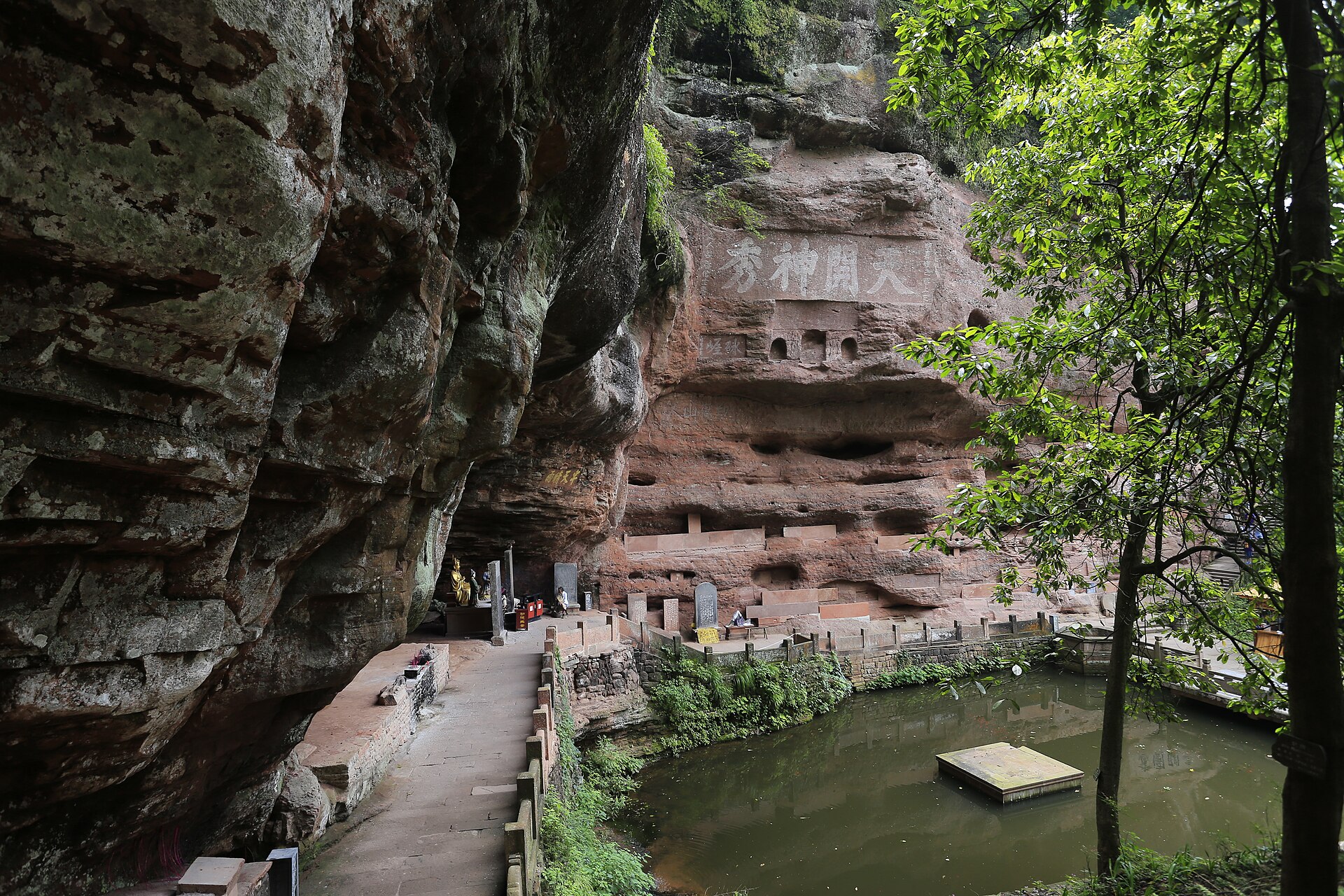
A three-sided recess in the cliff where the overhang has been hollowed into a row of caves, each with its own deity — Eight Immortals, Guanyin, the Dark Warrior, the Dragon King, the god of literature, Buddhist and Daoist and Confucian in one wall. The four characters tian kai shen xiu are cut across the face above them, and a spring-fed pool sits in front.
Yuehua street
The village on the ledge
A single street of white-washed houses and red temple walls along a crescent terrace under the summit, home to about thirty households of Daoist families. Guesthouses, a tea house, and a view over the valley that is the reason to stay the night rather than descend.
Xuansu taishi palace
The imperial hall · 1532
The hall built on the Jiajing emperor’s order, red-walled with a green glazed roof, standing on a stone terrace at the head of the street. Rebuilt more than once after fires and the 1960s, and still the ritual centre of the mountain.
Yuxu palace
The cliff shrine · Tang Yin’s stele
A shrine under the Zixiao cliff on the western side, entered through a three-tiered stone arch about 17 metres high. Inside, a stele carries an inscription composed and written by Tang Yin, the painter, which is the single most quoted document on the mountain.
Incense-burner peak & Xiaohutian
Two small curiosities
A free-standing rock pillar in front of the palace that reads as an altar, and a gourd-shaped cave behind the street with a hall cut into it and dinosaur footprints in the ceiling above — twenty-odd of them, identified in the 1990s.
Getting up.
A cable car, a stone stair, or the two together.
The stone stair
The historic route climbs from Dengfeng bridge at the foot through what are called the nine li and thirteen pavilions: a paved stair with a series of roofed rest houses, roughly four and a half kilometres and about ninety minutes at an unhurried pace. This is the way the pilgrims came, and the way to see the carvings on the lower cliffs.
The cable car
A short line from the base station to just below the street, eight minutes, and the sensible choice if you are carrying a bag or arriving in the afternoon. It does not remove the walk entirely: there are still twenty minutes of steps from the upper station.
Down on foot
The descent is worth doing on the stair even if you rode up. The rock art is concentrated on the way, and the light on the red cliff is best in the last two hours before dusk, when the tour groups have gone.
When to go.
A green mountain in summer, a red one in winter.
March – May
The best all-round window: the cliff is dry, the valley is in leaf, and the days are long. April and May are the pick.
June – August
Hot and humid, with the heaviest rain, but this is when the streams and the pool below the caves actually carry water, and the mountain is at its greenest. Afternoon storms are routine.
September – November
Clear, dry and cool, with the best light on the sandstone and the fewest people midweek. October is the single best month.
December – February
Cold, quiet and cheap, with occasional rime on the cliff and almost nobody on the stair. Some halls close early; the street stays open.
Before you go.
Three things that change the day.
Two tickets, not one
The scenic-area ticket and the cable car are sold separately, and the street’s guesthouses can register you for a multi-day ticket so that a night on the mountain does not mean paying twice. Confirm the current arrangement at the gate; prices here change more often than the timetables.
Stay up, not down
The valley below fills with cloud on maybe two hundred mornings a year, and it is gone by nine. Sleeping on the street is the only way to see it, and the guesthouses are simple but genuinely on the edge.
What is nearby
Xidi and Hongcun are 40 to 50 minutes by road, Huangshan’s south gate about an hour. Qiyun works well as the quiet half-day between the villages and the big mountain, which is how we usually place it.