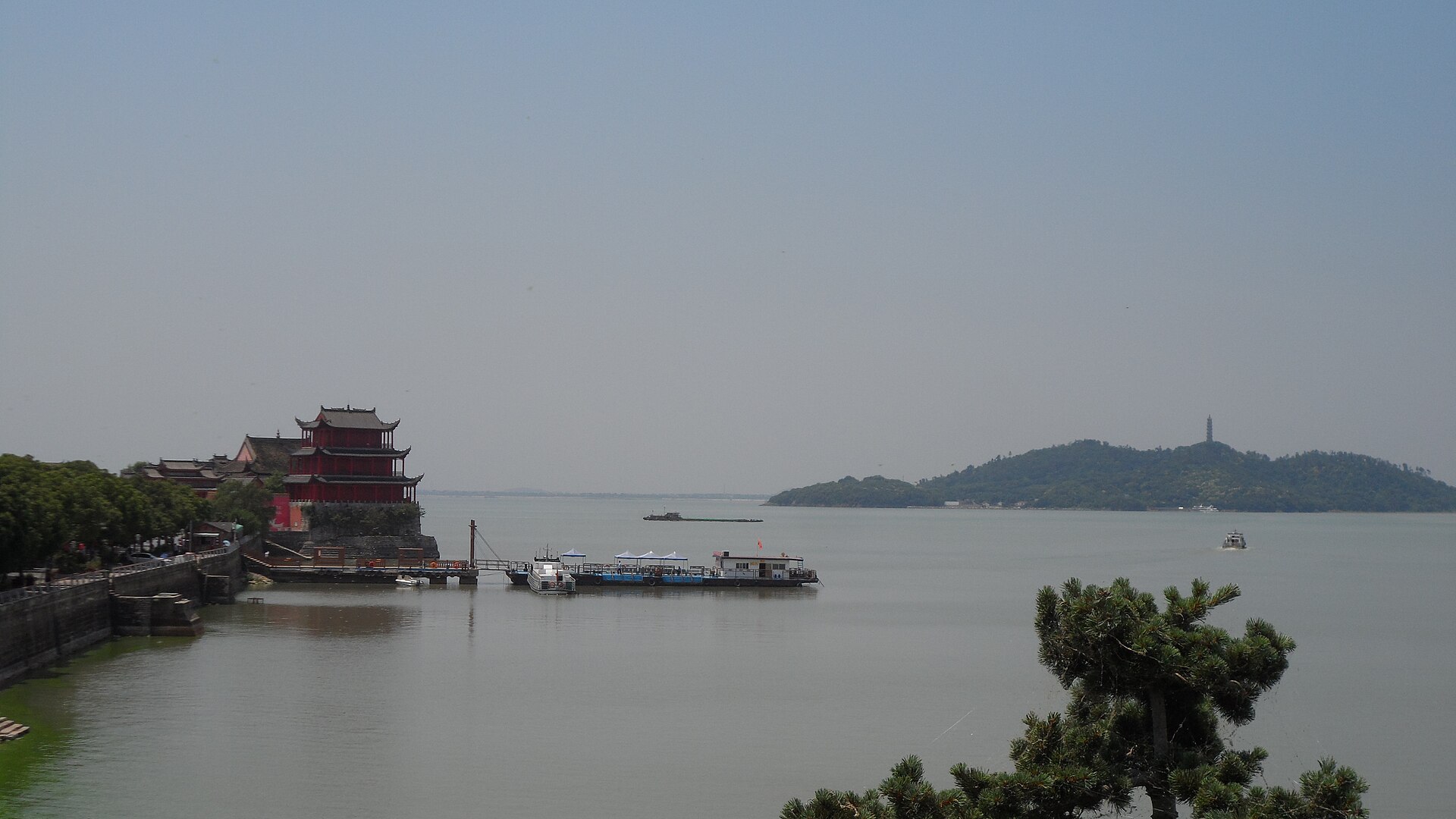
The fifth-largest freshwater lake in China, with a temple on its north shore, a pagoda on its only inhabited island, and a canal town at its southern end.
Chao lake sits in the middle of Anhui, shaped roughly like a bird’s nest, 55 kilometres east to west and 21 north to south. At the normal regulated level of 8.37 metres it covers about 770 square kilometres; at nine metres, closer to 780. It is shallow — an average depth under three and a half metres, a maximum of about eight — and that shallowness is why it is warm, silty, productive and prone to algae, in that order. The basin drains 13,500 square kilometres across five prefecture-level cities, takes in 39 rivers and discharges through the Yuxi river into the Yangtze.
Two dates explain the modern lake. In 1962 a sluice was completed at the outflow, and since then the level has been managed rather than natural: winter low, summer high, kept within a band. In 2011 the lake was transferred whole to Hefei, which made the provincial capital the only one in China to contain an entire one of the five great freshwater lakes. A 156-kilometre ring road around the shore was finished in 2014, and it is now the easiest way to see the lake in a day.
The fishing stopped in 2021, when the lake entered the ten-year Yangtze basin ban. The boats that remain are for visitors. What the ban has done to water quality is a matter of some argument; what it has done to the shoreline is visible — the reed beds are back, and so are the winter waterbirds, which is the quiet reason to come between December and February.
The shore.
Four stops, none of them more than an hour apart.
Zhongmiao
The temple on the headland
A red-walled temple complex on a low spit at the northern shore, built at a point where the rock runs out into the water like the crest of a phoenix. The present halls are Ming in foundation and heavily restored; the terrace behind them is the best place on the lake to look south.
Laoshan island
1.5 km offshore · boats from Zhongmiao
The only inhabited island in the lake: 86 hectares, one hill, a wooded slope, a fishing hamlet and a brick pagoda on the summit ridge. Boats run from the Zhongmiao jetty, ten minutes, weather permitting.
Sanhe old town
The canal town · 40 km south
A river town at the southern end of the lake where three waterways meet, with stone-paved streets, tall narrow houses and the earthworks of an 1858 battle that decided a war. The most interesting place on the lake for anyone who has already seen a temple.
Zimei cave & Wangqiao
Karst · 1,500 m of passage
A cave system in the hills north of the lake with a main passage over 1,500 metres long, and beside it the Wangqiao cave, a small rock-cut Buddhist shrine carved into the cave wall that is the only one of its kind in the province.
The island pagoda.
Two builders, 247 years apart.
The tower
Laoshan pagoda, also called Wenfeng, is a seven-storey octagonal brick tower about 51 metres high, with 133 steps inside, 802 brick-carved Buddha figures set into the walls and 25 inscribed boards. From the top storey the lake runs out flat to the horizon in every direction except the north, where the shore hills stand up.
The first attempt
It was begun in 1631, on the initiative of the prefect of Luzhou, on the strength of a local rhyme that promised the prefecture a top examination candidate once the island had a spire. The magistrate of Hefei supervised the work. Three or four storeys went up and then the money and the dynasty ran out, and the tower stood cut off for a quarter of a millennium.
The finish
In 1878 Li Hongzhang, by then the most powerful official in the empire, paid for the upper stages and sent a colleague from his home county to supervise. The inscribed boards inside are a roll-call of the Huai army that he had built: Li himself, his brother Li Hanzhang, Liu Mingchuan who later became the first governor of Taiwan, and a dozen more. The tower is as much a monument to that army as to the Buddha.
The listing
It was listed as a provincial site in 1998 and as a national one in October 2019, in the eighth batch. The number is 8-0309-3-112, if you are checking.
Sanhe.
Three rivers, one battle, eight old things.
The town
Sanhe means three rivers: the Fengle, the Hangbu and the Xiaonan meet here, and the town grew on the wedge between them, which is why it is a network of canals and stone bridges rather than a grid. It claims 2,500 years, and the local inventory of what survives is called the eight olds — old river, old bridge, old embankment, old street, old houses, old tea house, old opera stage and old battlefield.
The battle
In November 1858 the Taiping commanders Chen Yucheng and Li Xiucheng, with Wu Dinggui, dug nine earth forts west of the town and let the Xiang army under Li Xubin and Zeng Guohua attack them. The fighting ran for ten days. Both imperial commanders were killed, some 6,000 of their troops were lost, and the engagement became known as the great victory of Sanhe — the worst defeat the Xiang army suffered in the whole war, and the reason the Taiping capital survived another six years.
The earthworks
The fort lines and a section of the town wall are still there, low grass-covered banks on the western side of the old town, marked but not reconstructed. It is one of the few places in China where a nineteenth-century battlefield can be read on the ground without a museum in between.
When to go.
Two windows, and a winter that is better than it sounds.
March – May
The best months: mild, the reed beds green, the ring road pleasant to drive, and the island boats running on a normal schedule.
June – August
Hot, humid and often hazy, with the lake at its highest level and the algae at its worst in late summer. If you come, come early in the day.
September – November
Clear and dry, with the best light on the water and the harvest in the fields around Sanhe. October is the pick.
December – February
Cold, grey and quiet, and the best season for birds: the lake is a wintering ground for migratory waterfowl, and the protected species count runs to about thirty. Bring a scope and a warm coat.
Tell us whether you want the island, the old town or the birds — they are three different trips — and whether you are driving the ring road or coming by rail to Hefei.