Two towns share the name and sit 220 kilometres apart on a road that was only finished in 2019. This is the Yunnan approach: what the drive actually costs, where the bus leaves from, and which of the three roads is worth taking.
The cheapest way into Yading is also the prettiest, and almost nobody writes it down.
Everyone approaches Yading from Chengdu: a flight to a 4,411-metre runway, or two days on the 318. But the reserve sits in the far south-west of Sichuan, close to the Yunnan border, and there is a road in from Shangri-La that is shorter, lower and far better looking than either. It is 220 kilometres. It takes a morning. It crosses two passes above four thousand metres, a landslide zone and a river gorge full of larch trees.
It also has a catch, and the catch is the reason this page exists. The road is new enough that Chinese-language information about it is fragmentary and often out of date, the Sichuan half is still being rebuilt after every wet season, and the bus timetable that appears online does not match the bus that actually leaves. Everything below is the version we would give a traveller sitting in a guesthouse in the old town with a bag packed for the morning.
Two Shangri-Las, and no shared history.
One is a county town in Yunnan at 3,300 metres. The other is a village at the gate of a nature reserve.
Shangri-La, Yunnan
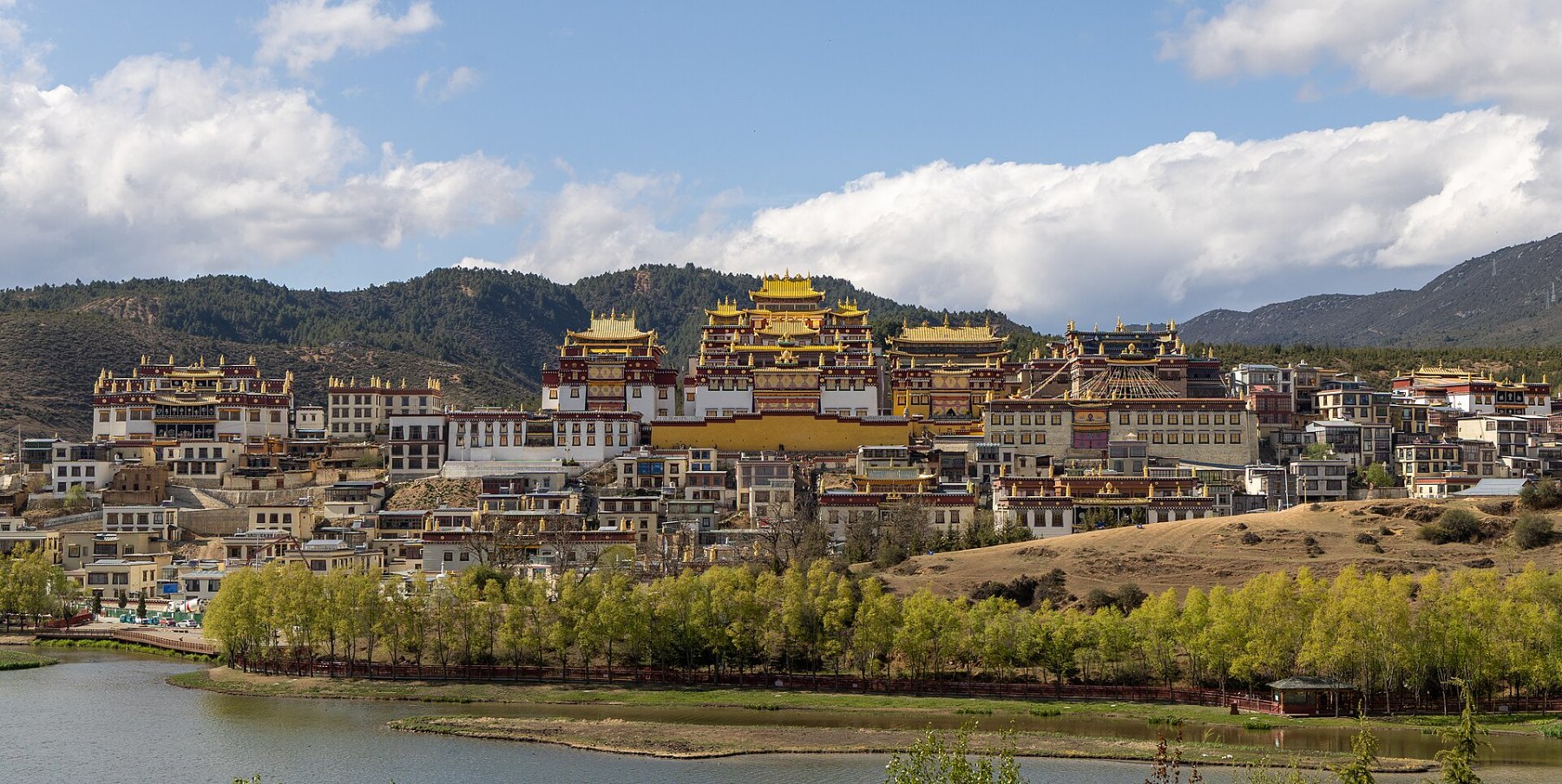
The former Zhongdian, renamed in 2001 after the fictional valley in Lost Horizon, and the capital of Diqing prefecture at about 3,300 metres. It has an airport five kilometres out, a railway station on the edge of town, a rebuilt Tibetan old quarter and the largest monastery in Yunnan on the hill above it. This is where the road begins.
Shangri-La town, Sichuan
Also called Riwa, or Yading town: a strip of guesthouses and noodle shops at 2,900 metres, thirty-odd kilometres from the reserve gate and the last place to sleep before it. The Chinese name was borrowed from the Yunnan one in the 1990s as a tourism decision. There is no other connection.
Why the naming matters
Because every search returns both, and because buses, tickets and hotel bookings are labelled with whichever one the seller prefers. If a timetable says Shangri-La and gives a departure at seven in the morning, check whether the destination is the Yunnan city or the Sichuan village. They are six hours apart.
The distance between them
220 kilometres by the direct road, and a long day the other way round through Xiangcheng. It is the only place in the world where you can have breakfast in one Shangri-La and dinner in the other.
The three roads, and which one to take.
All of them start north of the Yunnan old town. They diverge within twenty kilometres.
Route
Distance and time
Surface
Verdict
G664 direct, over Echu Shan
220 km, 5.5–6 h
Paved for the first 140 km in Yunnan; the last 80 km in Sichuan is a construction site in places
The shortest and the one the bus uses. Choose it unless it has rained hard in the previous week
East via Dongwang, then the G227
about 300 km, 6–7 h
Better engineered, less landslide-prone, better scenery
The road locals recommend when the direct one is damaged. Set Dongwang as a waypoint or the navigation will not find it
Old road over the two Snow Mountains to Xiangcheng
300 km and more, 8 h plus
The pre-2019 route: unpaved in sections, closed for snow and repairs
Historically important, currently not a route. Do not plan on it
The G664, leg by leg.
Four hours of larch forest, one border, one pass, and a road that keeps being repaired.
Out of the city
You leave Shangri-La north on the Gezan road, through a tunnel and up into the hills above the city. Within an hour the land has changed: spruce and larch, herders' huts, no villages. The Yunnan half is mostly paved and mostly empty, and it climbs gently to around 4,100 metres before the border.
The high point
The road's summit is a tunnel at about 4,299 metres on the Huodieka ridge, after a stretch of switchbacks that is the first place weather can stop you. Snow here closes the road for hours rather than days, but it does close it. Below the tunnel the road drops into the upper Yangtze gorge and the temperature climbs with it.
The border
Yicun, at 2,440 metres, is where Yunnan ends and Sichuan begins, and it is the only settlement of any size for a long stretch. There is a farmhouse restaurant, a shop, and drivers eating egg-fried rice at two in the afternoon. It is also the point where the surface deteriorates: from here to the pass above the reserve is a road under permanent reconstruction.
The last 80 kilometres
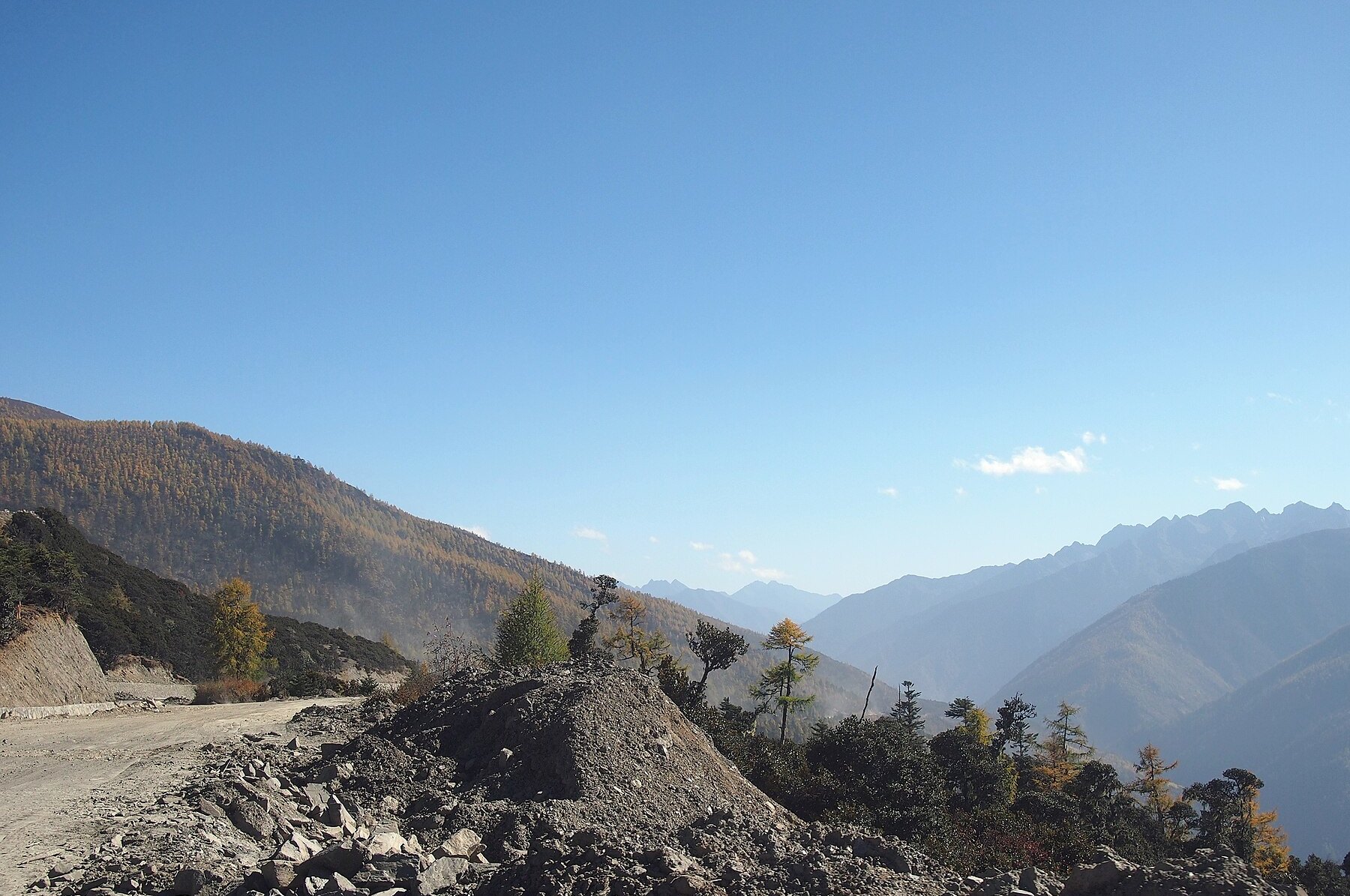
This is the part that decides your day. The road follows the Kas river through Kasi village at 2,687 metres, past the mouth of a side valley that trekkers used to walk out of, and then climbs the Echu pass. There are sections where one lane is being rebuilt while the other carries traffic, sections of gravel and rockfall debris, and a dust cloud that follows the bus for kilometres. Then, at 4,200 metres, the Echu viewpoint, and the three peaks of Yading on the skyline for the first time.
The tunnel
A 4.84-kilometre tunnel under the Echu pass is under construction, scheduled to open around 2027. It will bypass about 38 kilometres of the worst road on the route. Until then, the pass is the pass.
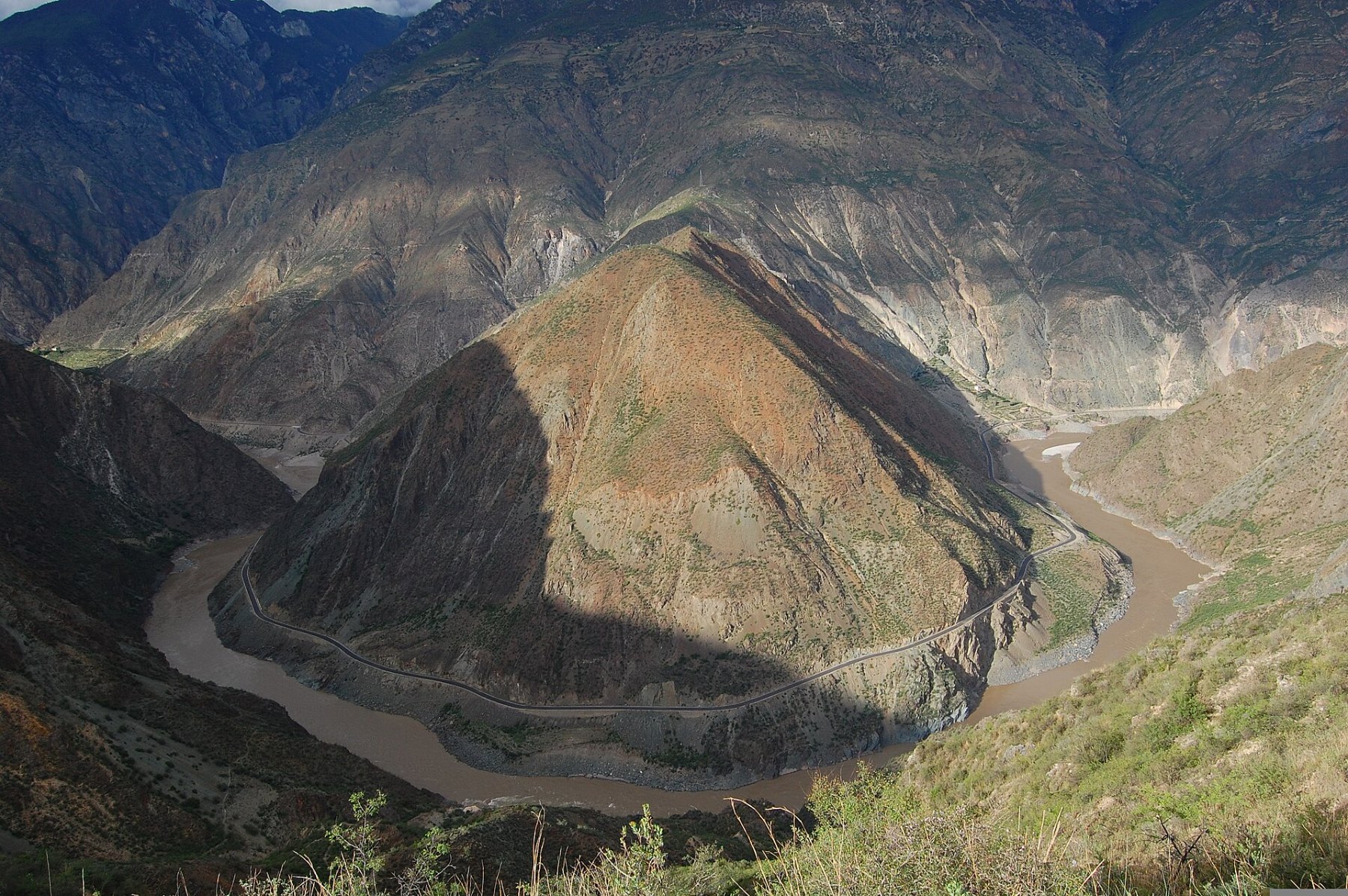
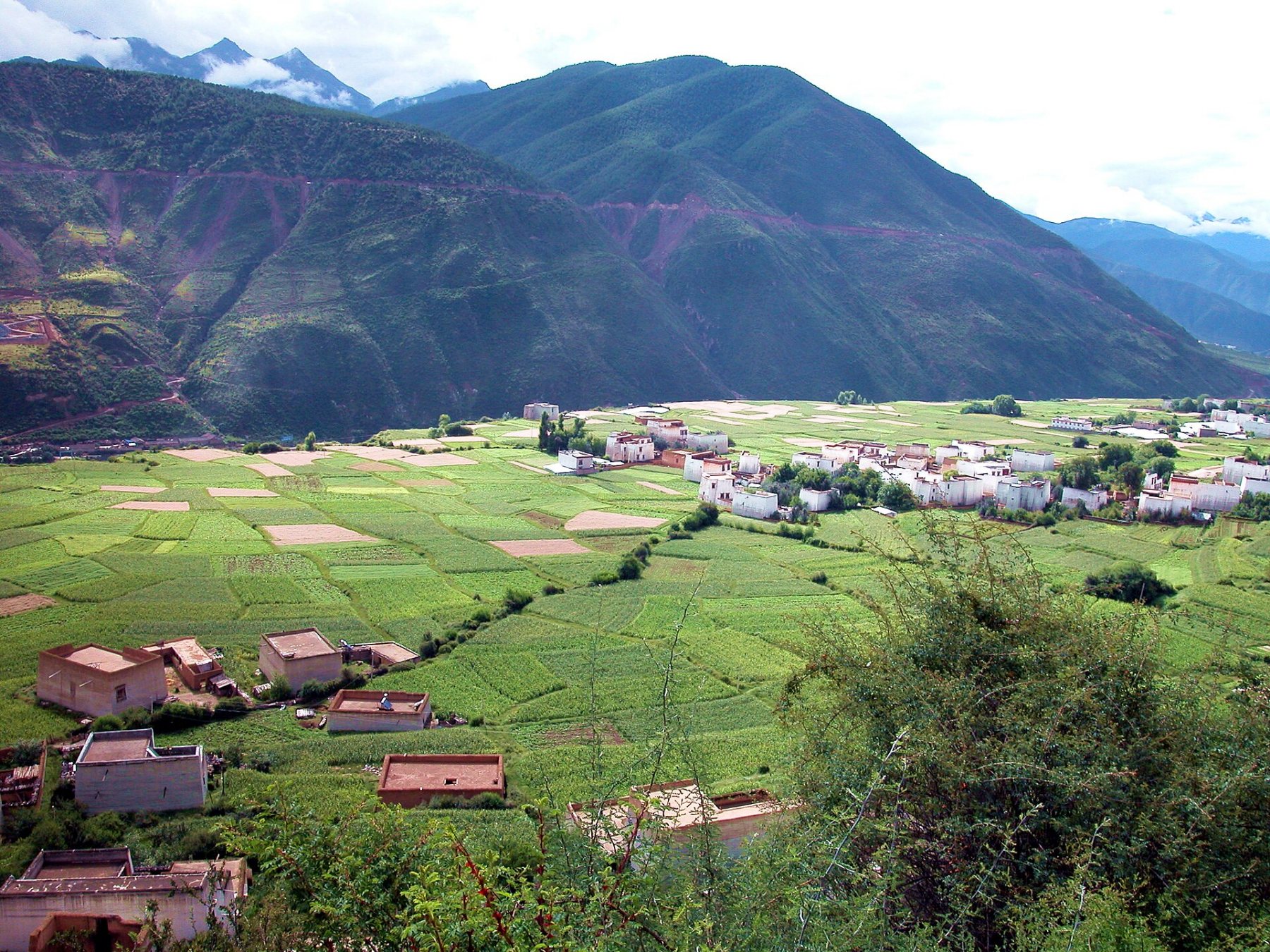
Songzanlin, above Shangri-La — the last thing you see before the road climbs.The Jinsha bend beyond Benzilan, on the Deqin side of the same corner of Yunnan.Xiangcheng, if you take the longer eastern road.
By bus: one departure, and it leaves early.
The long-distance station on Shangbala road, not the tourist shuttles from the old town.
The service
One coach a day from Shangri-La's long-distance bus station to Daocheng, timed for about seven in the morning, listed at roughly 330 kilometres and a little under a hundred yuan for the ticket. It uses the G664 and takes five and a half to six hours in good conditions. The return leaves Daocheng bus station around eleven in the morning and reaches the Yunnan old town in the late afternoon; a traveller on that run in October 2026 logged five and a half hours including a forty-minute hold at a landslide repair.
Booking it
Tickets go on sale at the station and through the usual Chinese booking channels a day or two ahead. In October the coach filled; in January it does not. If you are travelling in autumn, buy the day you arrive rather than the morning you leave, and be at the station by half past six.
The Xiangcheng connection
A second, newer service runs from Shangri-La through Qingde in Xiangcheng county and on towards the Yading gate, with a vehicle change at the Qingde depot arranged by the county operator. It is slower overall but it puts the white-house villages on your route and it is the option to ask about if the direct coach is full. Tickets through the Xiangcheng station, which also answers questions by phone.
Shared shuttles
Hotels and the old-town travel shops sell seats in eight- to fifteen-seat vans, leaving the east gate of the old quarter in the morning and again in the early afternoon, with returns from the Yading visitor centre at first light and in the late afternoon. Faster than the coach, roughly twice the price on the seat, and the outbound run will stop at the Wudi lake turn-off if you ask; the return does not. Book a day ahead; they do not run half-empty.
Rail to Shangri-La, then road.
Since 2023 the Yunnan end has had a train, and it changes the arithmetic.
The line
The Lijiang–Shangri-La railway opened on 26 November 2023: 139.7 kilometres from Lijiang station through Hutiaoxia and Xiaozhongdian to Shangri-La, with trains roughly every hour through the day. The fastest take about seventy minutes; the slowest close to two hours. Second class runs 56 to 70 yuan.
From Kunming
Direct trains from Kunming South reach Shangri-La in about four and a half hours, which makes the whole approach possible in one day from a provincial capital without a flight.
Why it matters here
Because the bus leaves at seven. Arriving by train the evening before, sleeping at 3,300 metres in the old town and walking to the station in the dark is a far better plan than flying into Diqing at dusk and trying to arrange a car for the same night. It also puts the altitude gain in two steps: 2,400 at Lijiang, 3,300 here, then down to 2,900 at the gate.
And by air
Diqing Shangri-La airport is five kilometres from the old town and has direct flights from Kunming, Chengdu, Chongqing and Lhasa. There is no scheduled flight between Diqing and Daocheng Yading; the two airports are a day apart by road, which is the whole point of this page. Landing at 3,300 metres and driving straight over a 4,299-metre pass on the same day is not a plan we would recommend to anyone.
Where to break it, and where not to.
Four stops that earn their hour, and one that does not.
Wudi lake
A green lake in a hanging valley above Langdu, reached by a short detour off the G664, with a small sanitation fee at the gate. Give it an hour and a half: the walk round the shore is flat and the water is the colour people drive to Yading to see. Shuttles stop if asked; the coach does not.
Kasi village
At 2,687 metres in the gorge, the last village before the pass, with walnut trees, a river and the trailhead for the Kasi valley route up to Luorong. The route is closed with the rest of the reserve's non-developed ground, but the village is a reasonable place for noodles and a leg stretch.
The Echu viewpoint
At 4,200 metres, where the road crosses the shoulder and the whole eastern side of the reserve opens up. On a clear afternoon you see Xiannairi and Chanadorje from the car park. It is also where the light goes, so if you are driving yourself, plan to be here by four.
The gate town, deliberately
Sleep at 2,900 in Shangri-La town, not at 3,750 in Daocheng and not in the village at 3,900. After a day that touched 4,299 metres, the difference between 2,900 and 3,900 is the difference between a good night and a bad one. Our accommodation page has the trade-offs.
Not Daocheng town, not on this road
The county town is 85 kilometres further on, on the far side of the reserve turn-off. It is the right base for the plateau, the airport and the Haizi Shan boulder country, and the wrong one for an early start into the valley. If you are coming from Yunnan, you have no reason to go there at all.
The altitude profile is a saw, not a ladder.
3,300 up to 4,299, down to 2,440, up to 4,200, down to 2,900. In one day.
What the numbers do
Shangri-La sits at 3,300. The road climbs to a tunnel at 4,299, drops to the border village at 2,440, follows the gorge at 2,500 to 2,700, then climbs 1,760 metres to the Echu pass at 4,200 before descending to the gate town at 2,900. That is two full passes and a thousand metres of net descent, in five hours of sitting down.
Why it feels worse than the numbers
Because acclimatisation is about time at altitude, not distance travelled. The two hours between the border and the Echu pass are the hardest: you have just spent an hour at 2,440 feeling excellent, and then you are at 4,200 with a headache and no idea why. Drivers who do this route weekly still notice it.
What to do about it
Two nights in Shangri-La before the drive, water instead of beer the night before, and no plan that requires thinking on the pass. If you are sensitive, the saw profile is an argument for the eastern route through Dongwang, which stays lower for longer and crosses no 4,200-metre pass.
Season, surface, and the state of the road.
The G664 is not a road you can assume.
October
The best month by a distance: larch turning gold on the Yunnan side, the first snow on the high ridges but not yet on the road, and dry gravel on the Sichuan half. It is also when the coach fills and the shared shuttles sell out.
July and August
The wet months, and the reason the Sichuan half is always under repair. Landslides between Walong and Bengding close the road for hours at a time; in September 2026 a slip put the route under restricted passage for days. If you are here in summer, take the eastern road and add two hours to whatever you were told.
November to March
Ice on the Echu pass and on the Huodieka switchbacks, and a road that is ploughed late if it is ploughed at all. The pass is not high enough to be permanently closed, but it is high enough that a two-wheel-drive car with summer tyres is a bad idea. Ask at the station in the morning rather than trusting yesterday's report.
Driving it yourself
Possible, common among Chinese travellers, and not a first-time-foreign-licence road. Ground clearance matters for the reconstruction sections, the drop-offs have no barrier for long stretches, and the last hour is best driven in daylight. If you take a car and driver from Shangri-La, the standard arrangement is a one-way drop at the gate town; the driver will have done the road this month and will know where it is broken.
The trek exits, and why you cannot use them.
This road is the western edge of the reserve. That used to matter to walkers.
What used to be here
Two of the great Yading walks ended on this road: the Kasi valley route, which climbed from Kasi village to Luorong pasture, and the western traverse, which came off the high lakes past Snake lake and down to Baihe village at 2,436 metres. Both are marked on older maps and both are still described in guidebooks that have not been updated.
What the notice says
Since 20 November 2025 every route outside the reserve's developed boundary is closed, including the kora and both of these exits. The penalties are real and they are applied to individuals, not just to operators. Our closed ground page has the wording and the dates.
What that means on this road
You can drive past the trailheads and you can look up the valleys. You cannot walk them, and no local operator can arrange it for you. Plan the Yunnan approach as a road journey with the reserve's two developed valleys at the end of it, not as the start of a traverse.
Which shape works.
Three itineraries, from the shortest to the one we would actually book.
Three days, one way
Train to Shangri-La in the evening, sleep in the old town, 07:00 coach, gate town by early afternoon, sleep at 2,900, reserve the next morning, out on the third day by shuttle and onward flight from Daocheng. Tight, and it works.
Four days, by car
The same with a car and driver, which buys you Wudi lake, the Echu viewpoint at four in the afternoon, and the freedom to stop at Kasi. Add a night in the gate town rather than trying to see the valley on the day you arrive.
A week, the loop
Lijiang, Shangri-La, the G664 to Yading, then out east through Daocheng and Litang to Kangding and Chengdu — or back north through Deqin for Meili. The second version is the one that makes a Yunnan trip and a Yading trip into a single journey, and it is the reason this road exists.
What we would not do
Land at Diqing at four in the afternoon and drive it in the dark. The pass is unlit, the reconstruction sections are unmarked, and the first view of the reserve is worth arriving in daylight for.
We route the western approach with a night at 3,300, a morning bus or a car that stops at the pass, and a bed at 2,900 on the night it matters. Tell us where you are starting and we will build the rest around it.