Baota Shan
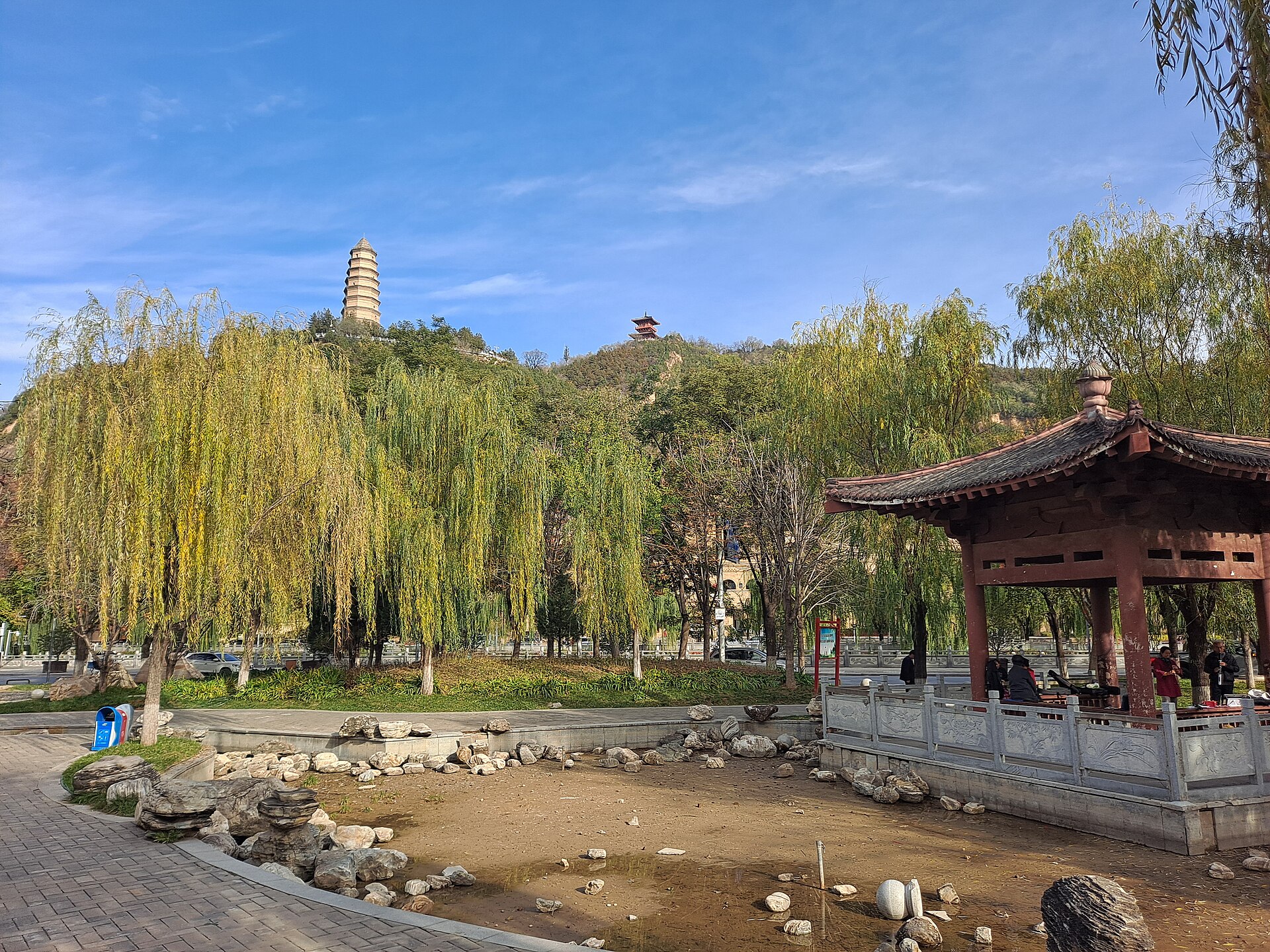
The hill above the old town, with the pagoda that gives it its name at the top. The climb is a staircase, the view is the whole Y of valleys, and the bell is rung at New Year.
 Start your enquiry
Destinations / Shaanxi / Yan’an
The loess country: a plateau 900 to 1,900 metres high, cut into ridges and gullies, with a pagoda on the hill above the town and thirteen years of the war in the caves beneath it.
Explore the guide ↓Northern Shaanxi · the loess plateau
The loess plateau is the largest accumulation of wind-blown silt on earth, and northern Shaanxi is in the middle of it: 82,200 square kilometres of the province, 40 per cent of the total, lying between 900 and 1,900 metres. The material is deep — tens to hundreds of metres — fine, vertical, and soft enough to dig into with a spade, which is the single fact that explains the architecture, the agriculture and the erosion.
Water cuts it into ridges and gullies, and the cutting is fast. The plateau loses soil to the Yellow River at a rate that has made the river what it is, and the response since the late 1990s has been to take the steepest farmland out of cultivation and put it back into grass and shrub. The hills around Yan’an are visibly greener than they were a generation ago, which is either a recovery or a very large experiment, depending on who you ask.
Yan’an itself sits in a Y of river valleys at about 1,000 metres. It is a small town with a large history: the endpoint of the Long March in 1935, the headquarters of the Communist Party from 1937 to 1947, and the place where the war years were spent in caves cut into the loess terraces above the town. The sites are preserved, the caves are real, and the town around them is a modern city of a million people.
The town, the caves, and the river two hours east.
The hill above the old town, with the pagoda that gives it its name at the top. The climb is a staircase, the view is the whole Y of valleys, and the bell is rung at New Year.
The cave complex where the Party’s central organs worked through the war: meeting rooms, offices and living quarters cut into the terrace, with the furniture still in place.
A second headquarters site in a side valley, smaller and quieter, with the caves set among old trees. Most visitors do one and skip the other; do both.
Yaodong: rooms dug into the loess, vaulted in brick or stone, with a kang bed against the window wall. Still lived in, still being built, and the reason the plateau is habitable in winter.
The Yellow River forced into a 50-metre channel on the province’s eastern border. The reason most people come north at all.
Terraced fields, earth-walled courtyards and the grain stores that go with them. Best seen on the road between Yan’an and Hukou rather than at any single site.
The plateau has a short good season.
The best months: dry, 15 to 25 degrees, and the loess green after the spring rain. Dust storms are possible in April.
The rainy season in the north, with short violent storms that cut the gullies deeper and turn the roads to slurry. Hukou is at its biggest, which is the trade-off.
Clear, cool and dry, with the harvest in and the light at its best. The single best window for the loess.
Cold and windy, with snow that makes the terraces beautiful and the side roads difficult. Indoor sites stay open; the villages shut down.
Two nights, and Hukou as a day from here.
Two hours by high-speed rail from Xi’an, or four to five by road. The station is outside the town and the sites are spread across it, so a car for the day is normal.
Day one: Baota Shan and one of the two headquarters sites. Day two: Hukou, east and back, with the loess villages on the way.
The old town around Baota Shan for atmosphere; the new city for hotels. Neither is expensive and both are quiet by nine.
The rail link makes Yan’an a two-night add-on to a Guanzhong itinerary rather than a separate trip.
How a plateau with no timber got a building tradition.
A vaulted room dug into a vertical loess face, lined with stone or brick, with a heated brick platform bed along the window wall. Cheap, warm in winter, cool in summer, and built by digging rather than adding.
The same caves housed the Party’s offices, a printing press, a hospital and a radio station. The sites at Yangjialing and Zaoyuan are preserved as working rooms rather than as monuments.
The hills behind the town are the most visible reforestation project in China. Whether the plateau can be held this way is an open question, and the locals will tell you both answers.
Distance, dust and the state of the roads.
Yan’an to Hukou is 90 minutes to two hours each way on a good road. Do not plan it around a train.
Spring wind lifts the loess. A scarf and sealed contact lenses are not over-preparation in April.
The cave complexes shut at 5pm and the last entry is an hour before. Baota Shan is the exception and is best at dusk.
The interiors are unheated and stay at about 10 degrees year round. In January that is warmer than outside; in July it is a shock.
Two nights in Yan’an, one of them ending at Hukou. Come in May or October, take the train from Xi’an, and give the loess villages the time between the sites.
Start my journey brief ↗