The main falls
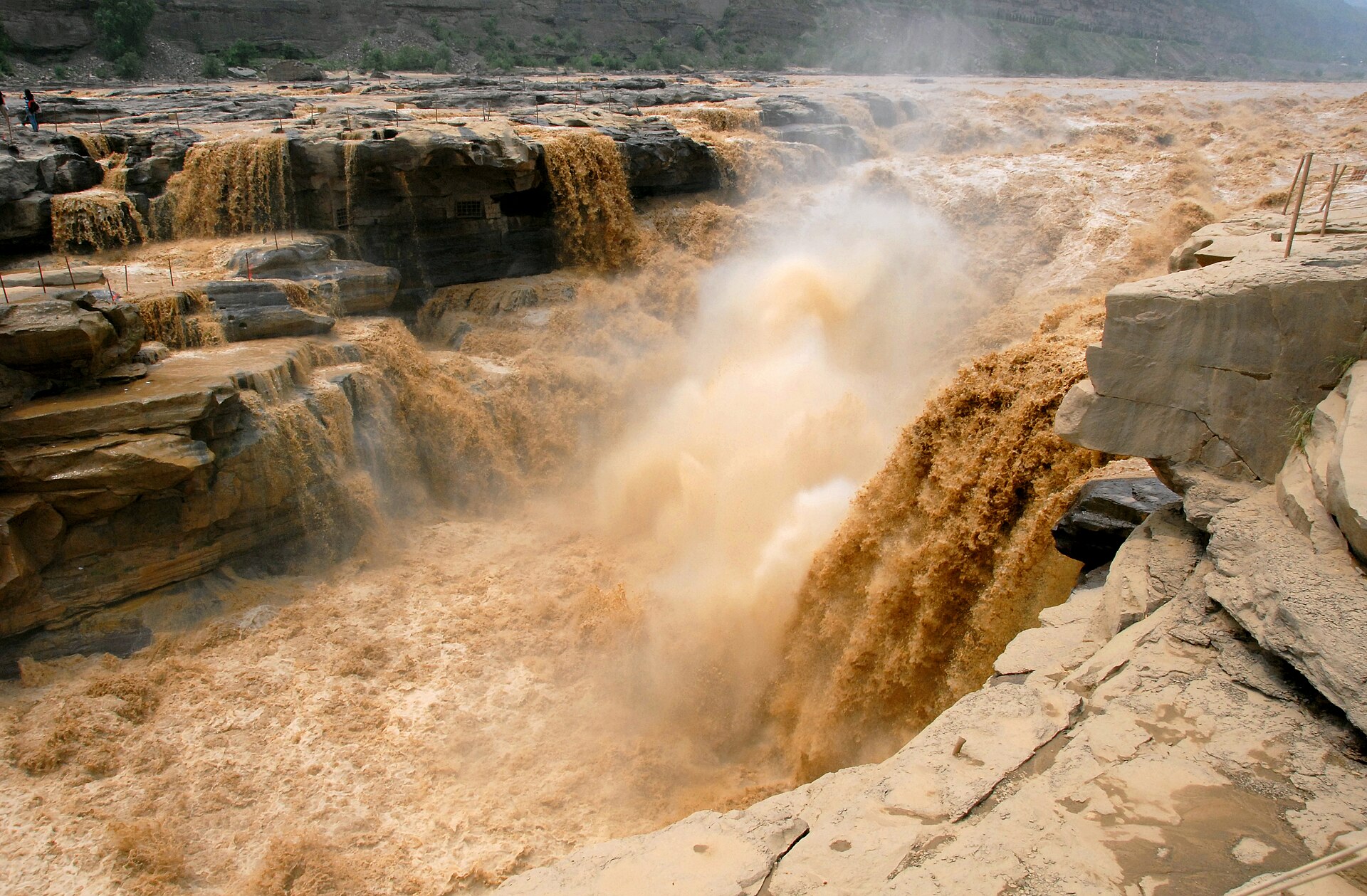
The rock terrace at Yichuan looks straight up the channel to the lip. In flood, the spray soaks the first twenty metres of the path and the noise makes conversation impossible.
 Start your enquiry
Destinations / Shaanxi / Hukou
The Yellow River arrives 300 metres wide and leaves through a channel 50 metres across, dropping 30 metres into a slot in the rock. In Chinese it is a kettle pouring: hu kou, the mouth of the pot.
Explore the guide ↓Yan’an · Yichuan · the Shanxi border
Hukou is not a waterfall in the usual sense. It is a constriction: the Yellow River, running south through the gorge it has cut between Shaanxi and Shanxi, meets a band of hard rock, and the whole channel narrows from three or four hundred metres to fifty. The water goes over the lip into a trench below, thirty metres down, and comes out the other side still inside the gorge.
The volume is what makes it. At ordinary flow the falls are three or four channels through the rock ledges; in flood the whole width goes over at once and the spray reaches the viewpoint. In the spring thaw, when the ice upstream breaks up, the river rises for a fortnight and the falls run as one sheet — the taohua xun, the peach-blossom flood, named for the wild peach flowering on the banks at the same time.
The two banks belong to two provinces. Shaanxi’s side, at Yichuan in Yan’an prefecture, is the one this guide covers: a long rock terrace upstream of the falls, a stair down to the water, and the widest view of the drop. Shanxi’s side, at Ji county, has the cave that lets you stand behind the curtain. Both are the same river and neither is the whole thing.
The falls, the gorge, and the two banks.
The rock terrace at Yichuan looks straight up the channel to the lip. In flood, the spray soaks the first twenty metres of the path and the noise makes conversation impossible.
The channel the river cuts after the drop, running on between vertical walls. From the lower terrace you see why the name means a pot’s mouth rather than a curtain.
The Qinshui gorge upstream: 30 kilometres of river between rock walls, with the old ferry crossings and the village terraces above the water.
The falls freeze into columns and the spray builds ice on the rails and the rocks. The site stays open and almost nobody comes.
Ji county’s side has the Long Dong, a cave behind the curtain, reached by a tunnel from the Shanxi terrace. A different view of the same water, and a different ticket.
The revolutionary capital and the loess country: the pagoda hill, the cave houses, and the war-years sites. Hukou is usually done as a long day from there.
Two floods, one freeze, and a low season in between.
The peach-blossom flood: ice breaking upstream, the river at its widest, and the falls running as a single sheet. Cold, windy, and the best two weeks of the year.
The river drops to its clear-water period and the falls split into channels. The most comfortable weather and the easiest photography.
The summer flood, from rain on the loess. The biggest water of the year and the most spectacular spray, with the highest risk of the lower terraces being closed.
Ice. The falls freeze into blue-white columns, the site is silent and nearly empty, and the road down can be closed after snow.
A long day from Yan’an, or a stop on the road north.
Two hours by road each way, and the site takes two hours. Doable as a day, better as a night in Yichuan so you are at the gate when it opens.
Four to five hours by road, or the high-speed train to Yan’an plus a car. Most people combine it with two nights in Yan’an rather than day-tripping from the capital.
The Shaanxi side is the wider view and the easier access; the Shanxi side has the cave. Crossing between them means a long detour to a bridge, so choose one.
In flood the spray carries fine yellow silt that gets into everything. A dry bag for the camera is not excessive, and the path down is wet and slippery.
The colour, the silt, and the song.
The colour is loess: the river picks up the plateau’s soil all the way across the north and carries it here. It is the most sediment-laden large river in the world, and the reason the plain downstream is farmland.
The Yellow River Cantata was written in Yan’an during the war years and set the river as the country’s voice. Every Chinese visitor knows the tune; it is played at the site, which is either moving or relentless depending on your patience.
For centuries this was the crossing between Shaanxi and Shanxi, and the gorge was a trade route before it was a spectacle. The old ferry points are still marked on the banks.
Wind, water and the state of the river.
The falls are a different object at 300 and at 1,500 cubic metres a second, and the lower terraces close when the river is high. Ask at the gate, not on the website.
The gorge funnels it. In March and April the spray blows across the terrace and you will be wet within a minute; a shell and a hat are worth carrying.
The rock terrace is uneven and slick with silt. The stairs to the lower viewpoint are steep and narrow when busy.
Hukou pairs naturally with Yan’an’s war-years sites and the loess villages, which is how most itineraries in the north are built.
Two nights in Yan’an, one of them in Yichuan so you are at the gate at opening. Go in the peach-blossom flood if you can, and accept that in August you may only see it from the top terrace.
Start my journey brief ↗