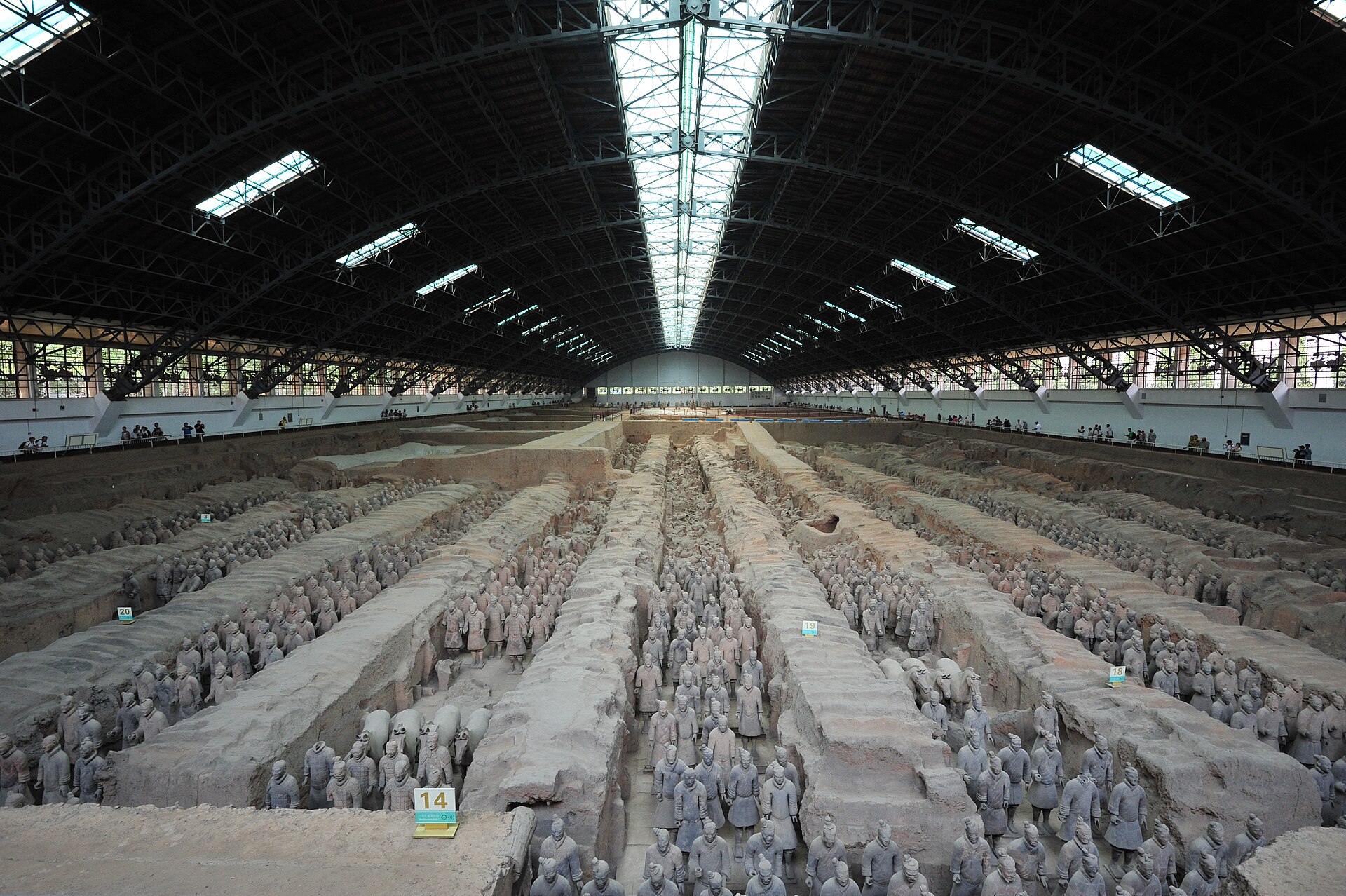
Pit 1
The great hangar and the reason to come: the full army in formation, with the conservation workshop at the far end. Walk the length first, then come back along the side.
 Start your enquiry
Destinations / Shaanxi / The Terracotta Army
Six thousand life-size figures in battle order under a hangar roof, buried for 2,200 years beside the tomb of the first emperor and dug up in 1974 by farmers looking for water.
Explore the guide ↓Lintong · 40 km east of Xi’an
In March 1974 farmers from Xiyang village were digging a well about 1.5 kilometres east of the tomb mound of Qin Shi Huang and hit fragments of baked clay. What they had found was Pit 1: a corridor 230 metres long and 62 wide, 14,260 square metres in all, sunk four and a half to six and a half metres below the surface and roofed with timber, containing an estimated 6,000 figures and horses in battle formation.
The army is not a sculpture garden. It is a military unit, arranged as one: three ranks of archers at the front, thirty-eight columns of infantry and chariots behind them, and files facing outward along the flanks and rear. Every figure is different — faces, hair, the fold of a sleeve — and every one was painted, though almost all of the pigment went within minutes of the pits being opened. What you see is the clay, not the colour.
The site is one part of a much larger complex. The tomb mound itself, 1.5 kilometres west, is unopened; the pits around it are the emperor’s bodyguard, his cavalry, his acrobats and his bronze cranes. Two pits were found in 1976, a third in the same year, and excavation is still going on: the museum is a working archaeological site with a conservation laboratory on the floor of Pit 1, and the figures you see being repaired are being repaired in front of you.
Three pits, the bronze chariots, and the mound.
The great hangar and the reason to come: the full army in formation, with the conservation workshop at the far end. Walk the length first, then come back along the side.
A smaller, l-shaped pit left largely unexcavated, with a few figures in situ showing how the others were found: broken, fallen, and interleaved with roof timbers.
The smallest pit and the one that explains the others: a headquarters group, with a chariot and officers, and no rank and file.
Two four-horse chariots in bronze and gold, found beside the mound and displayed in their own hall. The finest metalwork on the site, and most people walk past it.
The emperor’s burial mound, 1.5 kilometres west and included in the ticket. A grassy hill, a museum of the finds, and the scale of the thing without any of the treasure.
A pit of figures that are not soldiers: entertainers, strongmen and a bronze tripod, displayed in a hall beside the mound. The oddest and least crowded part of the complex.
Any month, but not any hour.
The quietest months, when you can stand at the rail of Pit 1 with room to yourself. Cold, and the halls are unheated.
The best weather and the fullest coaches. Go at opening or after three in the afternoon; the middle of the day is a scrum in Pit 1.
Hot, humid and peak season. The halls are ovens by noon. If this is your only window, book the first slot and be out by eleven.
The first week of May, the first week of October and the Spring Festival are best avoided entirely. The site takes 60,000 people a day and feels like it.
Half a day, done in the right order.
Pit 1 first while it is quiet, then Pit 3, then Pit 2, then the bronze chariots, then the shuttle to the mound. Most groups do the reverse and you will meet them coming the other way.
The train from Xi’an North to Lintong takes about 20 minutes, then a shuttle; by road it is an hour from the city. The 306 bus from the railway station is the cheap option.
One ticket covers the pits and the mound at Lishan Yuan, with a free shuttle between them. Buy it online with a time slot in high season and keep the booking code.
The on-site guides are licensed and worth an hour of your time at Pit 1. Audio guides are cheaper and worse; the labels are thin on the ground.
What the army was for, and why it is here.
King of Qin from 246 BC, first emperor of a unified China from 221 BC, dead in 210 BC. The tomb was begun in his lifetime and the workforce, according to the histories, ran to 700,000 men.
The mound has never been opened. The histories describe mercury rivers and a ceiling of pearls; modern survey has found mercury concentrations in the soil consistent with the account, which is as far as the evidence goes.
The site is on the south bank of the Wei, with the Qinling behind it and the plain in front: the geomantic arrangement of an imperial tomb, and the reason the mound is aligned with the mountain rather than the city.
The things that make the difference.
Three to four if you include the mound. The complex is large, the distances between halls are real, and the shuttle has a queue.
Photography is allowed but flash is not, and the halls are dark. A fast lens in Pit 1 is worth more than a long one.
The hangars are unheated in winter and unventilated in summer. Water in July, a warm layer in January.
In high season you will be sharing Pit 1 with several thousand people. Book the first slot of the day and go straight there, or accept that the atmosphere is part of the experience.
One morning, in the order the site wants: Pit 1 at opening, then 3, 2, the chariots and the mound. Book the slot, take the train, and skip it entirely on a public holiday.
Start my journey brief ↗