The city wall
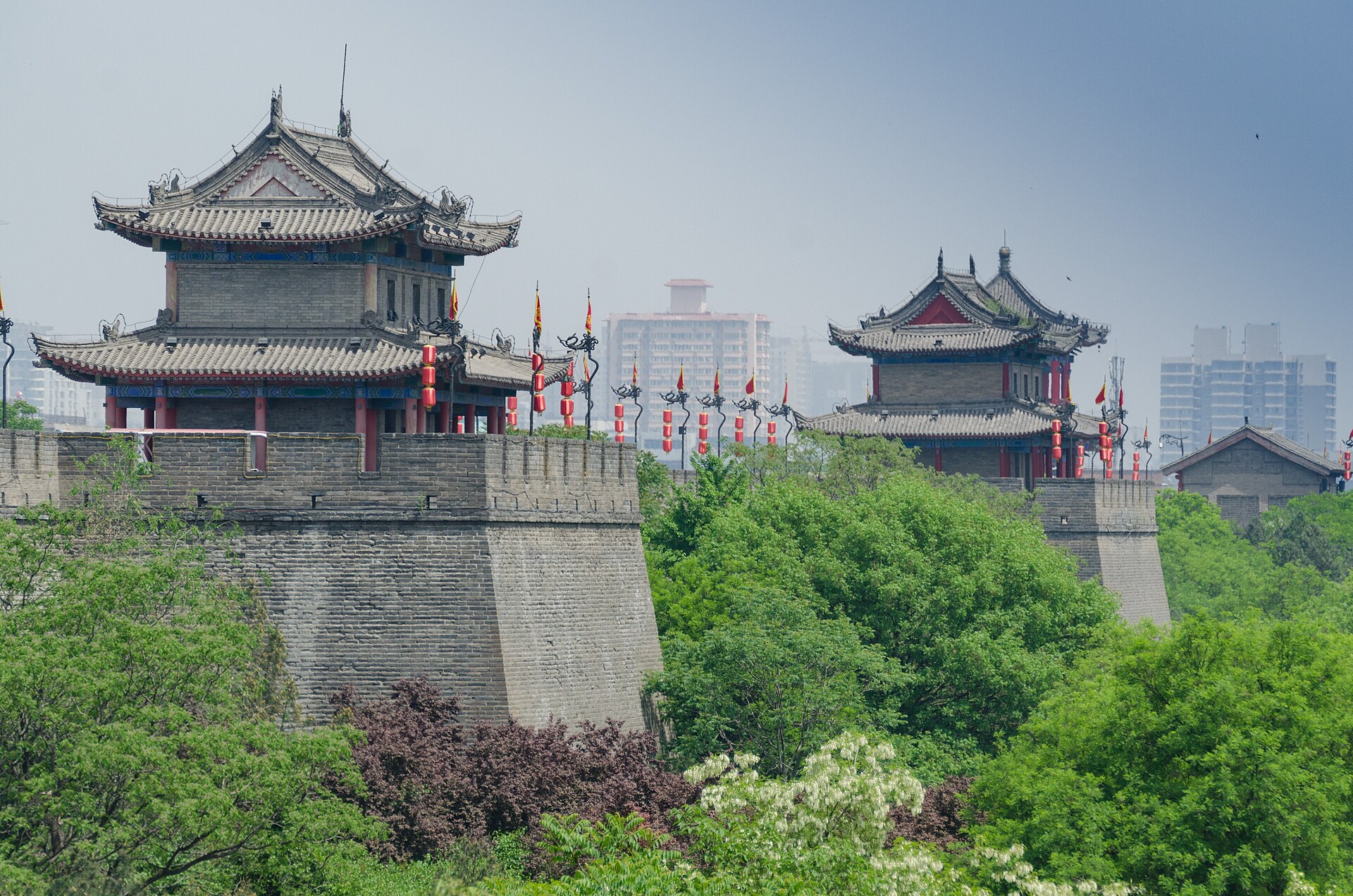
Walk it, or hire a bicycle at the south gate and ride the full circuit. The best introduction to the city’s shape, and the only place to see the old town from above.
 Start your enquiry
Destinations / Shaanxi / Xi’an
The hinge of the province and the start of almost every route in it: a walled Ming city of 11.3 square kilometres inside a 13.74-kilometre rampart, two hours from the loess, one hour from the Qinling, and forty minutes from the pits.
Explore the guide ↓Central Shaanxi · Guanzhong plain · 400 m
Xi’an is the practical answer to most Shaanxi questions. The high-speed station runs to Huayin in half an hour and to Yan’an in two hours; the airport is an hour north; the Qinling foothills start at the southern edge of the plain. Almost every itinerary in this guide begins and ends here, and the city rewards two nights rather than one.
The historic core is small and walkable. The Ming wall runs a closed 13.74-kilometre rectangle around 11.3 square kilometres of old city, 12 metres high with a 12 to 14-metre walkway on top — wide enough to ride a bicycle round in about ninety minutes, which is the single best thing to do on the day you arrive. Four gates are original: Changle in the east, Yongning in the south, Anding in the west, An’an in the north. The wall went up between 1370 and 1378 on the foundations of the Tang imperial city, and it is the only one of China’s great city walls that still closes a ring.
Inside it: the Bell and Drum towers at the centre, the Muslim Quarter north-west of them, the Forest of Steles, and the Shaanxi History Museum just outside the south gate. Outside it: the Big Wild Goose Pagoda four kilometres south, and the two pits at Lintong forty kilometres east. The city is dense with the last 1,300 years and almost empty of the previous thousand, which are underground.
Four things inside the wall, three outside it.
Walk it, or hire a bicycle at the south gate and ride the full circuit. The best introduction to the city’s shape, and the only place to see the old town from above.
A working Hui neighbourhood around the Great Mosque, with the city’s best street food: roujiamo, yangrou paomo, cold noodles, and persimmon cakes in winter.
A museum of carved stone from the Han to the Qing, including the Tang classics of calligraphy. Quiet, cool, and almost empty on weekday mornings.
The province’s finds in one place, from Zhou bronzes to Tang gold. Free tickets are released on a schedule and go quickly; the paid galleries are worth it.
Built to house the sutras Xuanzang brought back from India, and still the anchor of the southern city. The square around it is at its best after dark.
The Terracotta Army and the emperor’s tomb mound, an hour by road or 40 minutes by train. The reason most people come to Shaanxi at all.
Spring and autumn, and a city that works all year.
The best months: 10 to 25 degrees, dry, and the city at its most comfortable. Late April brings the peony gardens into flower.
Hot — 35 degrees is normal — and humid from July. Sightseeing moves to the early morning and after six, which is also when the wall and the pagoda square are at their best.
Warm, clear and dry, with the best light of the year. The first week of October is the busiest week in the provincial calendar.
Cold, dry and often hazy, with the wall and the museums nearly empty. Snow on the wall happens a few times a winter and is worth rearranging a day for.
Two nights minimum, three if you add Huashan.
Inside the wall for atmosphere and walkability; the younger hotel cluster around the south gate for restaurants; the high-rises south of the pagoda for quiet.
The metro covers the wall, the pagoda, the station and the airport line. For Lintong, the train from Xi’an North is faster than the road in traffic.
Day one: wall, Muslim Quarter, Bell Tower at dusk. Day two: Lintong in the morning, Shaanxi History Museum or the steles in the afternoon, pagoda after dark.
Add a day south to the Qinling foothills, or a day east to Huashan by early train with a night on the mountain.
Thirteen dynasties, and the reason the plain is full of emperors.
The city under the Tang was the largest in the world, 84 square kilometres inside its outer wall, with a grid of 108 wards and a population of about a million. The Ming wall encloses the Tang imperial city, which is why it feels small relative to the history.
Chang’an was the eastern terminus, and the Big Wild Goose Pagoda was listed with the Silk Road corridor in 2014. The city’s museums are as much about Central Asian trade as about dynasties.
The plain around the city holds more than seventy imperial tombs, most unopened. The Terracotta Army is one pit of one of them, which is the useful way to think about the scale.
The logistics that actually catch people out.
The Terracotta Army museum requires a timed booking in high season and the site is 40 kilometres out. Buy the ticket with the tomb included; it is one ticket for both.
The Shaanxi History Museum releases free slots on a fixed schedule and they vanish. If your dates are fixed, take the paid exhibition ticket instead of gambling.
Winter haze is real and can close the view from the wall for days. It is not dangerous, but it is not the photograph you came for.
The Muslim Quarter is a night market. Go after seven for the full street, and go at nine in the morning if you want to watch it being made without crowds.
Two nights inside the wall: ride the wall, eat in the lanes, give Lintong a morning. Then go east to Huashan or south into the Qinling — the city is a hinge, and it works best as one.
Start my journey brief ↗