What is there
Banks with ATMs, a hospital, pharmacies that sell oxygen and acetazolamide, a market, and a strip of Sichuanese and Tibetan restaurants. This is the last place to buy anything you forgot.
 Start your enquiry
Destinations / Sichuan / Yading
Two towns, one airport and a stretch of boulder plateau at 4,500 metres. None of it is the reason people come, and all of it decides how the first two days feel.
Explore the guide ↓Daocheng County · 2,900–4,411 m
Yading gets the photographs, but the two days around it happen on the plateau: a county town at 3,750 metres, a gate town at 2,900, and an airport at 4,411 that lands people straight into thin air. Getting this part right is the difference between walking into the reserve and being driven out of it.
The plateau also has its own season. For about two weeks in late September the marsh at Sangdui turns red, the poplars along the Bange river go gold, and the county briefly looks like the reason photography was invented.
The reserve's own advice is one to two nights below 3,000 m before the gate. This is what that means in practice.
| Base | Altitude | What it is for |
|---|---|---|
| Shangri-La town (Riwa) | about 2,900 m | The gate town: five minutes from the visitor centre, the lowest bed in the area, and the sensible first night. |
| Daocheng town | about 3,750 m | County capital, an hour or two from the gate, with the banks, pharmacies and the better food. |
| Yading village | 3,900–4,060 m | Inside the gate, above the valley floor: the only way to be at Pearl Lake before the first shuttle. |
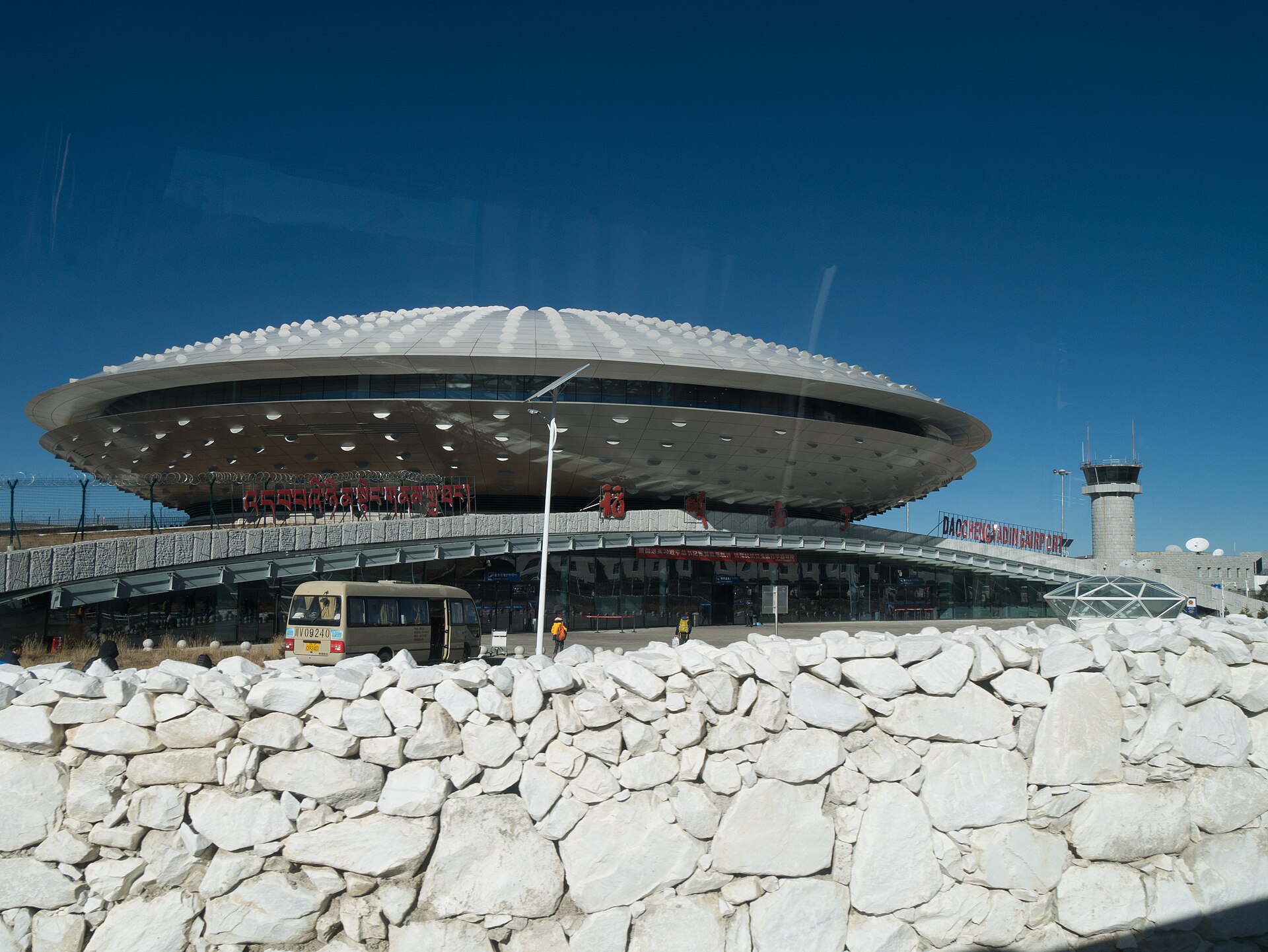
| Daocheng Yading airport | 4,411 m | One of the highest civil airports in the world. A one-hour flight from Chengdu, and an immediate altitude hit. |
A county capital on a plateau, with one street that matters and a lot of weather.
Banks with ATMs, a hospital, pharmacies that sell oxygen and acetazolamide, a market, and a strip of Sichuanese and Tibetan restaurants. This is the last place to buy anything you forgot.
There is no nightlife, no museum worth the altitude, and nothing to see from the main street. Daocheng is a base, not a destination, and it is honest about that.
Sleeping at 3,750 m for a night before the gate halves the shock of 3,900. It is not comfortable; it is useful.
Buses and shared cars run to Shangri-La town and the gate through the morning. The drive is an hour or two depending on the pass.
A fortnight in late September, and then it is over.
Groves of poplar along the river west and south of the county town, turning gold in the last week of September and the first of October. The classic photograph is a row of trunks with the plateau behind them.
A marsh about 25–30 km from the county town that turns deep red for roughly two weeks in late September. It is small, fenced, and best in low side light.
Both are weather-dependent and neither lasts. If autumn colour is the point of the trip, this is the week to plan around — earlier than most people assume.
The same road continues to Litang and the G318; the county is a corridor as much as a stop.
A glacial graveyard of granite blocks and small lakes, on the road to Litang.
A high basin above 4,500 m scattered with glacial erratics and hundreds of small lakes. The name means the mountain of lakes: haizi is the local word for a small high lake, and there are hundreds of them up there.
It is the strangest landscape on the drive and it costs nothing but time. Wind, no shelter, and a horizon that behaves like a sea.
Any month the road is clear. Snow closes sections in winter; ask before driving it in January.
Do not walk far here on your first day. It is higher than the reserve gate and there is no help nearby.
A 5,145-metre shoulder of the same range, 25 km from the gate town.
The 'shining mountain' north of the reserve: forested below, bare above, and one of the few places you can look across at the three peaks from outside the gate.
The larch and spruce on its flanks turn in the same fortnight as the poplars. It is a half-day from Shangri-La town and almost empty.
The road from the gate town north towards Daocheng crosses high ground with a view back into the reserve on a clear day.
Snow and ice on the pass. This is a summer and autumn road; in winter the drive is about the airport, not the views.
Two approaches, and they give you very different first days.
Chengdu to Daocheng Yading is about an hour, landing at 4,411 m. Fast, weather-prone, and the least forgiving way to arrive: the descent puts you at altitude before you have acclimatised at all.
Two days over the western road through Kangding at 2,560 m and Xinduqiao, arriving on the plateau gradually. It is the better acclimatisation and the better landscape, at the cost of two days.
The terminal is roughly an hour or two from the gate, by shuttle or pre-arranged car. There is nothing at the airport but the building and the wind.
From the gate town the road continues through Xiangcheng into Yunnan, which is how Yading fits into a longer route rather than a return trip to Chengdu.
Tell us whether you are flying in or driving, and what time you land. The first night is the one we would change if we could change only one.
Start my journey brief ↗