
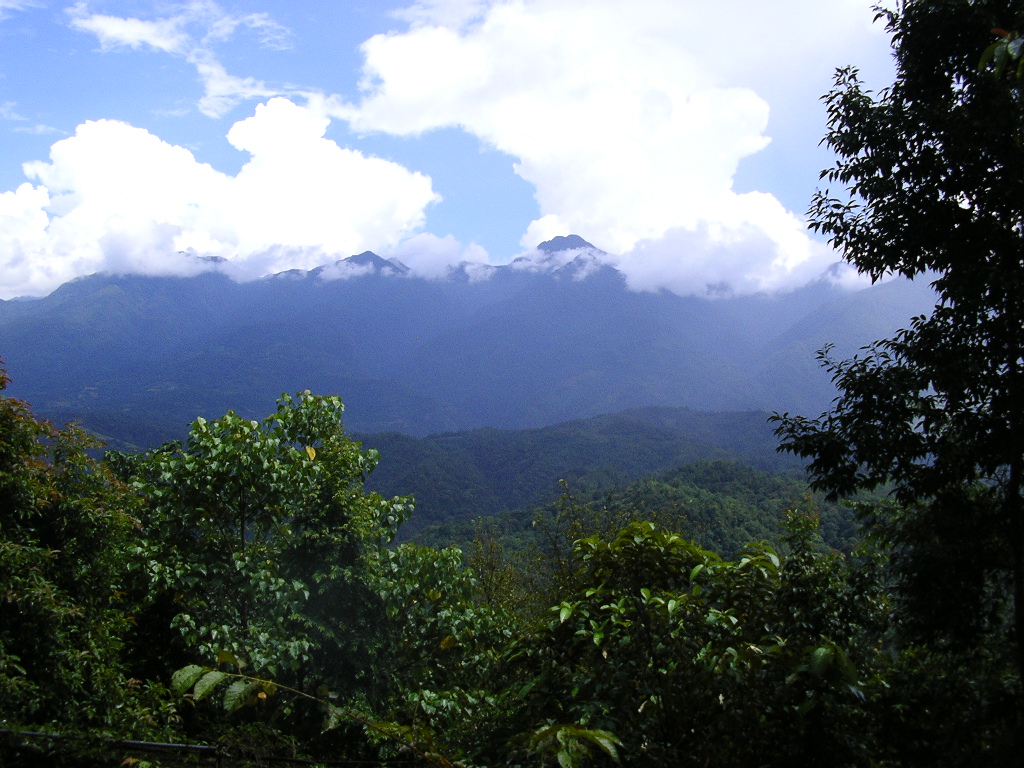
Ask international birders where the richest birding in China is and the answer converges on one slope: Gaoligongshan, the great north–south ridge west of the Salween in western Yunnan, and above all Baihualing, the village on its eastern flank. The mountain is one of the nodes of the region birders call the golden triangle of Asian birding, and the numbers behind the reputation are not promotional: 525 species recorded from Baihualing’s slopes — roughly 43% of every bird species ever logged in Yunnan — and 796 across the mountain as a whole.
Why birders call it a golden triangle.
The ridge runs from subtropical river valley to high alpine crest in one climb, so a week’s walking passes through more vegetation belts — and more bird communities — than most countries offer. The mountain also happens to be one of the most recently dynamic landscapes in China: over 620 new species of animal and plant have been described from Gaoligongshan since 1980, the richest run of new discoveries anywhere in the country. Hornbills in the low valleys, pheasants near the crest, and the famous hide trails in the mid-slope belt where most of the list lives.
The village that stopped hunting.
Baihualing’s second story is the one that makes the birding possible. The village was a hunting village; a generation ago the forest was its pantry. In 1995 its farmers founded China’s first farmer-run biodiversity protection association — forty-eight members at the founding, two hundred now — and the hunters became bird guides. Today the village runs 23 regulated watching points and hides, fields around 64 local bird guides, and hosts tens of thousands of visiting birders a year in family guesthouses. The economics are the conservation: a visitor with binoculars pays the same families who once hunted the forest, and the arrangement has held for three decades.
The mountain above the village.
Above the hide trails the mountain keeps its rare cast: the mid-slope flocks give way to pheasant ground — Sclater’s monal and the blood pheasant country, plus narrow-range endemics like Mrs Hume’s pheasant the mountain guards — and the specialities people travel for, the scarlet finch and the broadbills, move with the season. All of it is worked honestly: high-belt species are the rare row, and the guides who walk you there say so before you start.
The Skywalker gibbon, honestly.
The mountain’s sixth name belongs to an ape. The Skywalker gibbon — Hoolock tianxing, formally named in 2017, the first ape species ever named by Chinese scientists — survives in numbers under two hundred, and Gaoligongshan is the only place on earth it lives. Seeing one is a ranger’s game: reserve trackers follow the family groups, some for over a decade, and a morning with them is built around the dawn song and the trackers’ read of where the family is feeding. A sighting is a gift, not a deliverable — and the song alone justifies the alarm clock.
Planning the week.
We build the trip as a six-day private route in and out of Baoshan: three full birding days in Baihualing’s hide circuit, then two listening mornings with the reserve trackers. The itinerary lives at the Gaoligong birding tour, the behaviour rules behind it in watching without disturbing, and it pairs naturally southward with the Asian elephant tour — one province, two ends of its wildlife calendar.
Plan the triangle?
The Gaoligong birding tour: six days on the ridge
The Asian elephant tour: the southern half of Yunnan
Watching wildlife without disturbing it
The season calendar, for the whole country