
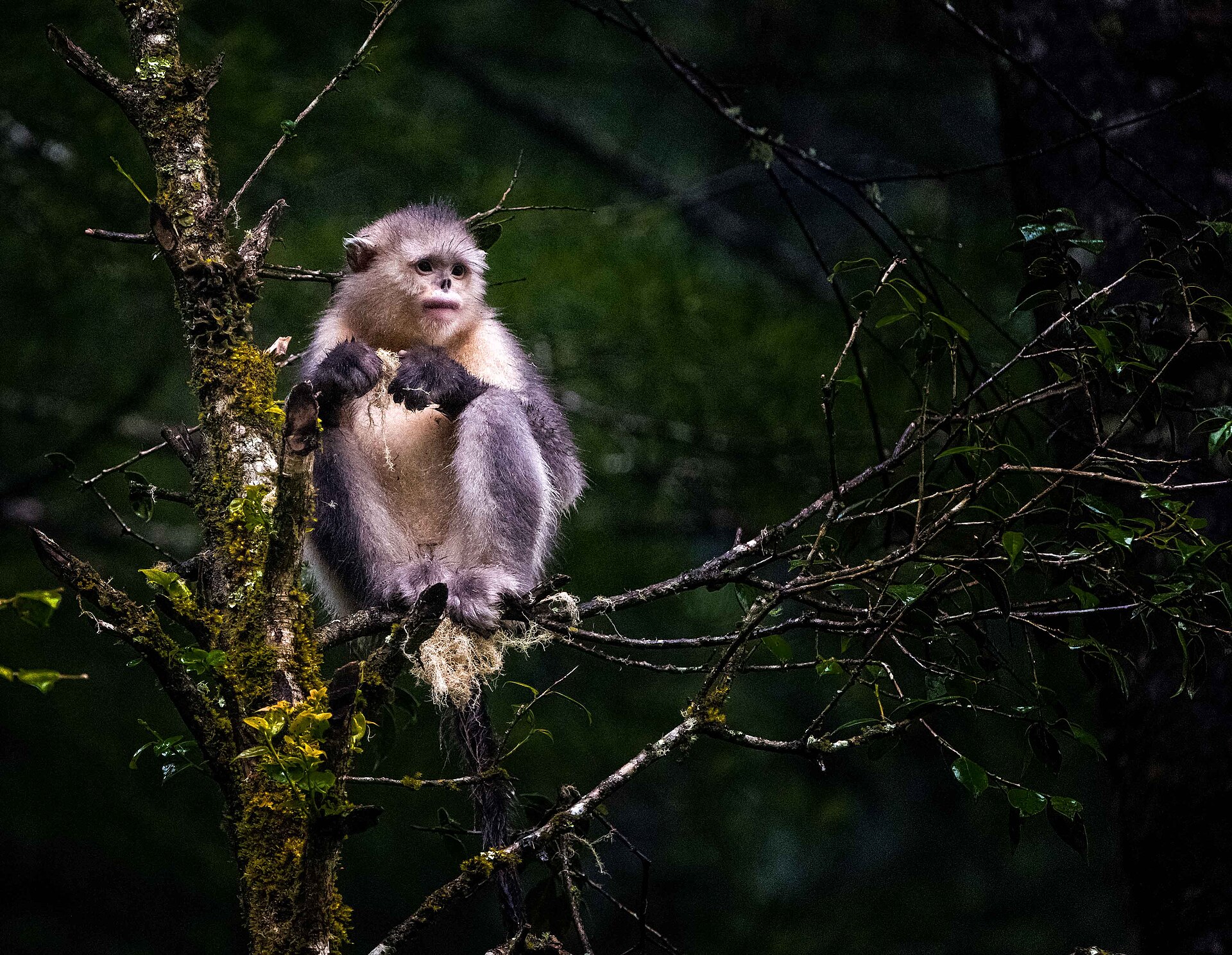
Travellers often ask why you cannot simply walk into a Chinese forest and find the animals. The honest answer is that you can — once — and then spend the rest of the trip finding nothing. The reliable wildlife encounters this site sells all rest on the same unglamorous institution: a small team of local rangers who follow one troop, one flock or one valley for years, until the animals treat them, and the people standing quietly behind them, as part of the landscape.
The work
At Xiangguqing in the Baima Snow Mountain reserve, the ranger teams start before the visitors: locating where the display troop roosted, reading the morning, walking the valley so that when the monkeys come down through the firs between nine and eleven, they are coming down because the day suits them. Villagers in the teams have done this work for decades — one Tacheng ranger described starting earlier than the monkeys and finishing later, every day, for fifteen years. At Yangxian, the equivalent institution was the nest guard: in the 1980s, watchers lived under the last ibis pine in shifts, twenty-four hours a day, for years.
Habituation is not a show
Habituation — animals tolerating quiet human presence because nothing bad ever came of it — is the only ethical shortcut that exists in wildlife watching, and it is slow, local and reversible. It is not the same as feeding shows, and the difference matters enough that we state it on every trip page: a display flock flying on schedule at a reserve is a conservation exhibit; a wild troop walking past you because a ranger earned forty years of trust is an encounter. The first is arranged for you. The second is earned, and you are borrowing it.
What the visitor owes
The debt is behavioural: the window hours exist for the animals’ day and are not negotiable; no flash, no food, no calls; distance rules set by the rangers, not by the length of your lens; and the ranger’s decision to move on, always, is final. The practical extension of this is why we build two mornings into every monkey trip — insurance for the troop’s bad days is also the price of never pressuring the good ones.
The three encounters that prove it
Xiangguqing’s monkeys, Yangxian’s ibis paddies and Baihe’s golden monkey canopy are all products of the same patience. None of them would survive a season of visitors who treated the window hours as a suggestion. All of them, treated well, will outlast every trip we build around them — which is the entire point.
Where this leads
The Yunnan snub-nosed monkey guide
Watching without disturbing
The Tacheng monkey tour