
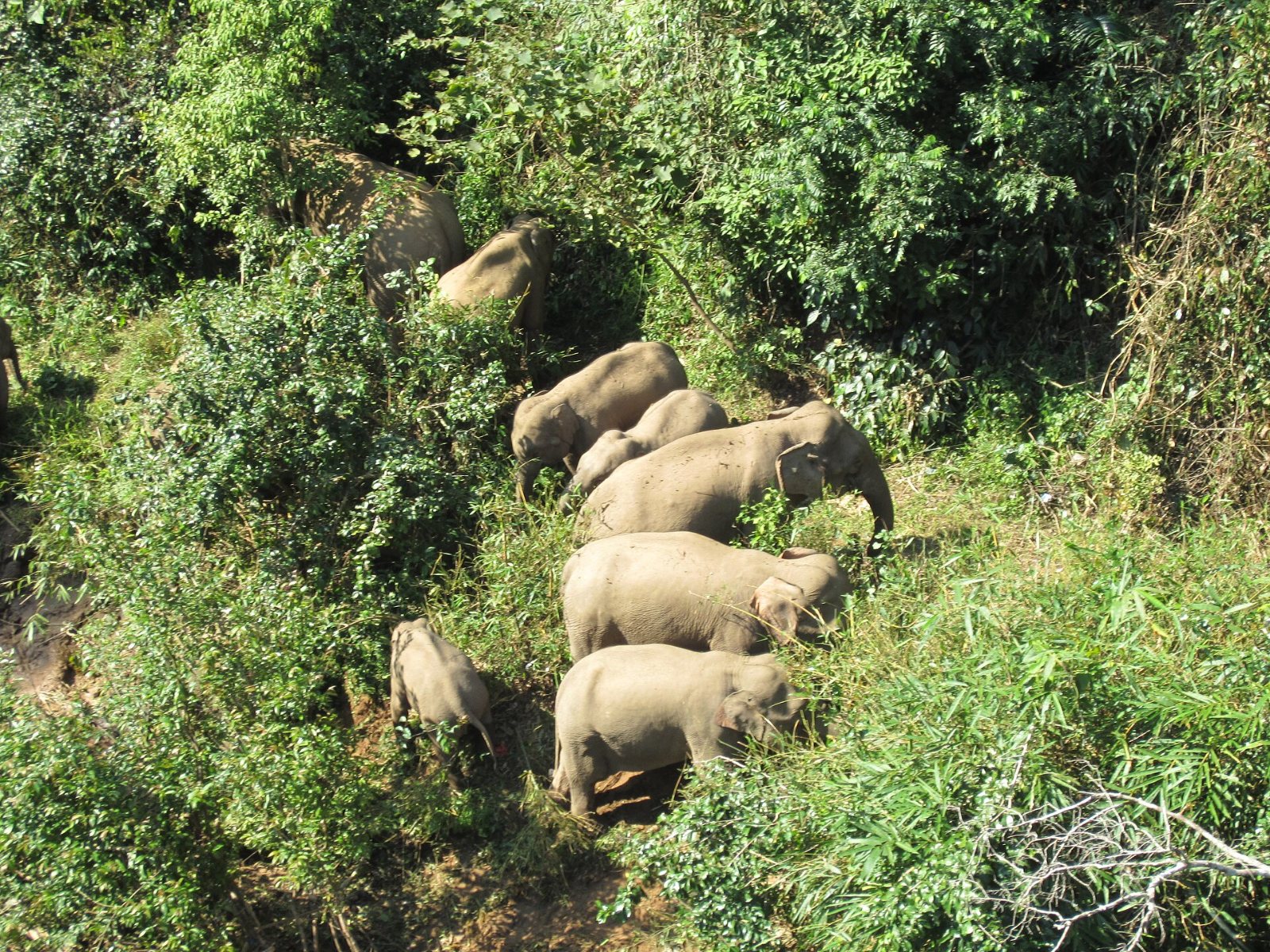
Wild Asian elephants in China are not a thing you go and find. They are a thing you position yourself for: one prefecture of southern Yunnan, one valley inside it, one dry season, and a timetable the animals wrote first. The national population is 300-plus animals — up from roughly 180 in the 1980s — and around eighty of them, in more than ten families, use the ground that matters here: the Mengyang sub-reserve, better known by the gate that watches it, Wild Elephant Valley.
One province, one valley.
The valley sits on migration ground the herds have used for generations to move between feeding areas, water and shade. It is a valley inside a much larger reserve, not an enclosure: the elephants range across tens of kilometres of forest and come down more often when the interior is dry. That is why the season matters more here than the ticket. The dry season runs November to April, December to February is the peak, and in those months water and food thin out in the forest interior while the undergrowth opens enough to see into — both changes work for the watcher.
The hours the elephants keep.
Elephants avoid the heat of the middle of the day, and the working pattern at the valley reflects it: the productive windows are roughly 08:00–10:00 and 16:00–18:00. The park runs 08:00–18:00 and closes to new arrivals at 16:30 — which is why the plan we build enters at the open of gate and returns for the last two hours, and treats midday as context: the museum, a long lunch, and the rescue and breeding centre, in that order. Entry is ¥58 and the cableway ¥50 one way; the cableway is a view, not an observation strategy.
Why the walkway works.
A 2,280-metre elevated walkway runs above the valley floor, and that is the whole idea: people stay in the air, elephants keep the ground, and nobody has to be moved for the other to pass. The walkway and the observation points sit on the north approach — the south side is where the shows, feeding baskets and interaction products sit, which is not what a wildlife trip is for. Most visitors run the valley as a day trip from Jinghong; we would rather base two nights close to the reserve so the second morning starts at the gate instead of on a road.
A coin toss, twice.
One visit is a coin toss. Two mornings in the same week, in the same season, is a different probability altogether — and it costs one night in Jinghong. The four-day trip we build carries that spare morning deliberately, because an honest elephant itinerary is built from hours on the ground rather than from promises. The herd decides; the schedule bends.
What we will not book.
No elephant rides, no feeding baskets, no “rainforest shepherding” walks and no shows. The valley also runs a rescue and breeding centre and an elephant school; we treat those as optional context, explained plainly, not as the reason to come. The same behaviour rules that govern every wildlife trip we run are written up in watching without disturbing, and the valley’s groundwork lives on the Xishuangbanna species guide.
The trip itself is a four-day private route in and out of Jinghong — the Asian elephant tour — and it pairs naturally with the panda forests of the north: one province north to south, two wildlife calendars.
Position yourself for the herd?
The Asian elephant tour: four days, two mornings
Xishuangbanna: the species guide
Watching wildlife without disturbing it
The Sichuan mammal tour: the northern calendar