South Peak
The highest point of the five sacred mountains. A platform on the summit block, the Yellow River and the Wei visible on a clear day, and the Changkong Zhandao plank walk on the east face below it.
 Start your enquiry
Destinations / Shaanxi / Huashan
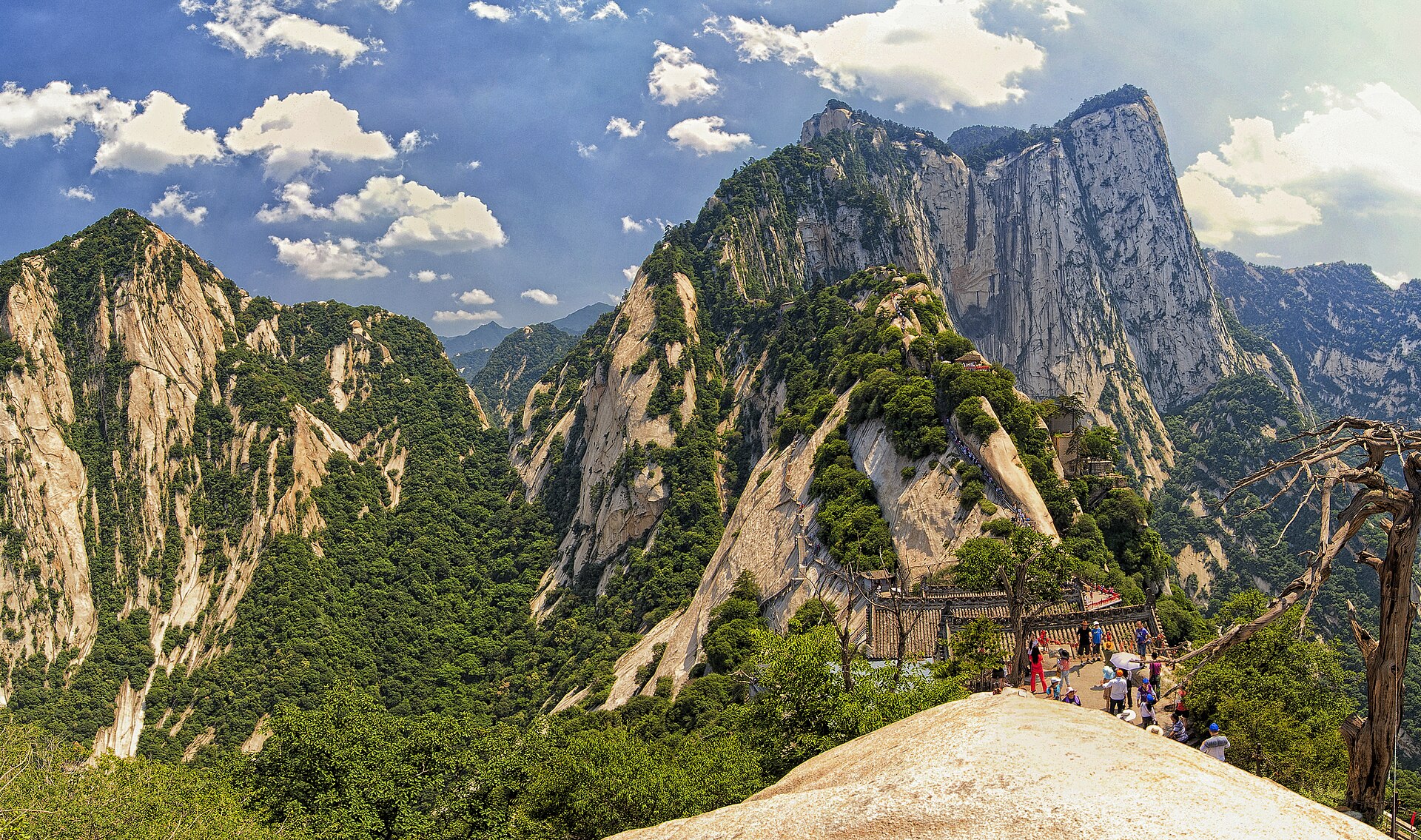
One block of granite, lifted and then cut into five peaks by faults, with a plank walk bolted to the south face and 2,154.9 metres of it above the Wei River plain. The highest of the five sacred mountains, and the only one you climb vertically.
Explore the guide ↓Eastern Shaanxi · Huayin · 2,154.9 m
Huashan is not a mountain chain. It is a single intrusive block of granite, about 120 million years old, that was pushed up along faults and then left standing while the soft rock around it eroded away. What remains is a massif roughly two kilometres across with near-vertical sides, split from within into five summits: South at 2,154.9 metres, East at 2,096.2, West at 2,082.6, Centre at 2,037.8, and North at 1,614.7.
That geometry explains everything about the place. Because the rock is one piece and the faces are sheer, there is no gradual approach: the paths are stairs cut into the stone or bolted onto it, and the drops begin where the handrail is. The classic climb from Yuquan Yuan to the North Peak is roughly four to five hours of continuous stone steps, past the Qianchi Zhuang — a 370-step chute at around 70 degrees — and the Canglong Ling ridge, a 530-metre crest with drops on both sides.
The result is a sacred mountain that feels like a via ferrata. There are two cable cars now: the North Peak line, running since 1996 up the line of the 1949 assault route, and the West Peak line, opened in 2013, which is 4,211 metres long with 894 metres of vertical and takes about twenty minutes. With them, a fit visitor can see all five peaks in a day. Without them, Huashan is a two-day mountain and a much better one.
The five peaks, the two plank walks, and the temple at the bottom.
The highest point of the five sacred mountains. A platform on the summit block, the Yellow River and the Wei visible on a clear day, and the Changkong Zhandao plank walk on the east face below it.
Boards 30 centimetres wide bolted to a vertical face, with a harness and a chain. Three sections; the lower one is the one in the photographs. Extra ticket, cash, and a queue.
Where people sleep to watch the sun come up, and the start of the Yaozi Fanshen — a 30-metre descent down a reversed overhang to a chess pavilion on a separate pinnacle.
The most sculptural of the five, with the cleft rock of the Chenxiang legend and the upper station of the 2013 cableway at its foot.
The dark dragon ridge between the North Peak and the centre: a stone crest a metre wide with air on both sides, and the place where Han Yu supposedly threw his letter of complaint over the edge.
The Taoist temple at the trailhead, founded in the Northern Song and rebuilt many times since, with a spring that gives it its name. Where the climbing route starts.
April to June, or September to October.
The best months: dry, 10 to 22 degrees on the summit, and the rock at its most stable underfoot. May weekends are busy with domestic groups.
Hot and wet, with afternoon thunderstorms that close the plank walks and the exposed ridges. The mountain is at its greenest and its most crowded, because it is 10 degrees cooler than Xi’an.
Clear, cool and dry, with the best light for photographs. The first week of October is the busiest week of the year — avoid it or book everything.
Cold, with ice on the north-facing stairs and occasional closures of the plank walks. Snow on the granite is spectacular and the mountain is nearly empty; crampons are not a joke here.
Two routes up, one night on top, or a long day.
West cable car up, walk the five peaks anticlockwise, North cable car down. Six to eight hours, all five summits, and the descents are on stairs rather than ridges.
Yuquan Yuan at dawn, up through Qianchi Zhuang and Canglong Ling to the North Peak in four to five hours, sleep at the East Peak, sunrise, then the south and west peaks and the cable car down.
Huayin is 30 minutes from Xi’an by high-speed rail, and the station is 15 minutes by shuttle from the visitor centre. Do not attempt it as a half-day from the city.
Entry and both cable cars are separate tickets, and the plank walks are a third. Budget for it, carry cash for the walk tickets, and check the day’s opening hours at the gate rather than online.
One of the five sacred peaks, and a Taoist stronghold for a thousand years.
Huashan is the Western Great Peak of the five, the one that governs metal and autumn in the old cosmology. The imperial sacrifices were made not on the mountain but at the Xiyue temple 15 kilometres away, on the plain.
The mountain is one of the birthplaces of the Quanzhen school, and the temples on the summit — Zhenyue Gong, Jintian Gong, the Dongdao courtyards — are working places rather than museums. More than twenty survive.
The “taking of Huashan” in 1949 went up the north face by a route the defenders had thought impossible, and the North Peak cable car now follows that line. It is the reason the mountain appears in modern military histories as well as travel ones.
The things that decide whether the day works.
Every route involves chains. Bring a small pack, gloves, and shoes with edges; the sandstone-and-granite stairways are polished by centuries of feet.
The summit is 2,154.9 metres and the valley floor is 400, so nothing here needs acclimatisation. It is 1,750 metres of up, in stairs, which is a different problem.
The cable cars move 1,000 people an hour each and the queues at 9am in August are an hour long. Either be at the gate at opening or come in the last three hours of the day.
The summit runs 8 to 12 degrees cooler than Xi’an and the wind on the ridges is constant. A shell jacket in July is not excessive.
Two days: climb the old way, sleep on the East Peak, sunrise, the plank walk, cable car down. One day if you must, west car up and north car down — but you will have seen the mountain rather than climbed it.
Start my journey brief ↗