
Hiking / Great Wall camping trek
Private hiking tour
The Great Wall camping trek.
Four days on the best of the wall: the unrestored towers of Gubeikou, the full Jinshanling ridge, and the steep traverse from Jiankou to Mutianyu — with one night camped close enough to the wall to hear the wind through the arrow slits. The line most walkers only do in pieces, done properly, from Beijing.
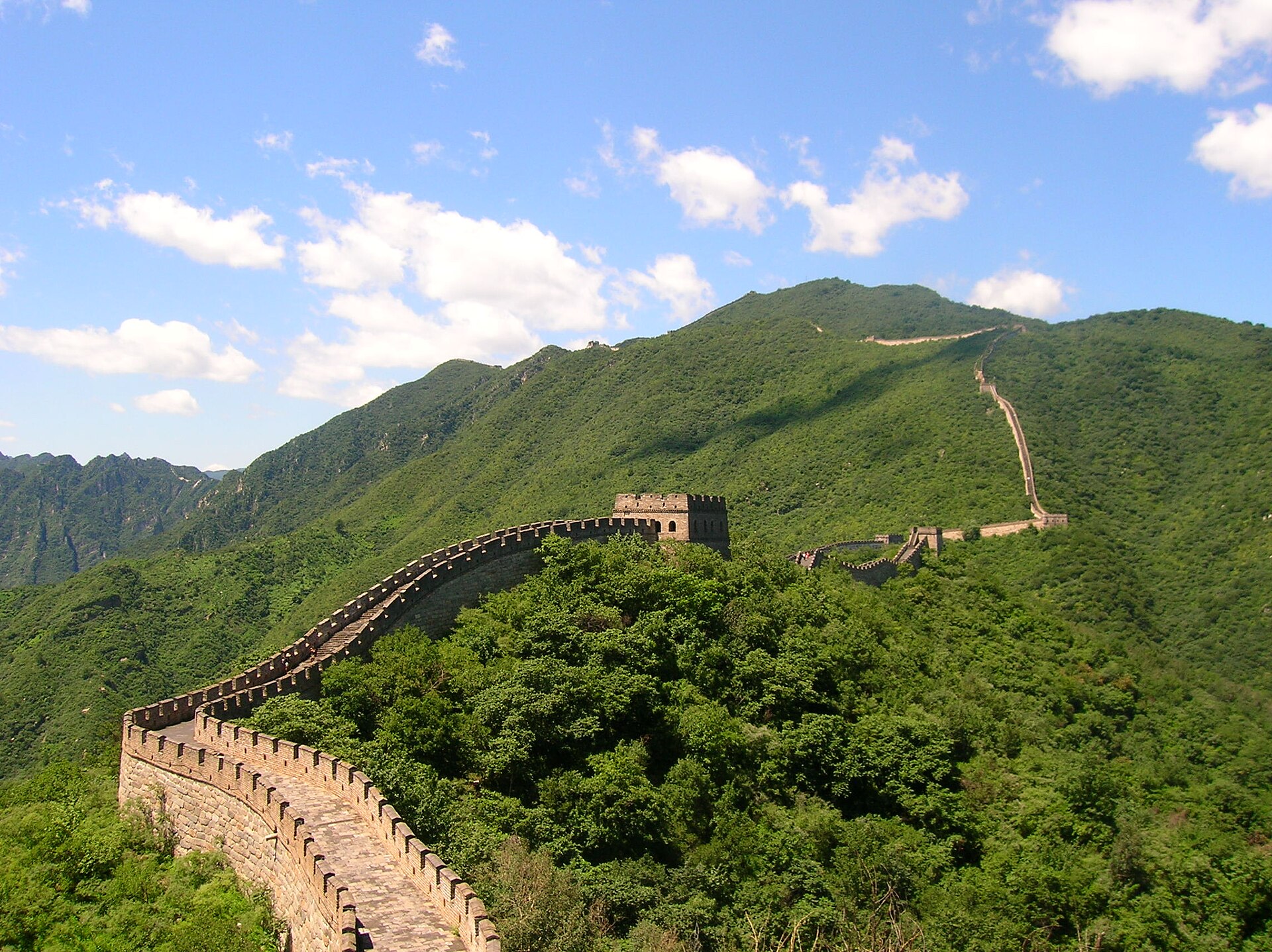
Ask about this itineraryThe wall on the Jinshanling ridge · where the crowds stop and the towers begin
walked across four days, from the Gubeikou water gates to the Mutianyu cableway — most of it on wall surface itself
watchtowers passed and entered, including Jinshanling's dense run of 67 within 10.5 km — the finest tower architecture on the wall
rebuilt and garrisoned this stretch in the 1570s; the brick towers with firing galleries and storeyed interiors date to his command
by private car to Gubeikou; the trailhead is a farming village, not a coach park — the wall above it is empty even on weekends
Why this route
Three sections, one argument about the wall.
Most visitors meet the wall at one rebuilt staircase — Badaling, Mutianyu, a photograph, a cable car, done. But the wall is not a monument, it is a 40-kilometre conversation between engineering and terrain, and it cannot be understood in an afternoon. This trek walks the three sections that carry the argument: Gubeikou, where the wall runs raw and unrestored across farmland and the ladies' towers still bear the ballistics of 1933; Jinshanling, where general Qi Jiguang's brick engineering is at its densest and most beautiful; and Jiankou, the notorious ridge-line that only hikers ever see, dropping over its shoulder to the fully restored grandeur of Mutianyu.
We walk it this way for a reason. Each section answers the question the last one raised: what was the wall before restoration, what did the Ming engineers intend, and what happens when the terrain beats the builders. By the fourth day you will have argued with all three answers in your legs.
One honest note on the camping. The wall itself is a protected monument and tent pegs do not belong in Ming brickwork. Our camp night is spent at a stone farmhouse on the Jinshanling shoulder, terraced fields below the towers, the wall close enough that sunrise arrives along it before it reaches the valley — the wall-top experience without a single chisel mark on history.
Route Briefing
West to east along the Ming frontier: two days on the Gubeikou–Jinshanling–Simatai corridor, one rest and transfer day, one big day on the Jiankou–Mutianyu crossing. Vehicle support at every road head.
- undefinedundefinedundefined
- undefinedundefinedundefined
- undefinedundefinedundefined
- undefinedundefinedundefined
Day by day
The four days.
The rhythm is wall in the morning, village in the late afternoon. Marching order follows the sun — the ridges run east–west, so the towers are always lit and never backlit.
-
Day 01
The wall that never got a facelift
Beijing → Gubeikou
Leave Beijing early and reach Gubeikou by mid-morning. This is the wall as the twentieth century found it: unrestored, overgrown, its towers cracked by frost and by the 1933 fighting between Chinese troops and the Japanese army — the ballistics scars on the 'ladies' and 'general' towers are still legible, and we read them before we climb.
The day's walk threads the wall line over farm ridges and through two fortress villages, roughly twelve kilometres with the towers stepping away ahead all afternoon. Nothing here is ticketed or tidied; the cows graze up to the wall's shadow. Arrive at a guesthouse in the water-gate village for the first night.
Evening talk over dinner: how the wall actually worked — beacon smoke codes, garrison rotation, why the passes are where the rivers are. It reframes everything you will walk for the next three days.
-
Day 02
Qi Jiguang's masterclass, and a night under the towers
Gubeikou → Jinshanling
The finest continuous day on the entire wall: the full Jinshanling ridge, ten and a half kilometres with sixty-seven watchtowers in a density found nowhere else. Qi Jiguang rebuilt this stretch in the 1570s with brick towers that storey, vault and overhang — the walk becomes a lesson in Ming military architecture you take one tower at a time.
The ridge gives the wall's best photographs in both directions, and the crowds stay near the two cableways, thinning to nobody within twenty minutes of either. Lunch is a thermos stop in a tower with a firing gallery for a window.
Late afternoon, descend to a stone farmhouse on the shoulder below the ridge — the camp night. Tents on the farm terrace, dinner cooked in the farmhouse kitchen, and after dark the wall runs along the skyline a few hundred metres above, lit by whatever the sky is doing. Sunrise from the terrace arrives along the wall before it reaches the valley.
-
Day 03
A short walk, a long road, fresh legs
Jinshanling → Jiankou valley
A deliberately gentle morning: a short loop to the Simatai reservoir end of the corridor — the section beyond the water gate runs off-limits toward the rescue-station ridge, and we keep to the legal side and the viewpoint, which is also the best angle back onto the Jinshanling skyline you walked yesterday.
After lunch, transfer by road southwest to the Jiankou valley, two and a half hours through the mountains behind Huairou. The scenery changes character: steeper, forested, the wall here running along knife-edge spurs that no road ever reached.
Settle into a farmhouse at the trailhead, check boots and headlamps over dinner, and walk the first kilometre of tomorrow's approach before dusk — the early start is what turns the Jiankou crossing from a scramble into a walk.
-
Day 04
The crossing, and the descent into grandeur
Jiankou → Mutianyu → Beijing
Up in the dark, on the trail by first light. The Jiankou wall is the wildest of the three: unrestored, collapsing in places, running along ridges with real exposure — we stay on the safe outer trail the whole way, past the Sky Ladder and the famous arrow-buckle bend to Zhengbeilou tower at 1,141 metres, the crossing's high point and its finest view.
From Zhengbeilou the wall descends east toward Mutianyu and the character changes with every tower: collapse becomes repair, repair becomes restoration, and by the final stretch you are walking Qi Jiguang's wall the way the postcards promised — fully rebuilt, crenellated, magnificent above unbroken forest. The crossing lands at the Mutianyu cableway, ten kilometres and every step of the argument in between.
Lunch at the wall's foot, then the drive back to Beijing, arriving by early evening. Most people book their Great Wall day trip before this trek; afterwards, they know why four days was the point.
What's included
What is included, and what is not.
A short list for a walking trip. The left column is arranged before you leave; the right column is either yours or a question we are glad to answer.
Included
Arranged and paid in your price.
-
E
n
-
P
r
-
T
h
-
A
l
-
A
l
-
T
r
Not included
The honest column.
-
F
l
-
T
r
-
L
u
-
C
a
-
T
i
undefined
Enquiry
Ask us about this one.
Tell us your dates. We will come back with the route conditions for your window, where the wildflowers or the autumn colours are holding, and a written outline with a price.
- Difficulty
- Moderate, with one demanding day
- Group size
- 2 – 8, private departures only
- Price
- From ¥4,800 per person
- Custom
- Add Simatai night towers, or a Huanghuacheng day
Enquiry sent
Thank you — your enquiry is with us.
We reply within one business day. A copy of what you sent has gone to your inbox.
Need to add something? Write to inquiry@chinadventure.com.
Back to the itineraryRead next