
Hiking & culture / The Turpan oasis walks
Private walking journey
Turpan Oasis Walks: 5 Days Below Sea Level
Turpan is a geography lesson you can walk. The depression floor sits 154 metres below the sea, among the hottest and driest inhabited land on earth — and it is green, because two thousand years of karez channels carry Tianshan snowmelt underground to a belt of vineyards and mulberry groves. This journey walks that contradiction at ground level: ruined cities, working channels, desert villages and the dunes at Shanshan, at a pace that leaves room for the food, which deserves it.
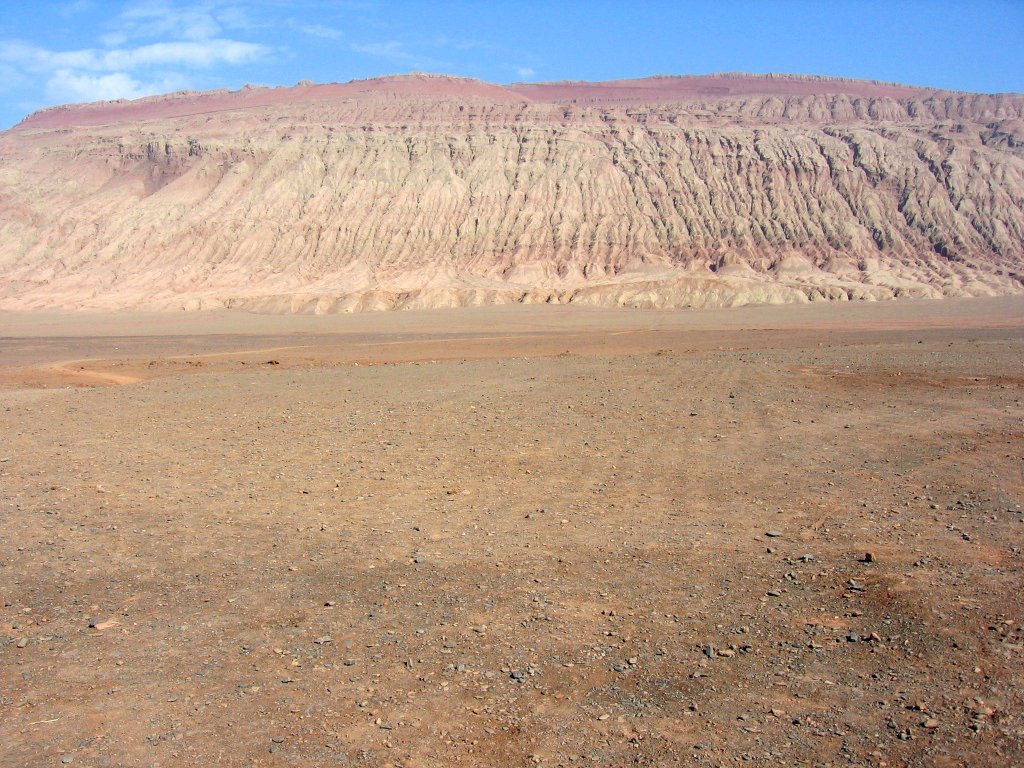
Ask about this itineraryThe Flaming Mountains from the plain — the red wall that guards the greenest oasis in the driest corner of China
the Turpan depression is the second-lowest land on earth after the Dead Sea — and in July it can pass 45 °C, which is why the walking year is spring and autumn, with winter the sleeper season
karez — gravity-fed underground channels tapping the mountain front, thousands of kilometres of them; the system is often called the underground Great Wall
Jiaohe, a whole city carved downward into a plateau, and Gaochang, the mud-walled capital of the Uyghur kingdom — both UNESCO-listed, both walkable at dawn
a Uyghur valley village under the Flaming mountains, grape trellises over the lanes and the region's oldest mosque site — the journey's cultural heart
Why this journey
The oasis, at walking pace.
Turpan's great sites are usually driven — a bus loop of ruins in the heat. Walking them, at the hours when the depression is kind, is a different experience: dawn in the empty lanes of Jiaohe before the tour vans arrive, an afternoon in the shade of a vineyard trellis where the raisins dry in air-vented brick houses, a village morning in Tuyoq when the bread ovens are lit. The distances are short and the walking easy; the interest is in the water engineering, the ruined cities and the food culture that ties them together.
It is also Xinjiang's easiest introduction — no altitude, no camping, five comfortable nights, and a winter-compatible climate when the rest of the region is snowbound. Pairs naturally with the silk oases journey to the west, or as a first week before the mountains.
Route Briefing
A loop from Urumqi through the depression: two nights in Turpan city, one in a Tuyoq valley guesthouse, one near the Kumtag dunes at Shanshan — every day built around a morning walk and a long afternoon.
- undefinedundefinedundefined
- undefinedundefinedundefined
- undefinedundefinedundefined
- undefinedundefinedundefined
- undefinedundefinedundefined
The Walks
Five days in the green and the red.
Half-day walks in the cool hours, long lunches, and afternoons left for shade, raisins and conversation. The depression rewards exactly this rhythm.
-
Day 01
Down into the depression
Urumqi → Turpan
Drive from Urumqi over the Bogda foothills and feel the land drop below sea level. Afternoon walk at a working karez: down the well stair, along the shaded channel, with the well-keeper explaining how snowmelt travels underground for thirty kilometres without losing a drop. Dinner in a vineyard trellis — grapes overhead, lamb over coals.
-
Day 02
A city carved downward
Turpan — Jiaohe
Dawn walk through the Jiaohe ruins while the stone is cool and the light is long — an entire city cut downward into a plateau between two river beds, abandoned in the Yuan era and left standing like a vase-shaped ghost. Return to town for a long lunch; afternoon at the Emin minaret and the bazaar's dried-fruit stalls, where the raisin taxonomy alone is an education.
-
Day 03
The valley village
Turpan → Tuyoq
Move to Tuyoq under the Flaming mountains — a Uyghur village of mud-brick houses, grape trellises and the region's oldest mosque site. Walk the village lanes and the valley path to the springs, lunch in a family courtyard, and stay the night in a village guesthouse: the stars here are worth the modest bed.
-
Day 04
The second city, and the dunes
Tuyoq → Gaochang → Shanshan
Dawn walk among the mud walls of Gaochang, the caravan capital Xuanzang reached in the 630s and where the king tried to keep him. Then east to Shanshan and the Kumtag dunes — a first evening walk on the sand as the dunes cool, and a desert-edge resort night.
-
Day 05
Dune dawn, and home
Shanshan → Urumqi
Sunrise on the dune crest before the sand heats, breakfast in the shade, and the drive back to Urumqi for afternoon departures. If the silk road is calling — and by now it usually is — the oases journey to the west begins where this one ends.
What's included
What is included, and what is not.
A short, comfortable journey — the value is in the timing and the access: dawn entries, family courtyards and the water engineers' explanation nobody gets from a bus window.
Included
Arranged and paid in your price.
-
T
r
-
A
l
-
A
l
-
A
l
-
A
l
-
D
a
Not included
Either yours to arrange, or a question we will gladly answer.
-
F
l
-
S
o
-
C
a
-
T
r
Season reality, said plainly: Turpan in July is an oven, and the walking year is April–June and September–October. Winter (December–February) is cold but bright and workable with adjusted hours — and it is the quietest, cheapest season. Summer departures are not offered for this itinerary.
Enquiry
Ask about the oasis walks.
Tell us your dates and how much walking you want. We will come back with the season-adjusted route plan and a written outline with a price.
- Difficulty
- Easy — half-day walks
- Best window
- Apr – Jun, Sep – Oct
- Group size
- 2 – 10, private departures
- Cost guide
- From ¥8,800 per person, twin share
Enquiry sent
Thank you — your enquiry is with us.
We reply within one business day. A copy of what you sent has gone to your inbox.
Need to add something? Write to inquiry@chinadventure.com.
Back to the itineraryRead next