Longxing Temple
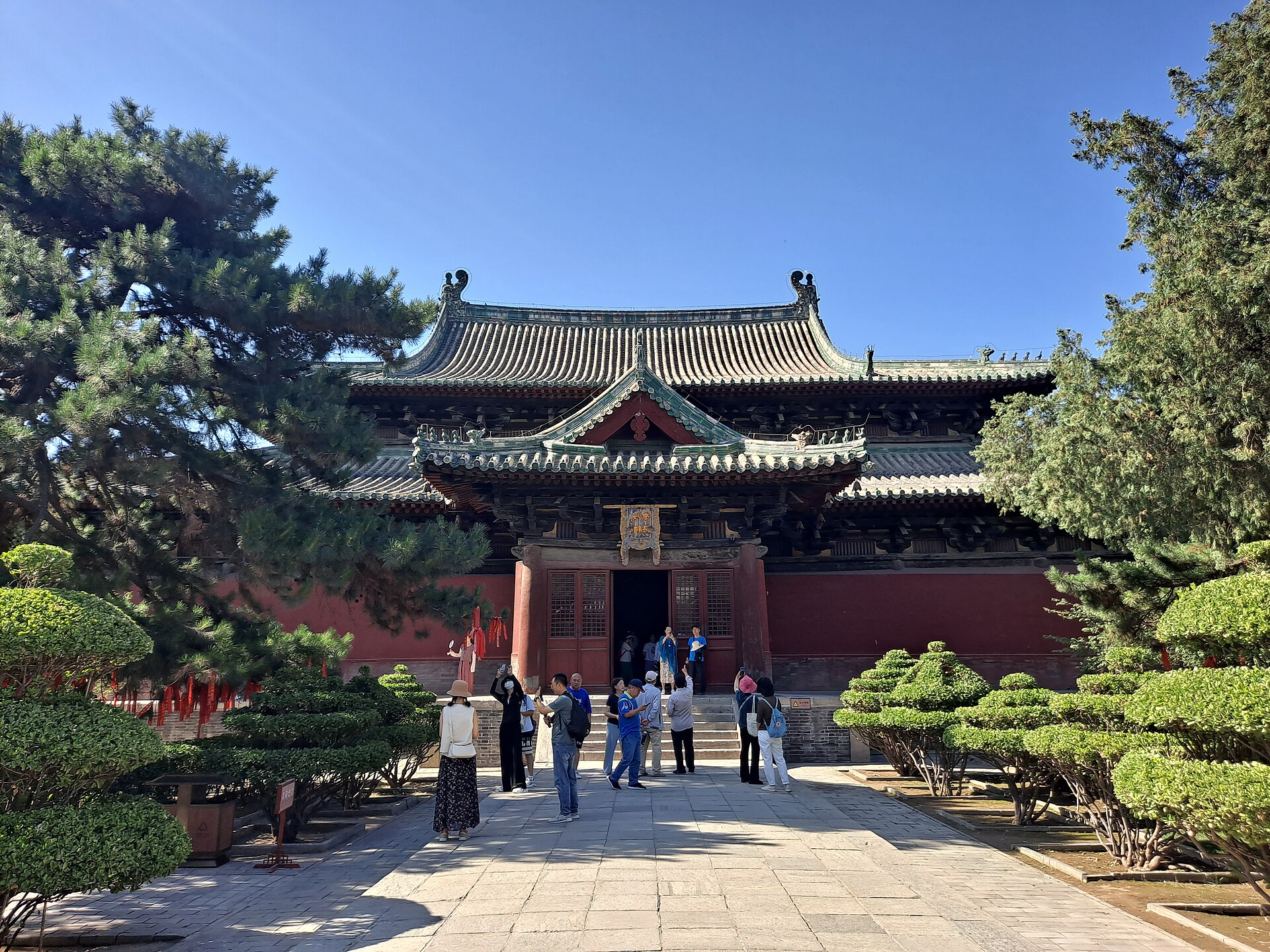
The working monastery at the north end of town: the Mo Ni hall of 1052, the Great Mercy hall with the bronze Guanyin, a Song wheelhouse of scripture, and a stele pavilion with the Kangxi and Qianlong inscriptions.
 Start your enquiry
Destinations / Hebei / Zhengding
A county town on the plain that kept more of its temples than most provincial capitals: one of the oldest working monasteries in China, a bronze Guanyin cast in 971, and four pagodas inside a square kilometre.
Explore the guide ↓Central Hebei · the Hutuo plain · 586
Zhengding is 15 kilometres north of Shijiazhuang, on the north bank of the Hutuo River, and it was a regional capital for a thousand years before Shijiazhuang existed. It has one of the densest concentrations of pre-Ming architecture in north China: a monastery founded in 586 that still works, four pagodas of four different dynasties within walking distance of each other, and a wall that has almost entirely gone.
The monastery is the reason people come. Longxing Temple was founded in 586 as Longzang, renamed Longxing in the Tang, and given its present name by the Kangxi emperor in 1710. Its Mo Ni hall is a Song building of 1052 with a cruciform plan found nowhere else in Chinese architecture, and its Great Mercy hall holds a bronze Guanyin cast in 971, over twenty metres tall, with forty-two arms, standing in a shaft built around it.
The town is also a case study in what happens to a place when the railway passes it by. The Jingguang line went through Shijiazhuang in 1905 and Zhengding stopped growing; the result is a county town of 500,000 with a historic core that was too poor to redevelop and is now being restored, slowly.
The monastery, the four pagodas, and the wall that is not there.
The working monastery at the north end of town: the Mo Ni hall of 1052, the Great Mercy hall with the bronze Guanyin, a Song wheelhouse of scripture, and a stele pavilion with the Kangxi and Qianlong inscriptions.
Cast in 971 for the Great Mercy hall, over twenty metres tall, with a crown of small Buddhas and forty-two arms. The hall was built around the statue rather than the statue fitted to the hall.
The brick-and-timber pagoda of Tianning temple, the tallest of the four, with a brick core and wooden eaves that have been rebuilt many times. Climbable in clear weather.
The square brick pagoda of Kaiyuan temple, nine storeys and 53 metres, with a distinctly Indian-looking profile. The temple around it is a fragment; the pagoda is the whole building.
The cone-shaped pagoda of Guanghui temple, with four arched false doors and a summit carved as a lotus and a vase. The odd one out of the four, and the most photographed.
The monastery where Linji Yixuan taught in the ninth century, the founding figure of the Linji school that became Japanese Rinzai. The Chengling pagoda holds his relics.
April to June, September to November.
Warm, dry and clear, with the courtyards at their best and the town before the summer heat. The peonies in the temple gardens open in the second half of April.
Hot and humid on the plain — 33 to 36 degrees — with the rainy season in July. The halls are cool and dark, which is the point of going in summer.
The best months: 15 to 25 degrees, clear air, and the light good for the pagodas. October’s first week is a holiday and the monastery gets crowded.
Cold and dry, with coal-season haze in December and January. The courtyards are empty and the halls unheated; the stone and brick read better in low winter light.
Half a day for the monastery, a full day for the town.
Zhengding is 15 kilometres from Shijiazhuang, which is an hour and a half from Beijing by high-speed rail and 40 minutes from Taiyuan. The airport is 20 minutes away; there is a high-speed station at Zhengding airport.
Longxing Temple first, at opening, before the tour groups; then the four pagodas on foot — they are within 1.5 kilometres of each other; then the rebuilt south gate and the wall fragment.
Zhengding itself has small hotels near the temple; Shijiazhuang has everything and is 30 minutes by bus or taxi. Most people day-trip from the city.
Zhaozhou Bridge is 30 kilometres south-east and takes half a day. The two together make the best single day on the plain, and both are on the same ticket circuit.
One building that exists nowhere else, and a statue that dictated its hall.
A cruciform hall with a roofed corridor running round it, built in 1052 under the Song. It is the only surviving example of its type in China, and the reason architectural historians take a county town seriously.
Cast in the Northern Song, in bronze, in sections, and assembled in place. The Great Mercy hall was built around it — you enter at the base and look up three storeys into the crown, which is the intended effect.
Zhengding is one of the birthplaces of Chan Buddhism as it is practised in Japan: Linji Yixuan taught here, and the Linji school’s line runs through the Chengling pagoda to the Rinzai temples of Kyoto.
Photography, crowds and the state of restoration.
The south gate and much of the street frontage have been rebuilt in the last decade, and it shows. The temples, the pagodas and the monastery are the historic fabric; the commercial street is not.
The Guanyin may be photographed from the hall floor but not with flash and not from the upper galleries. The halls are dark; a fast lens or a high ISO is more useful than a tripod.
Weekends in April and October bring coach parties from Shijiazhuang and Beijing. Weekday mornings are quiet, and the pagoda courtyards are almost always empty.
The plain is the hottest part of the province in July and the coldest in January, with no shade in the temple courtyards. Go early in summer, late in winter.
Half a day: Longxing Temple at opening, the Guanyin, then the four pagodas on foot. Add Zhaozhou Bridge for a full day on the plain.
Start my journey brief ↗