The main arch
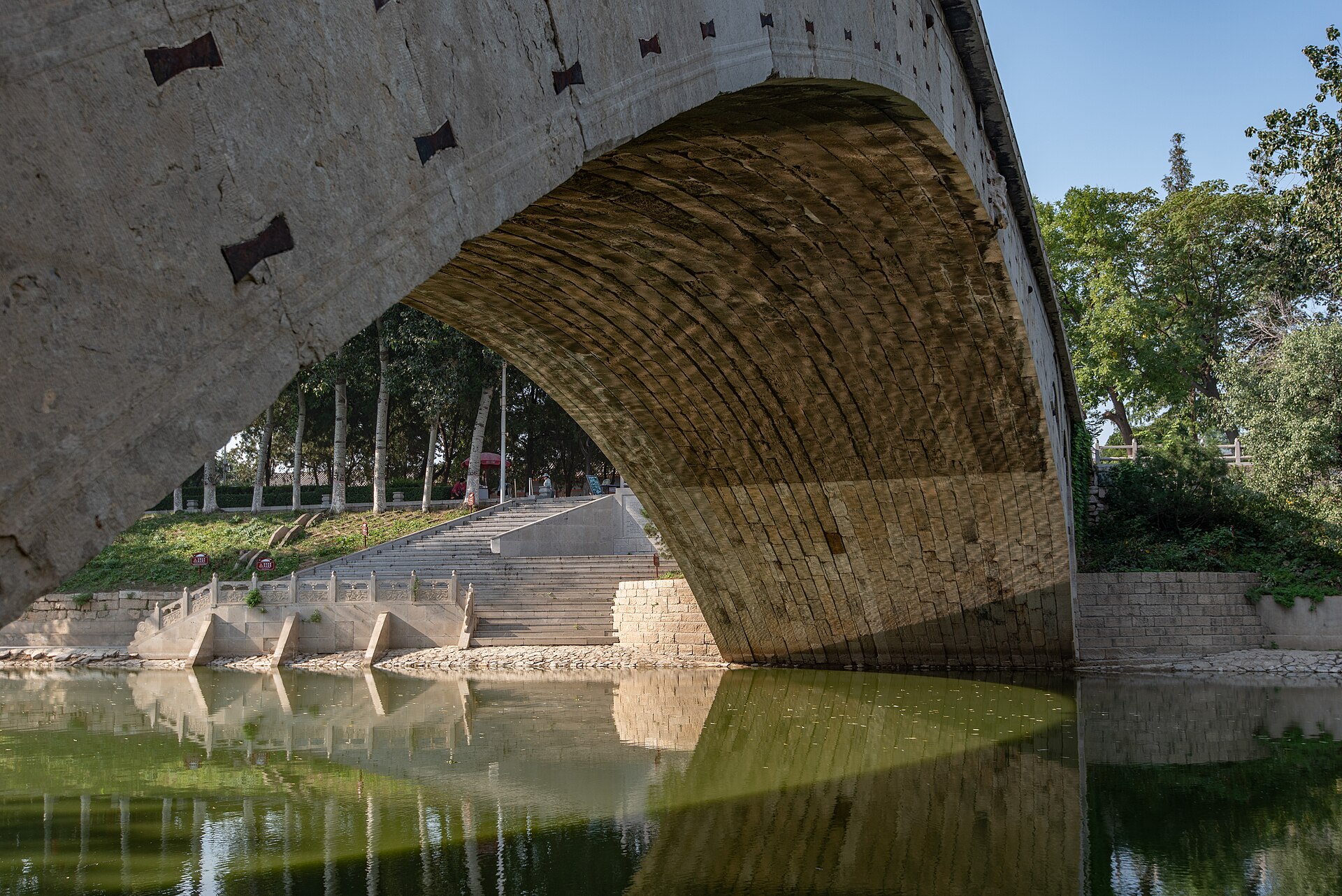
A segmental arch — part of a circle, not a semicircle — built from 28 parallel ribs of stone, each one keyed to its neighbours. The rise is 7.23 metres over a 37-metre span: a shallow curve that carries the road.
 Start your enquiry
Destinations / Hebei / Zhaozhou Bridge
One arch, 37.02 metres across, built between 595 and 605 by a craftsman called Li Chun, with four small arches cut through the shoulders above it — the oldest open-spandrel stone bridge in the world, and still standing.
Explore the guide ↓Central Hebei · Zhao County · 595–605
The Jiao River is a small, flashy stream on the plain: most of the year it is a trickle, and twice a decade it comes down in flood with the silt and the ice of a north China spring. The bridge built over it between 595 and 605 was designed for exactly that. A single segmental arch of 37.02 metres spans the channel in one leap, low enough that the roadway does not have to climb, and four small arches are cut through the spandrels above the springing points so that flood water passes through the shoulders instead of pushing against them.
That last detail is the invention. Every earlier stone arch in the world was solid above the arch ring, which puts the whole weight of the shoulders onto the arch and makes a wide span impossible without thick piers in the water. Cutting the spandrels open removes about 700 tonnes of load, lets the flood through, and drops the bridge’s mass by a fifth. Europe did not build an open-spandrel arch until the nineteenth century, roughly 1,100 years later.
The bridge is 64.4 metres long, 9 metres wide at the crown and 9.6 at the springing, with 28 parallel arch ribs, a rise of 7.23 metres, and a pair of small arches over each end — 3.81 metres on the outer pair, 2.85 on the inner. Li Chun’s name comes from a Tang inscription; almost nothing else about him is known. The bridge has been repaired, most heavily in the 1950s, but it has never been replaced.
The arch, the spandrels, the carving, and the river.
A segmental arch — part of a circle, not a semicircle — built from 28 parallel ribs of stone, each one keyed to its neighbours. The rise is 7.23 metres over a 37-metre span: a shallow curve that carries the road.
Two arches of 3.81 metres at the ends and two of 2.85 metres closer to the crown, cut through the shoulders. They take 700 tonnes off the structure, pass the flood, and are the reason the bridge is famous.
The balustrade and the arch ring carry reliefs of dragons, water beasts and lotus: the standard Sui repertoire, carved into the voussoirs. The originals are in the site museum; replicas are in place.
Iron keys set between the arch ribs to hold them together laterally — a detail that lets 28 separate ribs behave as one arch under load. Visible from the riverbank at low water.
A small museum beside the bridge with the excavated originals, the 1950s repair drawings, and the ASCE plaque of 1991 that made it the twelfth International Historic Civil Engineering Landmark.
The best view is from the downstream bank, low, where the whole arch and one small arch read as a single line. At high water the reflection completes it; in winter the river is a mud channel.
Any month; April and October for the light.
Mild, clear and green, with water in the river from the spring melt. The best light on the stone is in the two hours after sunrise.
Hot, humid and often dry: the Jiao can be a trickle in July. The bridge is at its least photogenic, and the plain is at its hottest.
The best window: clear air, low sun, and enough water after the summer rain to give a reflection. October’s first week is busy; the rest is empty.
Cold, with ice on the river and a hard low light that suits the stone. Snow on the arch is the photograph nobody has. The site is open all winter.
Two hours at the bridge, a day with Zhengding.
Zhao County is 42 kilometres south-east of Shijiazhuang, an hour by road. The high-speed station is at Shijiazhuang; from there a taxi is the simplest option, and a car for the day costs less than two one-way taxis.
The bridge is the centre of a 10-hectare park with a rebuilt Sui-style pavilion group, a museum and a sculpture court. Entry is one ticket; allow two hours, more if the museum is open in full.
Zhengding is 30 kilometres north-west: the bridge in the morning, Longxing Temple in the afternoon, or the reverse. Both sites are on the same plain and the drive between them is 40 minutes.
The classic view is from the downstream bank at low sun, with the small arch at the left of the frame. The site opens early enough for sunrise, which is when the stone is warmest.
Why a county bridge is on the civil engineering list with the Eiffel Tower.
A semicircular arch has to rise half its span, which means a humpback road and heavy abutments. A segmental arch rises a fifth of its span: the roadway stays low, the span can be wide, and the thrust goes outward into the abutments rather than down.
Cutting the spandrels open removed about a fifth of the bridge’s weight and let flood water through the shoulders. It also reduced the horizontal thrust on the abutments, which is why the bridge has survived 1,400 years of floods on soft ground.
The American Society of Civil Engineers designated it an International Historic Civil Engineering Landmark — the twelfth in the world and the only one in China, alongside the Eiffel Tower, the Panama Canal and the pyramids.
The 1950s restoration replaced much of the arch ring and added concrete behind the spandrels; it saved the bridge and altered it. The originals are in the museum, and the debate about how much of what you see is Sui is not settled.
A small site, a small river, and a very large idea.
The bridge sits in a landscaped park with a rebuilt gateway, a sculpture court and a shop. The structure is real; the setting is not. Go for the arch, not the atmosphere.
The Jiao is often dry in summer and frozen in winter. If the reflection matters, come in April or after the July rains; check before making the trip.
Most visitors spend 40 minutes. Two hours covers the bridge, the bank, the museum and the reliefs, which is the right amount for a structure this specific.
On its own the bridge is a long way for a small site. Paired with Zhengding, or as a stop between Shijiazhuang and Hengshui, it is one of the best half-days in the province.
Two hours: the arch from the downstream bank, the spandrels from the west end, the museum for the originals. Best in April or October, at sunrise, with water in the river.
Start my journey brief ↗