The east gate
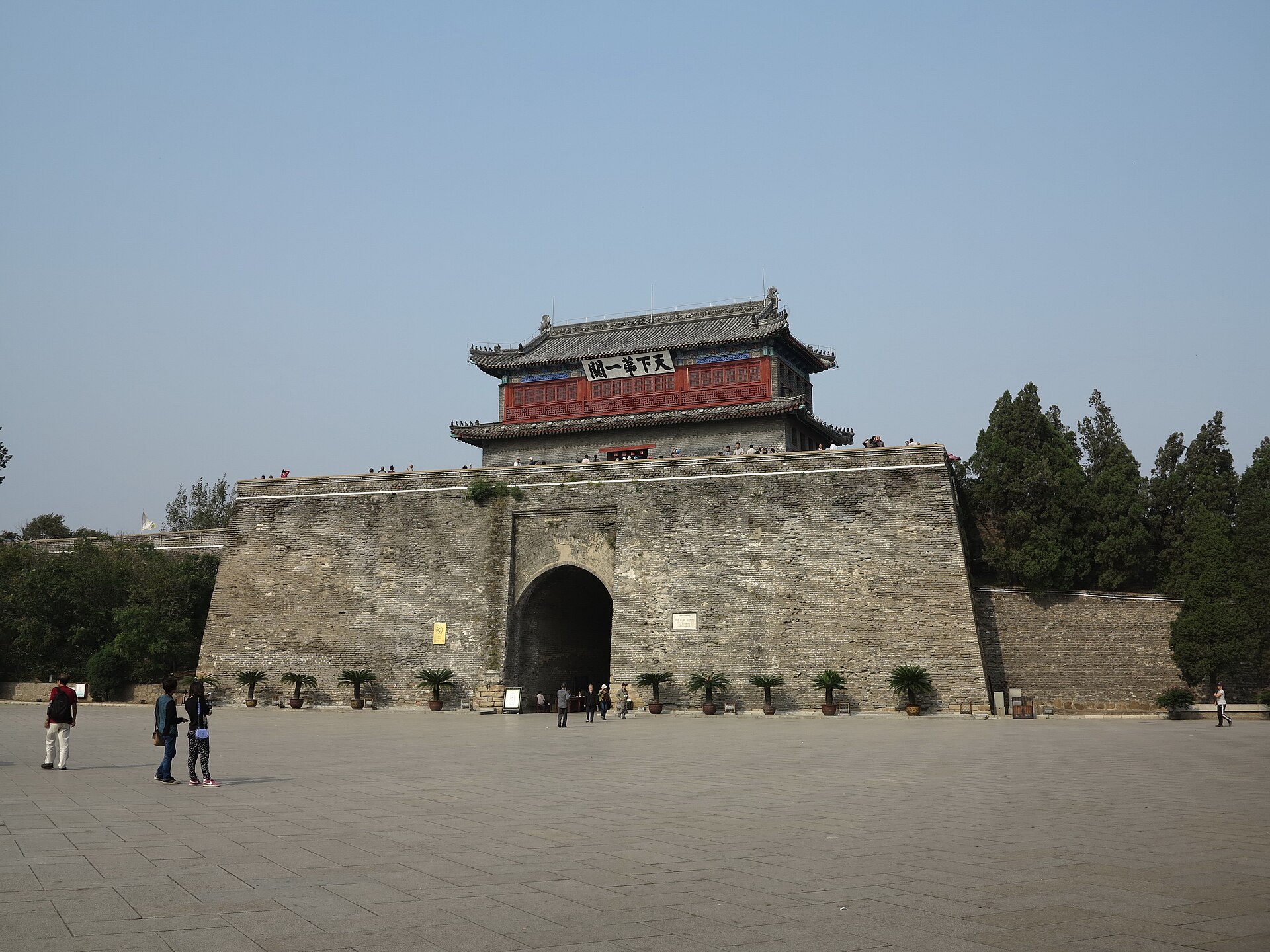
The 1381 gate with its barbican, its arrow tower and the plaque of 1472. The tower holds a small museum on the wall’s construction; the walkway on top runs north towards the Jiaoshan ridge.
 Start your enquiry
Destinations / Hebei / Shanhaiguan
The pass between the mountains and the sea, built in 1381 to close the road from the capital to Manchuria — and four kilometres south, the place where the wall walks into the Bohai and stops.
Explore the guide ↓Eastern Hebei · Qinhuangdao · 1381
The Shanhai pass sits where the Yanshan mountains run down to the sea, leaving a corridor about fifteen kilometres wide between the rock and the beach. Every army moving between north-east China and the north China plain uses that corridor or goes around through the passes 200 kilometres west. In 1381 the Ming general Xu Da was sent to close it: he moved the pass to this gap, built a square walled city four kilometres round with walls 14 metres high and 7 thick, and called it Shanhai wei — the guard of mountain and sea.
The city has four gates: Zhen Dong to the east facing Manchuria, Ying En to the west facing the capital, Wang Yang to the south facing the sea, Wei Yuan to the north. The east gate is the one with the plaque — “First Pass Under Heaven”, in the calligraphy of the Ming official Xiao Xian — and the one with the barbican and the arrow tower, because it was the one that faced the threat.
Four kilometres south, the wall runs out onto a headland 25 metres above the water and into the sea. The Old Dragon’s Head is the eastern terminus of the Ming wall: a stone bastion built into the tidal rock, rebuilt in the 1980s, and the reason the wall can be described as running from the sea to the desert. It is a strange place to stand — the wall, which is an object of mountains everywhere else, ending in salt water.
The gate, the wall on the ridge, and the end of it in the sea.
The 1381 gate with its barbican, its arrow tower and the plaque of 1472. The tower holds a small museum on the wall’s construction; the walkway on top runs north towards the Jiaoshan ridge.
The Ming walled city survives almost complete: four kilometres round, with the four gates and most of the parapet. An hour’s walk with the town on one side and the plain on the other.
The stone bastion where the wall enters the Bohai, on a headland 25 metres high. The Chenghai tower behind it, the sea wall, and the tidal rocks below. Twenty minutes from the gate by road.
The section climbing the mountain north of the pass, a long flight of stone stairs to a temple on the shoulder of the ridge. The view back over the pass and out to sea is the reason to climb it.
A national museum on the pass and the wall’s history, with the 1644 campaign and the 1933 defence of the pass as its two set pieces.
A wall section that crosses a river on nine stone arches, the only place the Ming wall spans water. Half a day with a car, and quieter than anything in the town.
May to October, and the coast decides the rest.
The best months: 18 to 26 degrees, dry, the sea at its clearest. Busy at weekends but not crowded, and the wall on the ridge is at its greenest.
Hot and humid, with the rainy season and the coastal holiday season at the same time. This is when the beaches at Beidaihe fill; the pass itself is manageable in the early morning.
Warm, clear and dry, with the sea still swimmable in early September and the best light on the wall’s stone. The first week of October is the busiest of the year.
Cold, windy and quiet. The sea wind at the Old Dragon’s Head in January is a serious thing; the upside is that you will have the wall and the gate almost to yourself.
Two days if you add the coast, one if you do not.
Shanhaiguan has its own station on the Beijing–Harbin high-speed line: two hours from Beijing, three from Shenyang. The gate is 15 minutes from the station by taxi; the Old Dragon’s Head 20 minutes further.
Old Dragon’s Head in the morning, when the tide and light are right and the coaches have not arrived; the gate and the city wall at midday; Jiaoshan in the late afternoon for the view back over the pass.
Beidaihe is 40 minutes west and makes the natural second night: a beach town that has been the capital’s summer resort since the 1890s, with the best birdwatching on the Bohai in spring and autumn.
The gate, the city wall, Jiaoshan and the Old Dragon’s Head are separate tickets; a combined ticket exists and is worth it for three of the four. Check at the gate rather than online.
The gate that changed hands twice and ended two dynasties.
The Ming general Wu Sangui held the pass against Li Zicheng’s rebel army, then opened it to the Manchu banners rather than surrender to the rebels. The Qing walked in through this gate, and the Ming ended the same week.
The pass was the scene of the first large battle of the Japanese invasion of north China, fought in January 1933 and commemorated in the museum. Its modern history is as military as its Ming one.
“First Pass Under Heaven” was written in 1472 by Xiao Xian, a Ming calligrapher and official; the original is inside the tower and the one over the gate is a copy.
Wind, tides, and the difference between the town and the wall.
The pass is a gap between mountains and sea and it funnels. Even in July the wind on Jiaoshan is two layers colder than the town; at the Old Dragon’s Head it is a sea wind with salt in it.
The Old Dragon’s Head is best at mid-tide: at low tide the bastion stands in mud, at high tide the outer rocks close. Check the tide table before you go, not after.
Shanhaiguan is a working town of about 150,000 inside and outside the wall, not a restored film set. The old streets have been rebuilt for visitors; the wall is real.
Most visitors do the gate and the sea and never climb Jiaoshan. The ridge is where the pass makes sense — corridor, sea and the wall going west, in one view.
One long day from Beijing: Old Dragon’s Head at nine, the gate at noon, Jiaoshan in the afternoon, back on the evening train. Two days if you want Beidaihe and the birds.
Start my journey brief ↗