The traverse
From the east gate at Wangjinglou west to Longyukou, or the reverse. The middle third is the steepest, with the wall climbing a knife ridge between two towers; the western third is gentler and emptier.
 Start your enquiry
Destinations / Hebei / Jinshanling
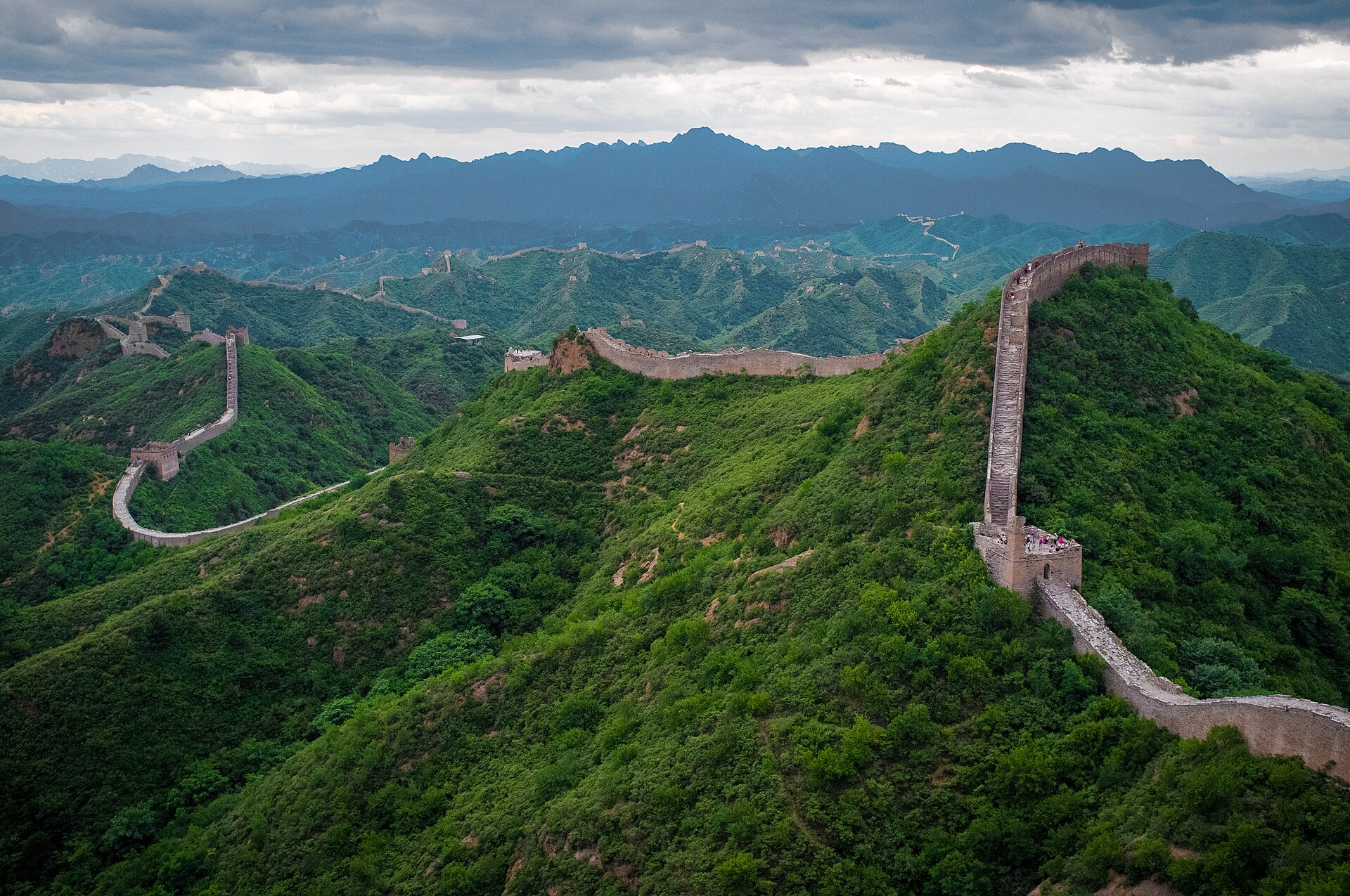
Ten and a half kilometres of Ming wall, sixty-seven towers, and the ridge line it was built to hold — rebuilt by Qi Jiguang between 1567 and 1582 and never restored since. The best-preserved walkable stretch in the country.
Explore the guide ↓Northern Hebei · Luanping · 10.5 km
Jinshanling runs west from Longyukou to Wangjinglou, 10.5 kilometres along the crest of the Yanshan in Luanping county, 130 kilometres north-east of Beijing. It is not the oldest wall in China and not the most photographed. It is the one where the military architecture is still legible: 67 watchtowers, 5 passes and 3 beacon platforms, with three kinds of obstacle — the horse-blocking wall, the barrier wall and the cross-wall screens — that survive nowhere else in the same condition.
Most of what you walk on went up in a fifteen-year window. Qi Jiguang took command of the Ji garrison in 1567, after a decade fighting pirates on the south coast, and applied the same logic here: hollow watchtowers that could hold a squad and its stores, walls thick enough to walk two abreast, and firing positions at two levels. The brick stamps — “character bricks” with the year and the workshop fired into the face — are the quality control of a very large public works programme.
The section has been open to walkers since 1986 and is unusual in that the wall runs through a landscape with no town in it. On the ridge you see it going away in both directions, over eight or nine spurs, for a distance you cannot walk in a day. That view, rather than any single tower, is the reason to come.
The towers worth stopping at, and the walk between them.
From the east gate at Wangjinglou west to Longyukou, or the reverse. The middle third is the steepest, with the wall climbing a knife ridge between two towers; the western third is gentler and emptier.
A brick-vaulted hollow tower 10.5 metres east to west and 9.7 north to south, with a walled compound beside it, of the kind that held a section’s command. The most complete defensive group on the wall.
Bricks fired with the year and the kiln stamped into the face, so a bad batch could be traced. A short length of wall near the east end still shows them in place.
Low walls built across the walkway inside the parapet, so an attacker who gained the wall could not run along it. The best set is near the General’s Tower.
The tower the section is measured to, on the highest ground at the eastern end, with the wall dropping away north into Chengde prefecture. Where the through-walk usually starts.
Six or seven towers between Shalingkou and Longyukou, a two-hour walk with almost nobody on it, and the best angle back along the ridge in late light.
April to June, or late September to early November.
Green ridges, blossom on the slopes, 10 to 22 degrees on the wall. Wind is the only problem, and on the exposed sections it is constant.
Hot and humid, with the rainy season from July and afternoon storms that make the stone slippery. Greenest and most crowded, because it is the closest good section to Beijing.
The best window: clear air, 15 to 25 degrees, the hills turning. The first week of October is a national holiday and the wall is a queue; the last two weeks are the best fortnight of the year.
Cold, dry and nearly empty, with snow on the north faces and ice on the stairs. Some towers close after heavy snow; the light is hard and the photographs are better than the walking.
One direction, five hours, a driver waiting at the other end.
East gate at Wangjinglou to west gate at Longyukou: 10.5 kilometres, 4 to 5 hours with stops, roughly 400 metres of up and 500 of down along the ridge. Walk it west to east if you want the sun behind you.
In at the east gate, out at Shalingkou in the middle: 4 to 5 kilometres, 2 hours, all of the good towers and the steepest ridge. The most common half-day.
Two and a half hours by road from Beijing, a little over an hour from Chengde. There is no railway; a car and driver is the practical option, and the same car should wait at the far gate.
Entry is one ticket and the internal shuttle another; the cable car at the east end saves 40 minutes of climbing but skips the first two towers. Check the gate hours at the entrance, not online.
Why this section reads as engineering rather than scenery.
The general who rebuilt it had spent a decade fighting pirates in Fujian and Guangdong, where the lesson was that a small force in a strong position beats a large one in the open. He applied it to the whole Ji garrison: around 1,200 towers in five years along 600 kilometres of wall.
Before 1567 the towers were solid platforms. Qi’s were hollow: two storeys, brick-vaulted, with stores, a water tank and firing positions for a squad of ten to twelve. The change turned a barrier into a chain of small forts.
Bricks, tiles and mortar batches were stamped with the year and the unit responsible — a batch number four centuries early, and the reason the repair programme of the 1570s can be dated tower by tower.
Stone stairs, no shade, and a long way between exits.
The wall is about 7 metres high and the ridge runs between 600 and 900 metres, so the walking is up and down stone steps, some of them 40 centimetres deep and worn smooth. Boots with edges, not trainers.
There is nothing on the wall: no water, no shade, no toilet between the gates. Two litres per person in summer, and a hat that stays on in wind.
Between the east and west gates there are two side exits, both of which need a car arranged in advance. Once you are up, the only way off is along the wall.
The ridge is exposed and storms arrive from the north with little warning in July and August. Lightning on a wall on a ridge is not a theoretical risk — come down.
One day: east gate at opening, walk west for five hours, car at Longyukou. Two days if you want the quiet western towers in evening light and the eastern ridge at sunrise.
Start my journey brief ↗