The lake district
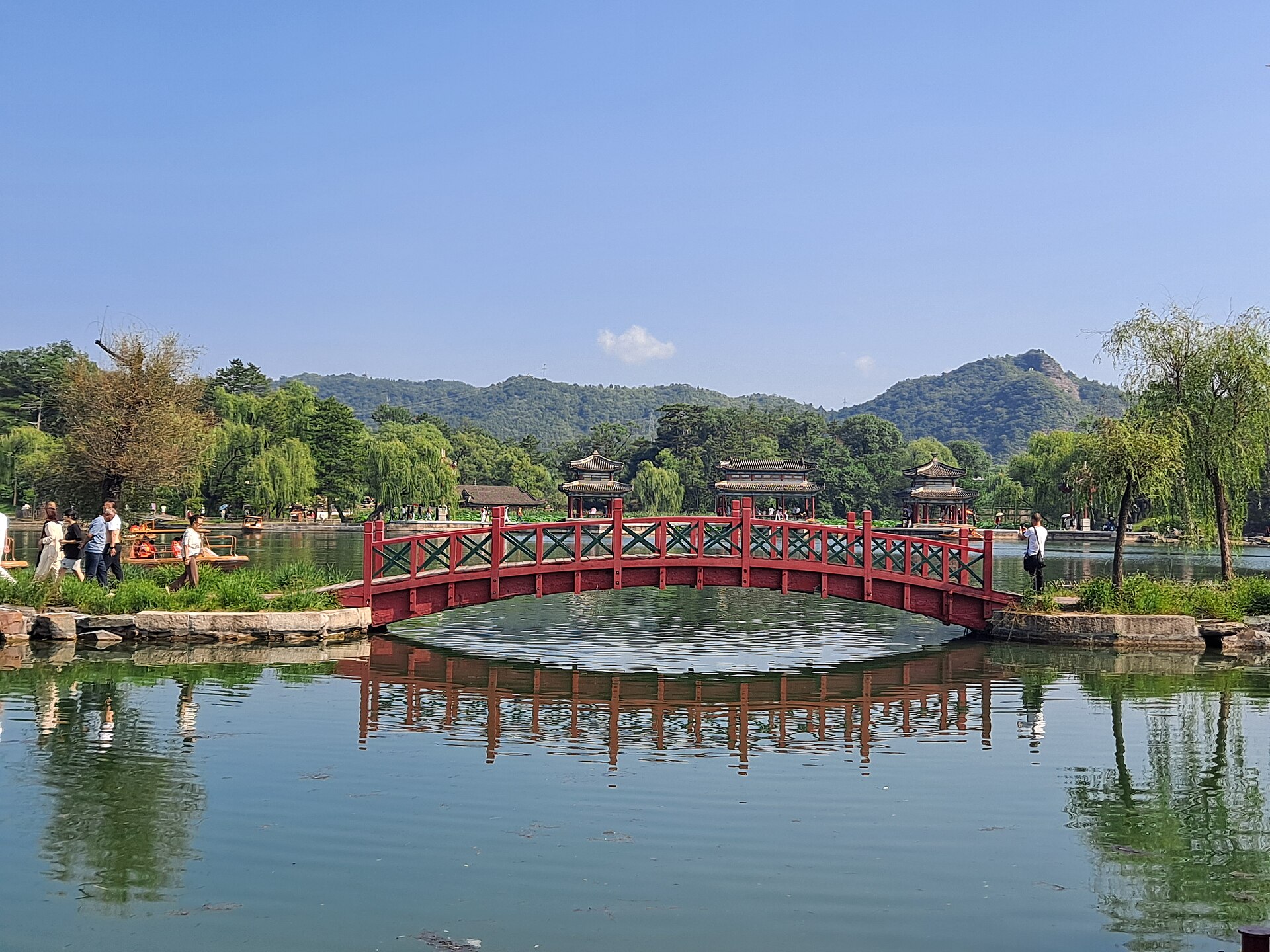
Eight lakes and islands in the south-east of the garden, with pavilions modelled on Hangzhou, Jiaxing and Suzhou. The Jinshan pavilion and the Yanyu tower are the set pieces; a boat makes the circuit in 40 minutes.
 Start your enquiry
Destinations / Hebei / Chengde
An imperial summer capital built over eighty-nine years, with the largest surviving royal garden in the world inside its wall — 5.64 square kilometres — and twelve frontier temples arranged outside it in a half-circle.
Explore the guide ↓Northern Hebei · the Rehe valley · 1703–1792
Chengde exists because the Qing court needed somewhere to be in September. The emperors hunted at Mulan 150 kilometres north, and the journey from Beijing took a week; the resort began in 1703 as a lodge on the way and grew over three reigns into a walled landscape of 5.64 square kilometres — mountains, lakes, plains and 120 building groups, arranged to echo the geography of the empire itself.
What makes it more than a garden is what was built outside the wall. Between 1713 and 1780 the Qing added twelve temples along the ridge north and east of the resort, each in a different architectural language: Tibetan, Mongolian, Han, and mixtures of all three. They were not decoration. Each one was addressed to a specific frontier people, and the largest, Putuo Zongcheng, is a copy of the Potala built for the Torgut return from the Volga and the emperor’s own sixtieth birthday.
The resort and its temples were listed as a World Heritage site in 1994. The garden is intact and enormous; the temples are partly restored, five of them open, and the rest standing in various states of repair among the villages that grew up around them. It is the most convincing case in China for architecture as diplomacy.
The garden, the lakes, and the three temples worth the taxi.
Eight lakes and islands in the south-east of the garden, with pavilions modelled on Hangzhou, Jiaxing and Suzhou. The Jinshan pavilion and the Yanyu tower are the set pieces; a boat makes the circuit in 40 minutes.
Four-fifths of the resort is hills, with a walled loop road and four pavilions on the ridges. The view from the Erma road over the temples and the town is the one photograph to take.
The throne hall, built in nanmu wood without paint, where the emperors received envoys. The plainness is deliberate: the garden was the display, the hall was the business.
The largest of the twelve: 220,000 square metres, a red terrace on the hillside, and a main hall roofed in gilded copper tiles that used over a tonne of gold. The copy of the Potala is not close, but the effect is.
Built for the sixth Panchen Lama’s visit, in the style of Tashilhunpo at Shigatse: 37,900 square metres, a red terrace, and a glazed pagoda on the slope behind.
The temple of universal peace, with a 22-metre wooden Guanyin carved in 1755 — the tallest of its kind in the world, and the reason the temple survived the twentieth century intact.
June to September; the garden was built for exactly this.
The reason the place exists: 10 degrees cooler than Beijing, with the lakes at their best and the lotus out in July. Also the busiest, and the mountain district is hot by midday.
The best month: warm days, cold nights, clear air, and the first colour on the hills. The holiday crowds arrive for the first week of October, so the last week of September is the sweet spot.
Cold and clear, with the poplars gold along the lake edges and the temples almost empty. The first week is a national holiday; after the 8th the town goes quiet.
Winter: the lakes freeze, the garden is bare, and the temples are open but bleak. Minus 10 to minus 20 is normal. The advantage is that you can photograph the halls with nobody in them.
Two days for the garden and the temples; one is not enough.
High-speed rail from Beijing in about an hour to Chengde South, then 20 minutes into town. The resort’s main gate, Lizhengmen, is in the middle of the old town.
The garden: in at Lizhengmen, the main hall, the lakes on foot or by boat, then the mountain road with the four ridge pavilions. Five to six hours; the mountain bus is worth the ticket.
The temples, in order of merit: Putuo Zongcheng, Xumi Fushou, Puning. They are 10 to 25 minutes apart by taxi and each takes an hour. The three together are a full day.
The resort, each temple and the mountain bus are separate. A combined ticket covers the resort and two temples; the boat is extra. Five of the twelve temples are open — the others are visible but not enterable.
Why a garden needed a ring of temples.
The Qing kept the Mulan hunting ground north of Chengde as a military exercise and a diplomatic stage: Mongol and Tibetan leaders were received there rather than in Beijing, where the protocol was impossible.
Each temple addressed a specific people in its own architectural language — the Potala for the Tibetans, Tashilhunpo for the Panchen, Ili for the Dzungars. The Qianlong emperor wrote that the aim was to win hearts, not to convert.
The resort and the twelve temples were inscribed together. It is one of the few World Heritage sites where the buffer zone is the argument: the temples and the garden only make sense as one system.
Distance, heat and the size of the place.
The garden is 5.64 square kilometres — four times the Forbidden City’s core — and the temples ring it for 5 kilometres. Plan on 12,000 steps a day minimum, and use the mountain bus and the boats.
In July and August the lakes district is humid and the mountain district is exposed. Start at eight, take the mountain road in the afternoon when the town is hottest.
Chengde outside the walls is a mid-sized Chinese city with a lot of tourist retail. The reason to come is inside the wall and on the temple ridge.
Many halls forbid photography of the interiors and some forbid it entirely. The gilded roof of Putuo Zongcheng can be photographed from the terrace but not from inside the hall.
Two days: the garden and its lakes on the first, Putuo Zongcheng, Xumi Fushou and Puning on the second, with the mountain road at the end of the first day for the view over the temple roofs.
Start my journey brief ↗