Saihanba
The state forest farm at the northern edge of Weichang: larch, pine and spruce on what was drifting sand in 1962, with the Matikeng plantation and the Qiangua boardwalk as the two set walks.
 Start your enquiry
Destinations / Hebei / The Bashang
The southern rim of the Mongolian plateau: 15,954 square kilometres of grass, birch scrub and sand tracks between 1,200 and 1,500 metres — and, in the middle of it, a forest that did not exist sixty years ago.
Explore the guide ↓Northern Hebei · Weichang & Fengning · 1,200–1,500 m
The Bashang is a step, not a slope. North of the Yanshan the land lifts about a thousand metres in a short distance and then flattens into the southern edge of the Mongolian plateau: 15,954 square kilometres of it in Hebei, at 1,200 to 1,500 metres, with the Yinshan and the Greater Khingan too far away to matter. The grass is short, the sky is large, and the wind comes from the north-west for eight months of the year.
It was the imperial hunting ground. The Qing enclosed the Mulan paddock here in 1681, partly for game and partly as a military training ground for the banners, and kept it closed to Han settlement for two centuries. By the 1950s the forest had been cut and the grassland overgrazed, and the sand from the Hunshandake dunes south of it was blowing into Beijing — 180 kilometres away and 1,500 metres lower.
The answer was Saihanba: a state forest farm created in February 1962, staffed by 369 people, of whom 127 were graduates sent from eighteen provinces. They planted larch and pine on the sand, failed twice, succeeded at Matikeng in 1964 with 95 per cent survival, and kept going. The forest is now 1.15 million mu with 82 per cent cover, and the sand no longer moves.
Grass, forest, and the two ways to see both.
The state forest farm at the northern edge of Weichang: larch, pine and spruce on what was drifting sand in 1962, with the Matikeng plantation and the Qiangua boardwalk as the two set walks.
A chain of small lakes inside the forest farm, formed by damming the headwaters of the Luan River, with boardwalks through the wetland and the best autumn reflections on the plateau.
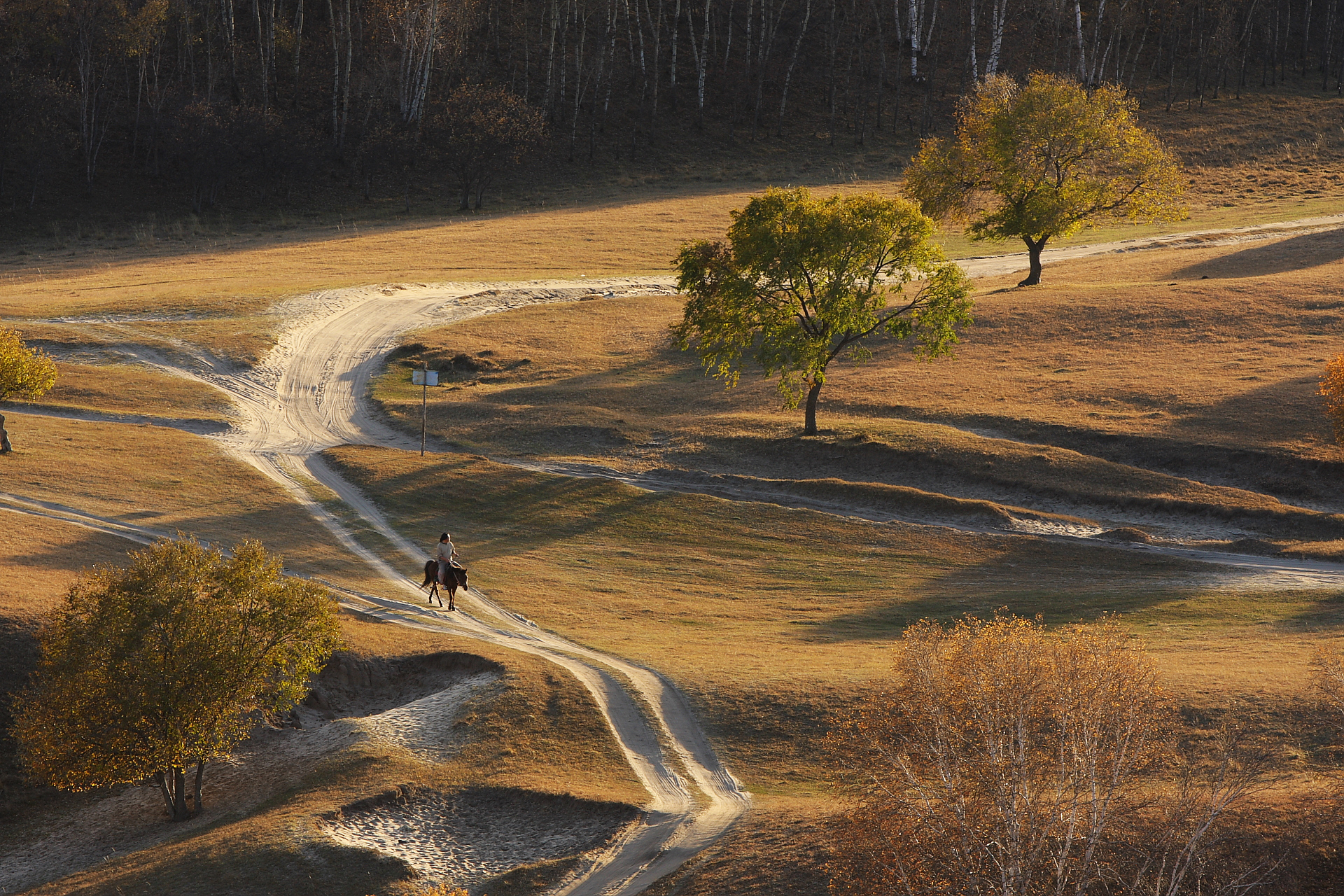
The open steppe just north of the provincial line, with the Ulan Butong grassland, horse herds, and the low hills that make the classic plateau photographs.
Birch scrub along the forest edge and in the gullies, white trunks and gold leaves in the first half of October. The most photographed thing on the plateau and the reason for the October crowds.
The Qing hunting enclosure, now a reserve and a cultural landscape: stone markers, a reconstructed gate, and 10,000 hectares of grass and forest managed as the emperors managed it.
At 1,400 metres, 200 kilometres from the nearest city, the plateau has some of the darkest sky in eastern China. Clear nights in September are the best.
July to September for the grass, early October for the larch.
Green and cool — 15 to 25 degrees — with wild flowers in the grass and the forest at its densest. Rain arrives in July, and the sand tracks turn to mud.
The warmest month and the busiest: the grass is at its height, the nights are still cold, and Chengde and Beijing both come up for the weekend. Book the forest farm in advance.
The best month: dry, clear, 10 to 22 degrees, with the grass turning and the larch beginning to colour in the last week. The light is low and long and the sky is at its best.
The larch turns gold in the first half of the month and the plateau is at its most photographed. By the last week the leaves are down, the first snow comes, and the forest farm closes some roads.
A car, two nights, and no fixed itinerary.
Chengde is the railhead: high-speed from Beijing in an hour, then 3 to 4 hours by road to Weichang and the forest farm. From Beijing directly it is 5 to 6 hours.
Chengde → Weichang → Saihanba → Wulanbutong → Fengning → back to Chengde: 700 kilometres, three days, all of it on paved road with the last stretches of track.
Weichang town for the forest farm, Wulanbutong for the grassland, and Chengde at either end. The forest farm has guesthouses inside the gate; the grassland has yurts and lodges of variable quality.
Saihanba is a working forest farm and a nature reserve: vehicles need a permit to drive inside, and the gate closes at night. Arrange it with the hotel, and expect a conservation fee.
The most successful piece of ecological engineering in modern China, and an argument about what it cost.
The farm was created in February with 369 people, including 127 graduates from eighteen provinces, on land where the winter minimum is minus 43 and the growing season is 60 days. The first two years of planting failed.
The turning point was a spring planting on a horseshoe-shaped flat, using seedbed-raised seedlings and a mechanical planter: 95 per cent survival, and the model for everything after. The farm’s first director had his ashes scattered there.
Forest cover went from 11.4 to 82 per cent, growing stock from 336,000 to 10.4 million cubic metres, and the farm now fixes about 860,000 tonnes of CO2 a year. It received the UN Champions of the Earth award in 2017.
Cold nights, long drives and a landscape without fences.
The plateau runs 10 degrees colder than Beijing in every season, and nights drop below freezing from September. In July the evening is 12 degrees; in October it snows.
Distances are long and fuel stations are sparse north of Weichang. The sand tracks off the paved roads are passable in a normal car when dry and not when wet. Do not drive them alone after rain.
Most of the plateau is working grassland or reserve: driving off the track damages it and is increasingly fined. The best views are from the ridges at dawn.
The forest farm and Wulanbutong take tens of thousands of visitors on October weekends. Weekdays in the second half of September are the quiet version of the same landscape.
Three days from Chengde: Weichang, Saihanba and the forest lakes, then the grassland at Wulanbutong, back over the plateau road. Late September for light, early October for colour, July for the grass.
Start my journey brief ↗