The channels
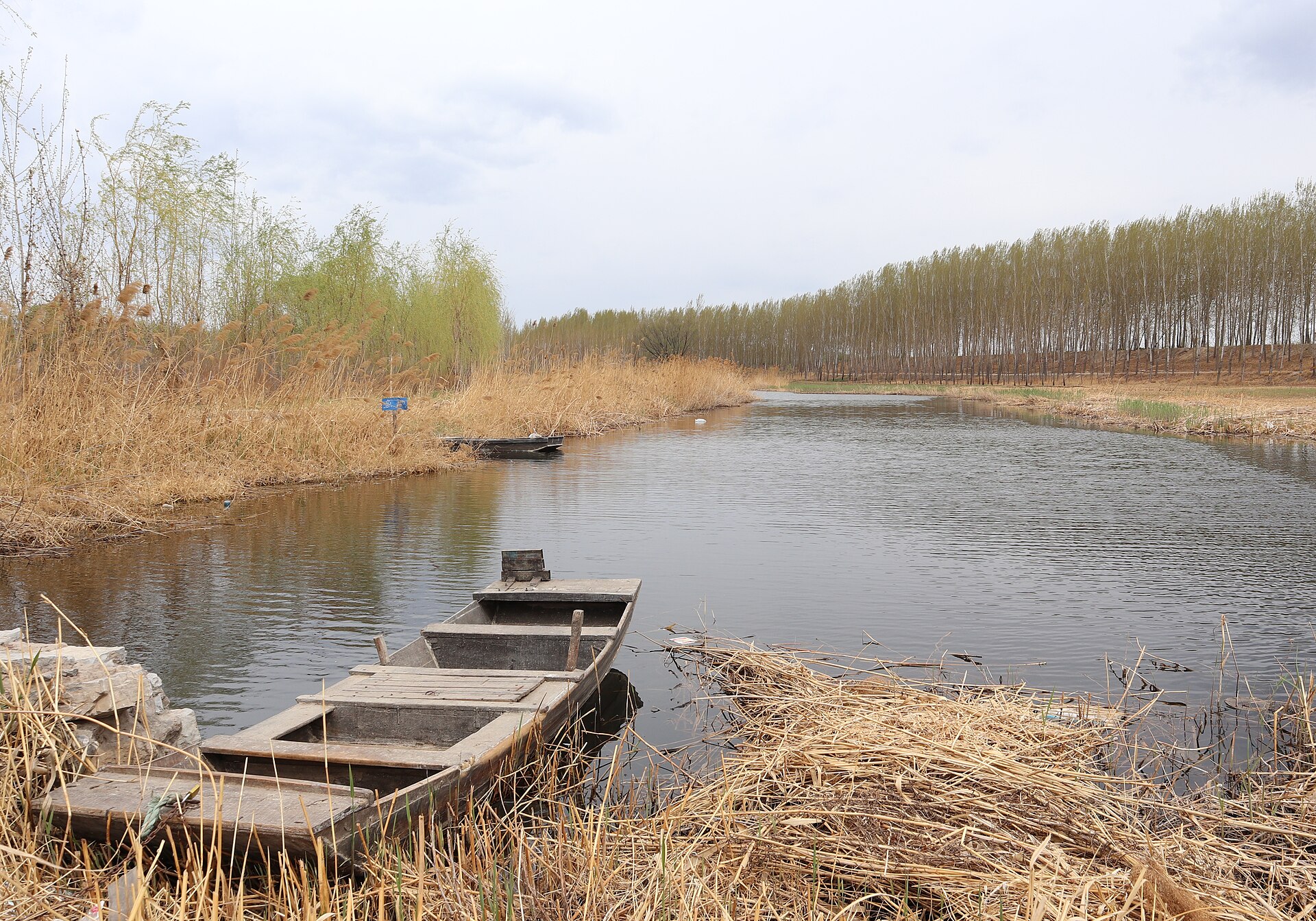
The marsh is seen from a boat or not at all: 3,700 channels between reed beds, with the villages on raised ground in the middle. Half-day trips run from the main wharves at Anxin and Quentou.
 Start your enquiry
Destinations / Hebei / Baiyangdian
Three hundred and sixty-six square kilometres of shallow water on the north China plain, divided into 143 basins by 3,700 channels and 12,000 hectares of reed — the largest freshwater lake in the region, and a marsh that has been managed for two thousand years.
Explore the guide ↓Central Hebei · Anxin · 366 km²
Baiyangdian is a shallow dish of water between the alluvial fans of the Yongding and the Hutuo, 366 square kilometres in area and 1.5 metres deep on average, deepest at three. It is not one lake: it is 143 named basins connected by 3,700 channels, separated by reed beds, and farmed — reeds, lotus, fish, water chestnut, rice on the eastern margins — for as long as there have been records.
Its shape is artificial as much as natural. The Northern Song built a line of dykes and ponds across it in 993 as a water defence against the Liao cavalry — a “water wall” 800 kilometres long, deliberately kept at one to three metres so that horsemen could not cross and boats could not manoeuvre. That depth and that fragmentation are still what the marsh looks like.
The lake has also dried out. It went dry in 1984 and again in the 2000s, and since 2017 has been kept filled by the Yellow River diversion, 482 kilometres of canal and river delivering water from Henan. With the Xiongan New Area established around it in 2017, the marsh has become the centre of a national restoration programme: water quality, reed management, and a bird list that has grown by about 90 species in eight years.
Channels, reed beds, and the villages inside the water.
The marsh is seen from a boat or not at all: 3,700 channels between reed beds, with the villages on raised ground in the middle. Half-day trips run from the main wharves at Anxin and Quentou.
Reed is the marsh’s cash crop: harvested from November, dried, and woven into matting, baskets and the reed-veneer pictures sold in the villages. The cut is the most interesting time to see the working lake.
The marsh holds about 5,000 hectares of lotus, flowering from late June to August. The Baiyangdian lotus festival is the busiest fortnight of the year.
Villages built on raised ground inside the marsh, reached only by boat, with narrow lanes, brick houses and fish restaurants on the water. Quentou is the largest and the most visited.
The marsh was a guerrilla base in the war with Japan: a museum on the “wild goose feather” squadron, who used the reed channels as cover. The other half of the marsh’s modern history.
A stop on the East Asian flyway: herons, egrets, grebes, and in migration cranes and spoonbills. Numbers peak in April and October, and the restoration has brought back species absent for decades.
July for the lotus, October for the birds and the light.
Migration and nesting: the reed beds are green, the birds are at their most active, and the marsh is quiet before the summer crowds. Cool and often windy.
Lotus season, hot and humid, with the marsh at its most photogenic and its most crowded. Afternoon thunderstorms are common; the boats stop in lightning.
The best window: the lotus goes over, the reeds turn, the light is low and the birds come through. Water levels are highest after the summer rain.
The reed harvest, from November: cutters working the beds, reed stacked on the banks, and the marsh almost empty of visitors. Cold, and partially frozen in January.
A boat, a village, and a half-day minimum.
Anxin is 1.5 hours from Beijing and 2 from Shijiazhuang by road; the new Xiongan station is 40 minutes away. From Beijing it is a long day trip or an easy overnight.
Boats are hired at the wharves by the hour or the half-day, with a fixed route. A half-day gets you a channel circuit and one village; a full day adds the bird areas and the far basins.
Quentou and the Anxin waterfront have guesthouses and small hotels; Xiongan has the new ones. Staying inside the marsh means being on the water at dawn, which is the point.
Entry to the scenic area, the boat and each village are separate. The boat price is negotiable at the wharf and fixed at the official counters; use the counters.
A water wall, a guerrilla base, and a literary school.
The Northern Song flooded the depression between the dykes to stop Liao cavalry: a belt 800 kilometres long, 1 to 3 metres deep, too shallow to cross and too shallow to row fast. The marsh’s present depth and fragmentation date from that decision.
In the 1940s the reed channels hid a guerrilla unit who used flat-bottomed boats and the local knowledge of the fishermen. The museum is small and specific, and the boats are the same shape as the tourist ones.
The writer Sun Li lived and worked here in the 1940s; his stories of the marsh founded the “lotus flower” school of Chinese fiction — plain prose about water, women and village work that is still taught in schools.
Shallow water, biting insects and a managed landscape.
Every channel is dredged, every reed bed is owned, and the villages are working settlements. The marsh is beautiful and entirely managed — go for the working lake rather than for wilderness.
From June to September the marsh is a mosquito habitat. Repellent, long sleeves at dusk, and a net if you sleep on the water.
A 1.5-metre average means the boat sits close to the bottom and the propeller fouls. The local boats use shallow-draft hulls and long shafts; a chartered speedboat will not reach the small channels.
The marsh is open water with no shade; in summer the reflection doubles the heat. Hat, water, and a morning start.
Half a day: a boat from Anxin, a circuit of the channels, one village and lunch on the water. July for the lotus, October for the reeds and the birds, November for the harvest.
Start my journey brief ↗