Foguang Ding
The highest of the three summits, reached by walkway and stair from the upper cable station. In clear weather the view runs west over the Taihang into Shanxi and east across the plain towards Baoding.
 Start your enquiry
Destinations / Hebei / Baishi Shan
A forest of white dolomite pillars at the northern end of the Taihang, 2,096 metres at the highest point, with the wall running along the ridge below it and two glass walkways bolted to the cliffs on the way up.
Explore the guide ↓Western Hebei · Laiyuan · 2,096 m
Baishi Shan — “white stone mountain” — is the northern end of the Taihang range, 15 kilometres south of Laiyuan town in the west of the province. What makes it unusual is the rock: dolomite that was laid down on a shallow sea floor between about 1.4 billion and 1 billion years ago and then cooked and squeezed into marble, and which now stands in a forest of separate pillars, towers and walls above 1,800 metres. It is the only landform of its kind in the country.
The massif is described in the Chinese way, by count: three summits, six platforms, nine valleys and eighty-one named peaks, with the highest, Foguang Ding, at 2,096 metres and the main ridge running for about seven kilometres. The cliffs are the point — vertical faces of white and grey rock in ranks, with beech and red birch in the gullies between them, turning in the last week of September.
It is also a mountain that has been made easy. A road climbs to about 1,600 metres, a cable car goes higher, and walkways run along the cliff bases for kilometres, two of them in glass. That is either an abomination or the reason a family can see the pillars at all. The compromise most people make is to ride up, walk the cliff circuit for three or four hours, and walk down.
The pillars, the two glass walks, and the wall on the ridge below.
The highest of the three summits, reached by walkway and stair from the upper cable station. In clear weather the view runs west over the Taihang into Shanxi and east across the plain towards Baoding.
The Baishi gallery: a walkway cut and bolted along the base of the north face, 1.3 kilometres of it, with the pillars directly above and the valley floor 400 metres below.
A glass-floored section 95 metres long and 2 metres wide, bolted to the cliff at 1,900 metres, opened in September 2014. Short, exposed, and the most photographed 95 metres in the province.
A second, longer glass section at about 1,600 metres, opened in 2015: 120 metres of glass walkway and an 80-metre glass bridge on two levels, the only one of its kind in the country.
The birch woods between the cliff bases are the mountain’s signature: bark the colour of rust, turning in the second half of September and lasting about three weeks.
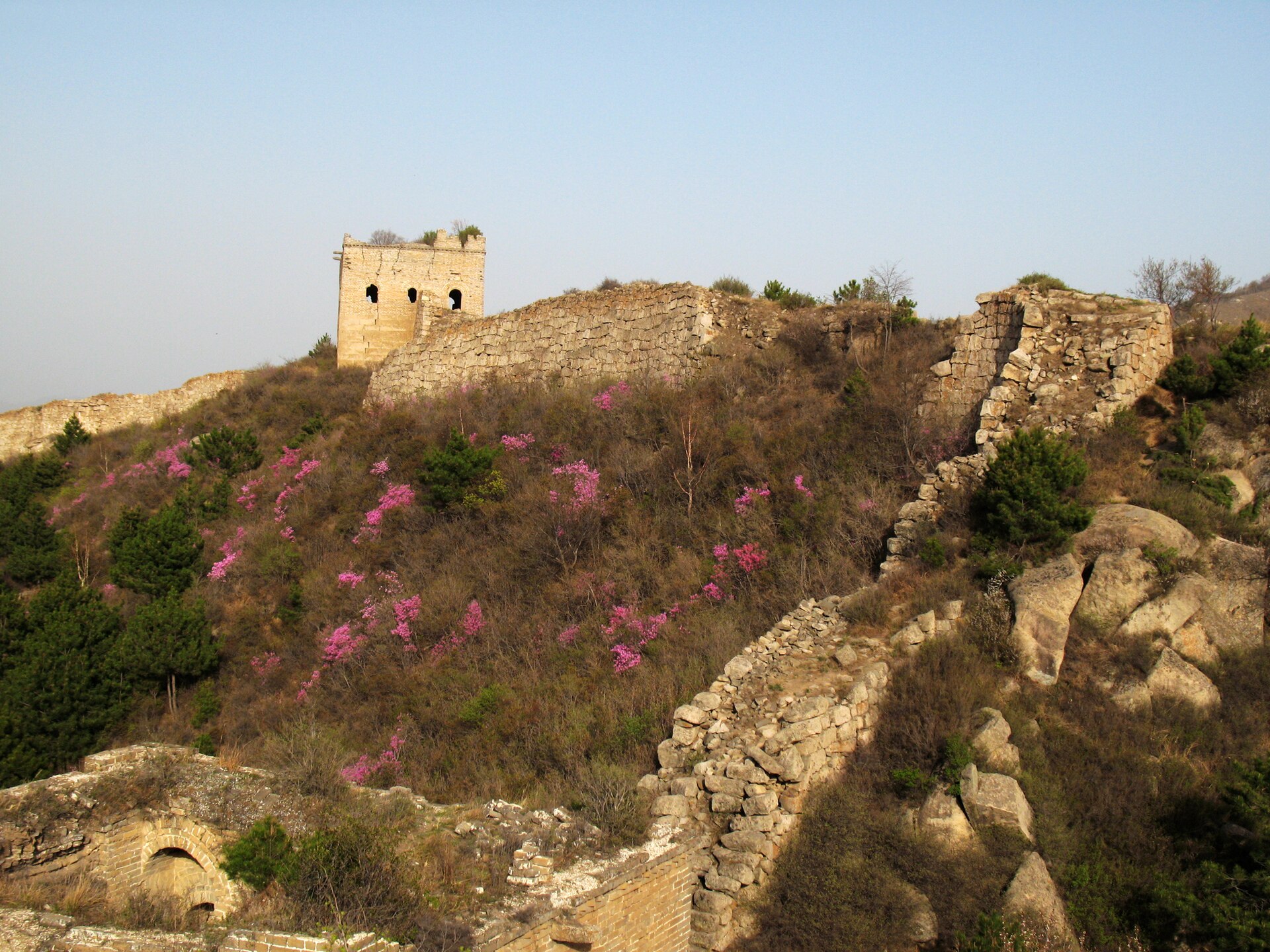
A Ming wall section runs along the ridge on the mountain’s eastern shoulder, ruined but walkable in parts, with towers at intervals. Almost nobody combines it with the pillars; it is the quietest hour of the day.
June to October; late September for the birch.
Cool and green, with cloud sitting in the valleys most mornings and the cliffs appearing and disappearing. The best month for the glass walkways, because the exposure is real when the cloud is below you.
The rainy season: the waterfalls and the cloud sea are at their best, and the mountain is busiest. Afternoon storms close the exposed walkways, and the cliffs are wet.
The best window. The air clears, the red birch turns in the second half of September, and the first half of October is the finest light of the year. The first week is a national holiday.
Cold, with ice on the walkways and the upper cable car sometimes stopped by wind. Snow on white rock is spectacular and the mountain is empty; crampons are sensible on the gallery.
Cable car up, four hours on the cliff, walk or ride down.
Gate at the east entrance, shuttle to the cable car, up to about 1,900 metres, the gallery and the two glass walks, the summit if the weather holds, then down on foot in two hours or back on the cable car.
Walk up from the gate at 1,100 metres: 3 to 4 hours of stone stair and forest track to the gallery, then the circuit, then down. A full day, and you will have the mountain to yourself above the cable car.
Laiyuan is 3 hours from Beijing and 2 from Baoding by road, with a new expressway most of the way. There is no railway to the mountain; the last 15 kilometres are a county road.
Entry, shuttle and cable car are separate. The glass walks need a cloth cover for shoes, sold at the entrance; the queue for the cable car at 10am in October is an hour.
A frontier that ran through the mountain, not around it.
The Taihang at Laiyuan was the border between Yan and Zhao in the Warring States period, and later between the Liao and the Song. The Ming wall here is a late layer on a line that had been a frontier for 1,500 years.
The Ming section on the eastern shoulder is built of the local stone rather than brick, which is why it has weathered into a ridge of rubble with towers standing out of it. It is unrestored and unsigned, and walking it needs care.
The dolomite was laid down in a warm shallow sea, buried, and then metamorphosed by heat from below during the Yanshan orogeny. The white colour is the same calcium-magnesium carbonate that makes the cliffs look like snow from the plain.
Exposure, weather and the limits of a glass floor.
The summit is 2,096 metres and the gate 1,100, so nothing needs acclimatisation. It is 1,000 metres of up, mostly on stairs and walkways, which is a different problem.
Both glass sections have a solid walkway beside them, so nobody has to cross on glass. The cliff gallery itself is the exposed part, and it is not optional if you want the circuit.
Cloud can arrive in twenty minutes and reduce visibility on the walkways to a few metres. The mountain has a lightning risk on the ridge in July and August — the walkways close, and you should be off them.
The ridge is exposed to the north-west and the wind is constant above 1,900 metres. A shell in September is not excessive, and a hat needs a chin strap.
One day: cable car up, the gallery and both glass walks, the summit if the cloud lifts, walk down. Late September if you want the birch, June if you want the cloud.
Start my journey brief ↗