Detian falls
The main event. Walk the riverside path from the lower platform up, take a raft to the base, and stay for the light in the late afternoon when the spray catches the sun.
 Start your enquiry
Destinations / Guangxi / Detian
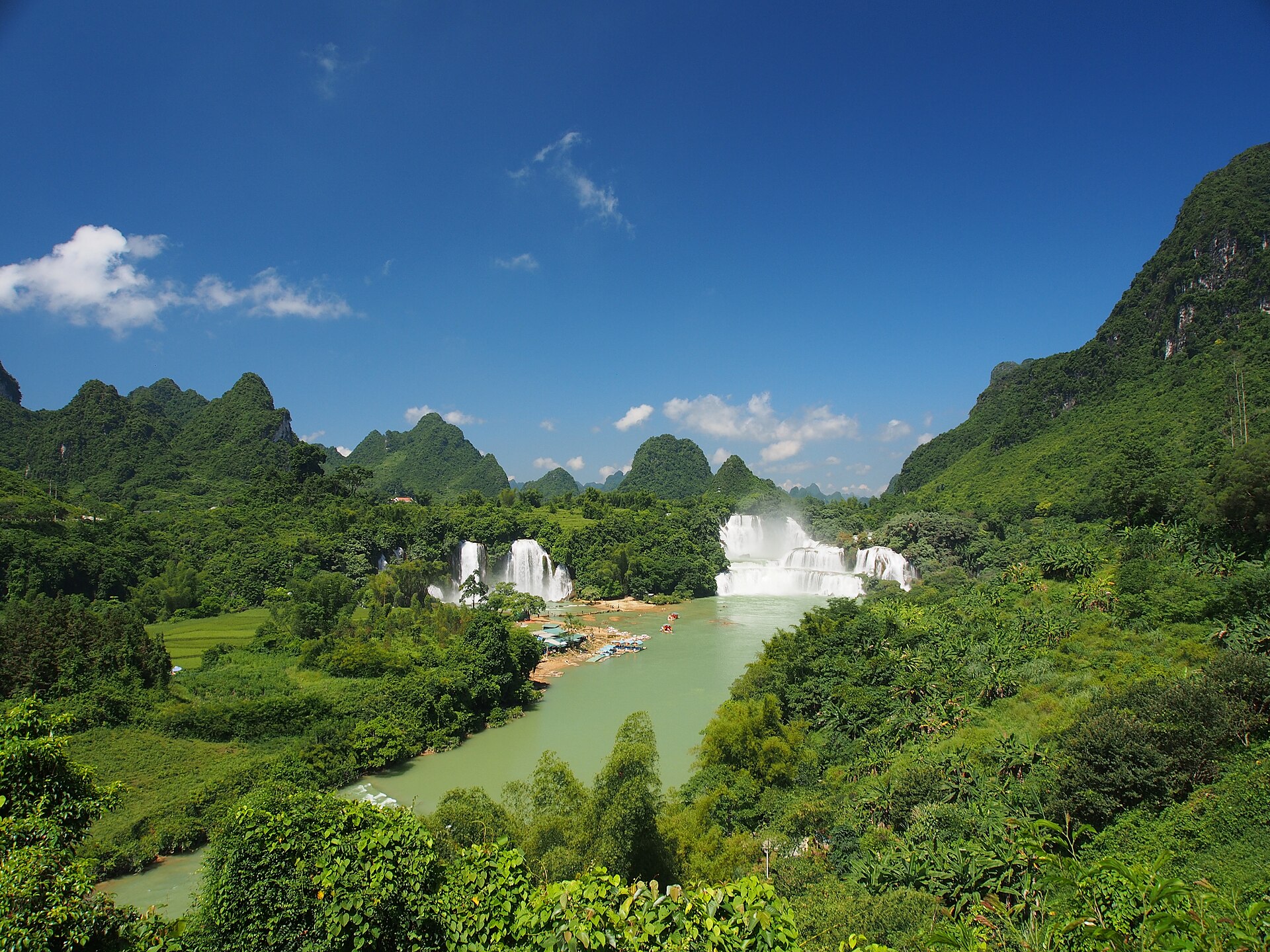
A three-tier waterfall 208 metres wide on the river that separates China from Vietnam, in a valley of karst paddies four hours south-west of Nanning.
Explore the guide ↓Daxin · the Vietnamese border
The Guichun rises in Jingxi, flows south into Vietnam, and comes back into China at Daxin, where it drops over a series of ledges into a green pool. The Chinese side is Detian; the Vietnamese side, immediately adjacent, is Ban Gioc. Together they are 208 metres wide with a total drop of about 70 metres and a flow that never stops, which is why they are described as the largest transnational waterfall in Asia.
The setting is as good as the water. The river arrives through a valley of karst towers and rice fields, and the falls sit below a wooded ridge with no town in sight. On the Chinese side there are five viewing platforms, a riverside path, and bamboo rafts that take visitors close enough to be soaked; on the Vietnamese side the same water is watched from the opposite bank.
Around it, the country is the reason to stay. Mingshi, twenty minutes away, is a valley of paddies and towers that looks like a smaller, emptier Guilin. The old border road runs along the river with the Vietnamese hills on the far side, and the market villages trade across a line that has moved more than once.
The falls, the paddy valley and the border road.
The main event. Walk the riverside path from the lower platform up, take a raft to the base, and stay for the light in the late afternoon when the spray catches the sun.
A valley of rice fields between towers, with a river, a bamboo raft and almost no one. The best reason to spend a night rather than a half day here.
A Qing-era marker on the riverbank, and the cross-border tourism cooperation zone that now allows a day visit to the Vietnamese side with a passport.
The road along the Guichun towards Shuolong runs between karst on both sides of a river that is the border. Quiet, green, and one of the prettiest drives in the province.
A subtropical valley with a very pronounced wet season.
The wet season, and the falls at their most powerful: broad, brown-green and loud. This is when the 208-metre width is fully realised. Expect heat and frequent rain.
Dry and cool, 12–20 °C. The water is lower and divided into separate chutes, which is less dramatic but far more legible, and the valley is quiet.
Warm, green, with the paddies flooded and the karst at its best. Water levels rise through May as the monsoon arrives.
The falls face east, so the spray is backlit in the morning. Afternoon gives the fuller, warmer view of the whole amphitheatre from the upper platforms.
Four hours from Nanning, and a passport for the far bank.
About 240 km and four hours from Nanning, or 78 km from Daxin county town. The nearest airport is Nanning; there is no rail. Most visits combine Detian with Mingshi and a night in Shuolong.
Two to three hours covers the platforms, the raft and the path. Add Mingshi for a half day, and the border road for a full one.
Shuolong, ten minutes from the gate, has the hotels; Mingshi has the views. Staying overnight is the difference between seeing the falls and seeing the valley.
A border that is also a watershed.
Detian and Ban Gioc are the same water seen from two banks. In the wet season the two falls merge into a single 208-metre curtain; in the dry season they separate into distinct chutes with rock between them.
The Guichun is the boundary, and the channel has shifted over the centuries. The 2000 land border treaty settled the line, and the markers along the river date from the Qing and from the settlement.
The villages here are Zhuang, and the market at Shuolong has traded across the river for longer than either state has been interested in the line. The cross-border zone formalises what was already a local habit.
Water, borders and the wet season.
The falls themselves need only a ticket, but the cross-border zone and any visit to the Vietnamese bank require a passport and a permit arranged on the day.
The rafts go close enough that the spray soaks everyone on board, and the path below the falls is permanently damp. Dry bags for phones, and shoes with grip.
The access road and the riverside path can close after heavy rain in July and August. Check before a long drive, and build in a spare half day.
Tell us whether the waterfall is the point or the valley is — and whether you want to cross the river. The second one needs a passport and a day.
Start my journey brief ↗