
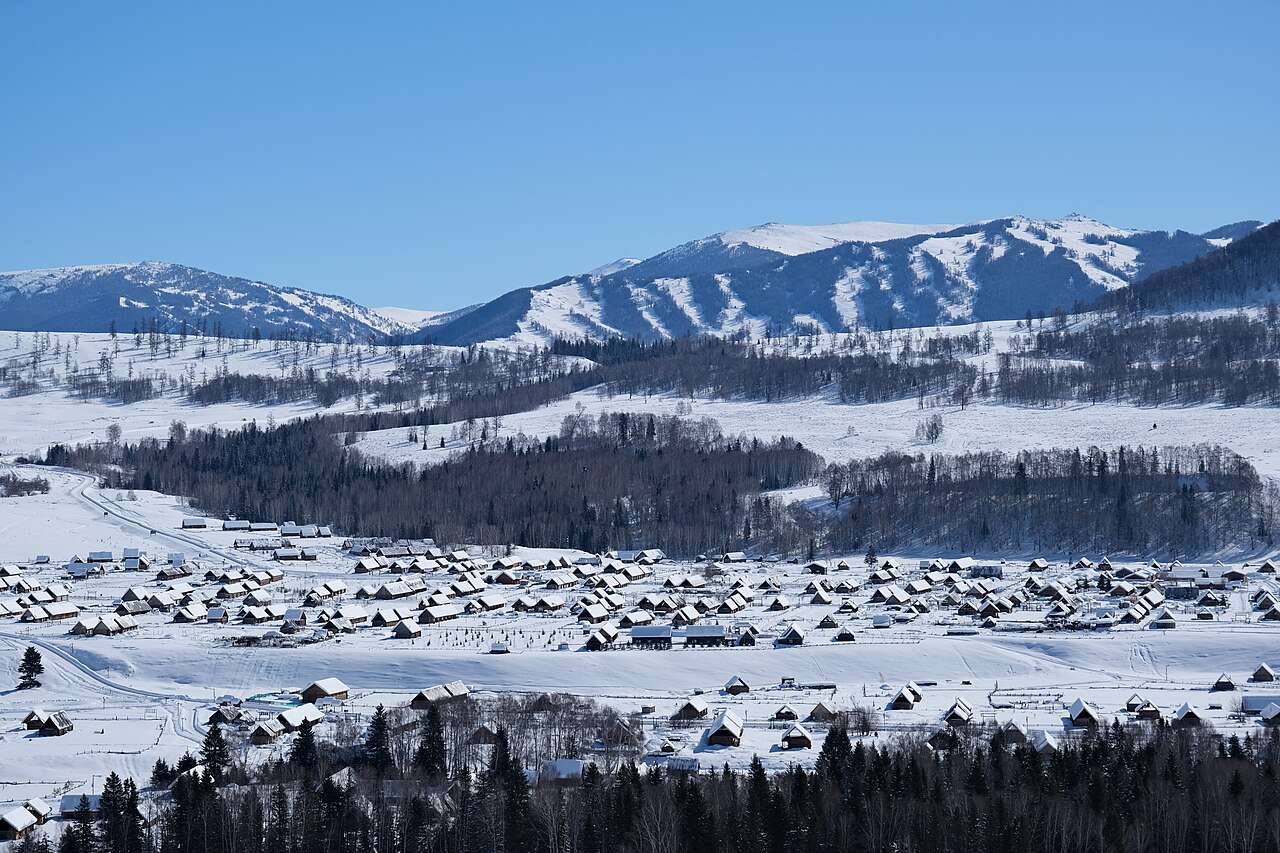
Northwest of Kanas, past the last checkpoint, the road drops into a valley of birch and log houses and simply stops. Beyond the village the meadows run to a border fence, and beyond the fence the forest climbs into Kazakhstan. Baihaba is the far corner of the plate, and it keeps time differently from everywhere else on it.
The end of the road.
The village sits at the end of a valley road that is, in effect, a corridor: entry is controlled, the flow of vehicles is limited, and the settlement of a few hundred people is visited on the region's terms, not its own. In practice this has preserved what mass tourism usually flattens — the lanes are unpaved, the houses are the originals, and the livestock has absolute right of way. An early arrival, before the day visitors, is worth the schedule it takes.
The log houses and their builders.
The architecture is the argument for coming. The village is Tuva and Kazakh, and its houses are hand-fitted log construction — squared timber, moss chinking, shallow-pitched roofs against the snow load — built by families whose carpentry traditions predate the border by centuries. The same building culture runs through Hemu and the Kanas basin; Baihaba's version is simply the most intact, because the village has never had room or permission to expand.
How the days run.
Guesthouse mornings start with the livestock and the bakery smoke; the day's work is hay, horses and timber; and the visitors, in a functional sense, are weather that passes through by late afternoon. The best hours are the two after the last van leaves: the village exhales, the light goes long and gold, and the sound of the place becomes hooves and axes again. Staying overnight is the difference between seeing Baihaba and actually having been there.
The fence and the meadow.
The border itself is calm — a wire fence, a graded strip, and the odd border post — and the walk along the meadow above it is the region's gentlest big-country walk. The five-metre strip inside the fence is closed ground, and the rule is respected without ceremony; the view into Kazakhstan, over a river and a forest that have never once looked different from this side, is enough. Sunset there, with the whole valley going blue behind you, is the hamlet's quiet signature.
Staying over versus day visits.
Our autumn phototour holds a night in the village, and it is the trip's most-cited morning: mist off the birches, smoke standing over the roofs, the bakery's first trays. Permits for the border corridor are handled as part of the park entry system and we arrange them in advance. Day visits run fine in summer; but the village's actual character — the slow clock — only starts after the gate closes for the evening.
Where this leads
Guide: Kanas & the villages
First snow in Hemu
The Kanas & Hemu autumn phototour